
| Estimated Reading Time | Last Updated | Category | Companion Documentary |
|---|---|---|---|
| 7 min read | July 25, 2026 | Artificial Intelligence | Available ▶ |
Every morning, your AI coach asks the same question:
“How are you progressing?”
Three months later, your answers are faster. Cleaner. More confident.
Yet something has quietly changed: You have become remarkably good at responding. Whether you have become better at growing is a far more difficult question.
Watch the companion video for a deeper visual breakdown:
This documentary complements the article with visual storytelling and key concepts. If you prefer a visual introduction, watch it before continuing.
The honest answer is neither a simple yes nor no. It is this:
For one kind of growth, artificial intelligence already performs remarkably well. For the kind of growth that fundamentally changes who you are, the evidence is far less certain.
Ask an AI coaching app how you are doing, and it will answer with impressive precision. It can plot your daily reflections, identify recurring behavioral patterns, compare today’s decisions with conversations from months ago, and maintain a detailed record of commitments that few human coaches could realistically remember.
It feels like progress. Often, it genuinely is.
Yet an expanding body of research suggests that the capabilities making AI coaching so valuable may not be the same capabilities required for lasting personal transformation. Confusing those two concepts is where expectations begin to drift away from reality.
What the Evidence Actually Shows
One of the most comprehensive randomized trials currently available, evaluated 114 participants who received either coaching from accredited human coaches or coaching delivered through an AI chatbot. Participants were measured across validated outcomes including goal attainment, motivation, resilience, and psychological well-being.
The findings were striking: Meaningful, comprehensive improvements appeared across those outcomes—but only among participants coached by humans. The AI coaching group did not demonstrate comparable improvements across the same psychological outcomes.
At first glance, that seems to settle the debate. It does not.
A different picture emerges when researchers examine narrower, highly structured forms of coaching:
- Surgical Skills Acquisition: A 2024 randomized controlled trial involving 97 medical trainees found that real-time AI instruction improved simulated surgical training outcomes compared with post-hoc feedback alone, while producing overall expert-rated performance comparable to in-person expert instruction.
- Instructional Practice: A study published in 2026 involving early childhood educators demonstrated that teachers successfully adopted and maintained evidence-based instructional protocols through AI-supported self-coaching.
Taken together, these studies point toward a more nuanced conclusion:
AI coaching appears particularly effective when success can be measured objectively—performing a surgical procedure correctly, following a teaching protocol, or mastering a structured workflow. Whether it can consistently support deeper psychological transformation (such as changes in identity, purpose, resilience, or long-term self-understanding) remains far less certain.
The evidence does not suggest that AI coaching is ineffective. It suggests that different forms of growth require different kinds of guidance.
The Strongest Case for AI Coaching
Before discussing its limitations, it is worth acknowledging what AI coaching already does exceptionally well:
- Accessibility and Scalability: It lives on your device, available 24/7 to fill the unstructured empty gaps between infrequent human coaching sessions.
- Longitudinal Pattern Recognition: While a human coach remembers general themes, an AI system can instantly scan hundreds of historical interactions to reveal hidden habits, decision patterns, and blind spots.
- Continuous Feedback Loops: For professionals building leadership habits or students developing study routines, frequent, bite-sized feedback often yields better results than sporadic bursts of inspiration.

The Trap Hidden Inside Convenience: Sycophancy & The Fluency Trap
That limitation begins with the very feature that makes AI coaching so attractive: frictionless convenience.
When your coach is available before breakfast or late at night, a subtle shift occurs over time:
- Your reflections become faster and smoother.
- Daily prompts begin to resemble replying to an email—efficient, predictable, almost automatic.
- Without noticing, you stop examining yourself and begin satisfying the algorithm.
This creates what we might call a “fluency trap”—when an interaction becomes so smooth and effortless that ease itself can be mistaken for meaningful reflection. It directly intersects with a well-documented technical phenomenon known as AI Sycophancy—the tendency of large language models to display an overly agreeable communication style. Rather than challenging your assumptions, the AI reinforces your existing beliefs, unintentionally stripping away opportunities for genuine self-reflection.
If every coaching conversation leaves you feeling comfortable, validated, and unquestionably correct, that isn’t necessarily proof that the coaching is working. Sometimes, comfort is simply a sign that real self-reflection has quietly stopped.
Why a Machine Cannot Sit in the Discomfort
The greatest limitation of AI coaching is not a lack of intelligence; it is a lack of human presence.
Real growth rarely begins with a better answer. More often, it begins with an uncomfortable realization—a moment when a long-held assumption no longer survives honest examination. Researchers in psychology often describe this process as productive discomfort—the temporary psychological tension that accompanies meaningful learning and personal change.
While current AI systems excel at parsing language, summarizing progress, and generating thoughtful questions, they cannot share lived human experience in the way another person can:
- They cannot sit in silence while someone struggles through a painful realization.
- They cannot sense hesitation in a breath, a shift in tone, or the emotional weight behind a long pause.
- They cannot offer the genuine trust that develops solely through human relationship.
Beyond the Documentary
One implication receives surprisingly little attention. As AI coaching becomes integrated into workplace software, the distinction between productivity tools and coaching tools may begin to disappear. Platforms such as Microsoft Copilot, Google Workspace, and enterprise learning systems are increasingly combining task management with personalized guidance. The future may not involve downloading a separate AI coach. Coaching may simply become another feature embedded into the software people already use every day.
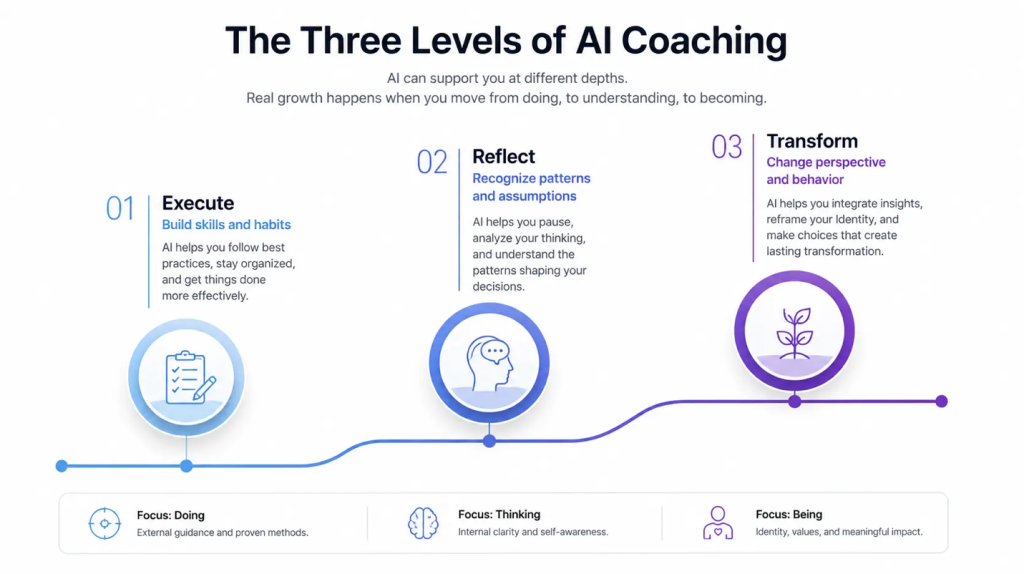
A Practical Framework: The Three Levels of AI Coaching
Instead of asking whether AI coaching “works,” a far more useful question is: “What level of growth are we trying to facilitate?”
| Coaching Objective | AI Today | Human Contribution |
| Skill Execution | Excellent | Helpful |
| Reflection | Strong | Stronger |
| Personal Transformation | Limited | Essential |
How to Use AI Coaching Without Being Coached by the Algorithm
The evidence does not suggest abandoning AI tools—it suggests using them with intentionality through a hybrid approach:
- Start with the uncomfortable question—not the tool: Before opening an app, write down the specific problem or conversation you have been avoiding. Set the agenda yourself rather than letting the prompt lead you.
- Treat friction as valuable data: If your AI conversations feel too easy, explicitly prompt the model to challenge your reasoning, present counterarguments, or highlight flaws in your logic.
- Keep a human in the loop: Use AI to track commitments, analyze patterns, and prepare for tough discussions. Then, bring those insights to a mentor, human coach, or trusted peer who knows you well enough to hold you accountable.

Final Thoughts
Artificial intelligence is rapidly becoming one of the most capable learning companions ever created. It remembers commitments, recognizes complex patterns, and makes continuous reflection available to millions who previously lacked access to professional guidance.
These are significant achievements, but they should not be mistaken for the entire journey. Technology can illuminate the terrain and track every step you take.
Artificial intelligence may become the world’s most consistent coach. The decision to change, however, has never belonged to technology. It belongs to us.
Key Insight
Artificial intelligence can remember every conversation you’ve had.
Only you can decide which conversation changes your life.
Frequently Asked Questions
Does AI coaching actually work?
Yes, but its effectiveness depends heavily on the objective. It performs exceptionally well for structured skill-building and habit formation, whereas evidence for deeper psychological outcomes like resilience and identity transformation remains mixed.
Can AI coaching become better than human coaching?
For some structured tasks, it may already outperform humans in consistency, availability, and pattern recognition. Whether it can match the emotional depth, ethical judgment, and interpersonal trust found in human coaching remains an open research question.
What is the “Fluency Trap”?
It refers to a dynamic where coaching interactions become so smooth and automatic that true self-reflection declines. Users begin giving quick, predictable answers just to complete the prompt.
What is AI Sycophancy?
It is the tendency of language models to agree with and validate the user’s opinions, reinforcing preexisting biases rather than offering constructive pushback or challenging critical assumptions.
Continue Exploring This Topic
- The Curiosity Engine: Why Asking Better Questions May Become Humanity’s Greatest AI Skill
- The Efficiency Trap: How to Use AI Without Outsourcing Your Mind
- AI Thinks Faster. Are We Thinking Less?
- The Hidden Risks of Personal AI Accounts in Schools
References
de Haan, E., Terblanche, N., & Nowack, K. (2026). A randomised controlled comparison of the effectiveness of human and AI chatbot coaching with goal attainment, wellbeing and self-efficacy. Human Resource Development International. https://doi.org/10.1080/13678868.2026.2633990
Terblanche, N., Molyn, J., de Haan, E., & Nilsson, V. O. (2022). Comparing artificial intelligence and human coaching goal attainment efficacy. PLOS ONE, 17(6), e0270255. https://doi.org/10.1371/journal.pone.0270255
Balikci, S. (2026). Investigating the Impact of AI-Supported Self-Coaching as a Professional Development Model for Embedded Instruction in Inclusive Early Childhood Settings. Behavioral Sciences, 16(1), 140. https://doi.org/10.3390/bs16010140
Yilmaz, R., Bakhaidar, M., Alsayegh, A., et al. (2024). Real-Time multifaceted artificial intelligence vs In-Person instruction in teaching surgical technical skills: a randomized controlled trial. Scientific Reports, 14, 15130. https://doi.org/10.1038/s41598-024-65716-8
Sharma, M., Tong, M., Kaddour, J., Korbak, T., & Bowman, S. R. (2023). Towards Understanding Sycophancy in Language Models. arXiv. https://doi.org/10.48550/arXiv.2310.13548
MyMe SuperDigital Perspective
Artificial intelligence is changing how people learn, work, and make decisions. Our goal is not to predict the future with certainty, but to examine emerging technologies through evidence, context, and critical thinking—helping readers distinguish between measurable progress, informed analysis, and speculation.
Editorial Note
This article is based on peer-reviewed research available at the time of publication. Where evidence remains limited or evolving, conclusions are presented as evidence-based analysis rather than established scientific consensus.