The Hidden Cost of Cognitive Overload — and the AI Tax on Your Attention
The problem is rarely a lack of energy. It is a lack of space to think. Here is what the science actually says about cognitive overload — and why a deliberate pause, not another app, is what restores clarity.
| Reading Time | Last Updated | Category | Companion Video |
| 11 min read | August 2026 | Future Society | Available ▶ |
Information has never been more abundant. The scarce resource is the attention — and the quiet — needed to make sense of it.
Watch the Companion Video
Your Mind Isn’t Tired. It’s Overloaded. introduces the core idea in a few minutes. This article explores it in greater depth.
The Real Shortage Isn’t Time. It’s Attention.
Your alarm goes off, and before your feet touch the floor the inputs begin — messages, headlines, a queue of small decisions. It can feel like fatigue. More often it is something else: a mind with no room left to process what it is taking in.
This is not a new observation. In 1971, the economist and Nobel laureate Herbert Simon put it precisely: a wealth of information produces a poverty of attention. When information is abundant, the bottleneck shifts to the one resource information consumes — our capacity to attend to it. Half a century and several billion screens later, that insight reads less like theory and more like a description of an ordinary Tuesday.
The measurements are striking. Informatics researcher Gloria Mark of UC Irvine has studied attention and screen use for nearly two decades. In her early research, published in 2004, people spent an average of about two and a half minutes on a screen before switching; in more recent measurements, that average fell to roughly 47 seconds. Returning to an interrupted project can take much longer. Mark’s research also found that people are about as likely to interrupt themselves as to be interrupted by something external. Digital environments can fragment attention, but our own habits contribute to that fragmentation as well.
| KEY TAKEAWAYS: – Modern focus is increasingly challenged by cognitive overload—too much input competing for limited attention and too little space to process it. – Attention is under growing pressure. Research by Gloria Mark found that people spent an average of roughly 47 seconds on a screen before switching, with self-interruptions occurring about as often as external interruptions. – Productivity systems can help, but they can also create additional cognitive overhead when managing the system becomes another task in itself. – Brief, deliberate reflection can support emotional processing and self-regulation. The evidence supports practices such as affect labeling and expressive writing, although their effects vary and are generally context-dependent. – The useful element is the deliberate pause and reflection—not a particular tool. A physical card, notebook, or walk can simply provide structure that makes that pause easier to repeat. |
Why Adding a System Sometimes Adds Noise
When overwhelm sets in, the instinct is to reach for structure — a new productivity method, a tracker, an optimization routine. Sometimes that helps. But every system carries a maintenance cost. A tool built to reduce mental load can quietly become another source of it: more notifications to triage, more dashboards to check, more decisions about the decisions.
There is a genuine tension underneath this. Modern life rewards speed and quick reaction. Yet our most important choices — and our ability to manage our own emotions — depend on the opposite: slowness, and a moment of awareness. You cannot react your way to clarity. At some point the momentum itself has to be interrupted.
| MYME INSIGHT More tools operate at the same frantic frequency as the problem. What breaks a reactive loop is not another input — it is a deliberate interruption to the input. Clarity is less about consuming better information and more about creating room to think. |
What a Deliberate Pause Actually Does
The claim that “pausing helps” is easy to wave away as wellness talk. But two well-established lines of research point at concrete mechanisms.
Naming what you feel calms the system that’s firing
In a 2007 neuroimaging study, Matthew Lieberman and colleagues at UCLA found that putting emotions into words—a process known as “affect labeling”—was associated with reduced amygdala activity and increased activity in a prefrontal region involved in emotion regulation. The findings suggest that naming an emotional experience can help modulate the brain’s response to it. A prompt that encourages you to notice and name what is on your mind may therefore serve as a simple form of structured reflection rather than journaling for its own sake.
Writing a thought down helps you process it
Beginning with James Pennebaker’s work in the 1980s, decades of research on expressive writing have found modest potential benefits for psychological and, in some contexts, physical health outcomes. One proposed explanation is that putting difficult experiences into words can help people organize and make sense of thoughts and emotions that might otherwise remain fragmented. A well-framed reflective question may serve a similar purpose by creating a deliberate pause in which thoughts can be noticed, organized, and examined more clearly.
The practical shift is small but real. Spend 30 to 60 seconds on a genuine question — What is occupying my mind that doesn’t deserve my energy right now? — and you move from stimulus-and-response to self-observation. That pause is the space in which clearer thinking becomes possible.
Two honest caveats
This is not magic, and overstating it does the idea a disservice. Lieberman’s study was a controlled lab task, and labeling emotions is one tool among many, not a cure. Pennebaker’s effects are typically modest, and reflection done poorly can tip into rumination — circling a problem rather than processing it. The evidence supports a simple, useful claim: a short, structured, honest pause tends to reduce mental noise and improve regulation. It does not support the idea that any single object will fix a fragmented attention span. What matters is the practice, repeated, not the packaging.
The value of the pause isn’t in rushing to the perfect answer. It’s in building the habit of stopping to ask the question at all.
The Tool Is the Pause — Not the Product
Here is the honest version of the pitch. The active ingredient in everything above is free: a moment of stillness plus a good question. You do not need to buy anything to interrupt your own momentum. A blank notebook, a sticky note on your monitor, a slow walk without headphones, or thirty seconds of breathing before you open your laptop will all do the job.
So what is a physical object good for? Reliability. The hardest part of a reflective pause is remembering to take one — and doing it without a screen, which is where most of the pull toward distraction lives. A physical reflection card removes the glowing interface and hands you a ready-made prompt, so the practice does not depend on your willpower in the moment. That is a real, modest benefit: it lowers the friction of a good habit. It is not a different or superior mechanism. Think of it the way a French press is to coffee — a convenient way to do a simple thing consistently, not a secret the drink can’t exist without.
Used that way, a set of prompts becomes one reasonable option among several, chosen because it fits how you like to work — not because clarity is for sale.
Where a Pause Fits Into an Ordinary Day
The practice earns its keep at the friction points — the moments where attention usually fragments.
- A student staring down an overwhelming syllabus can clear the overload with one focusing question before a block of deep study, rather than opening five tabs first.
- A creative professional stuck in attention residue can use a single prompt to break the paralysis and reconnect with their own thinking instead of someone else’s feed.
- Anyone carrying a deadline can take an end-of-day pause to name the tension and set it down before stepping back into personal life.
None of these is dramatic on its own. But small moments of intentional thinking compound. Over weeks they shift your baseline relationship with your own attention — from being pulled by whatever is loudest toward choosing, more often, where your focus goes.
| MYME INSIGHT The goal is not digital isolation. It is selective, intentional engagement — the ability to step out of the stream on purpose, ask one clear question, and step back in with a little more clarity than you had. |
The AI Cognitive Tax
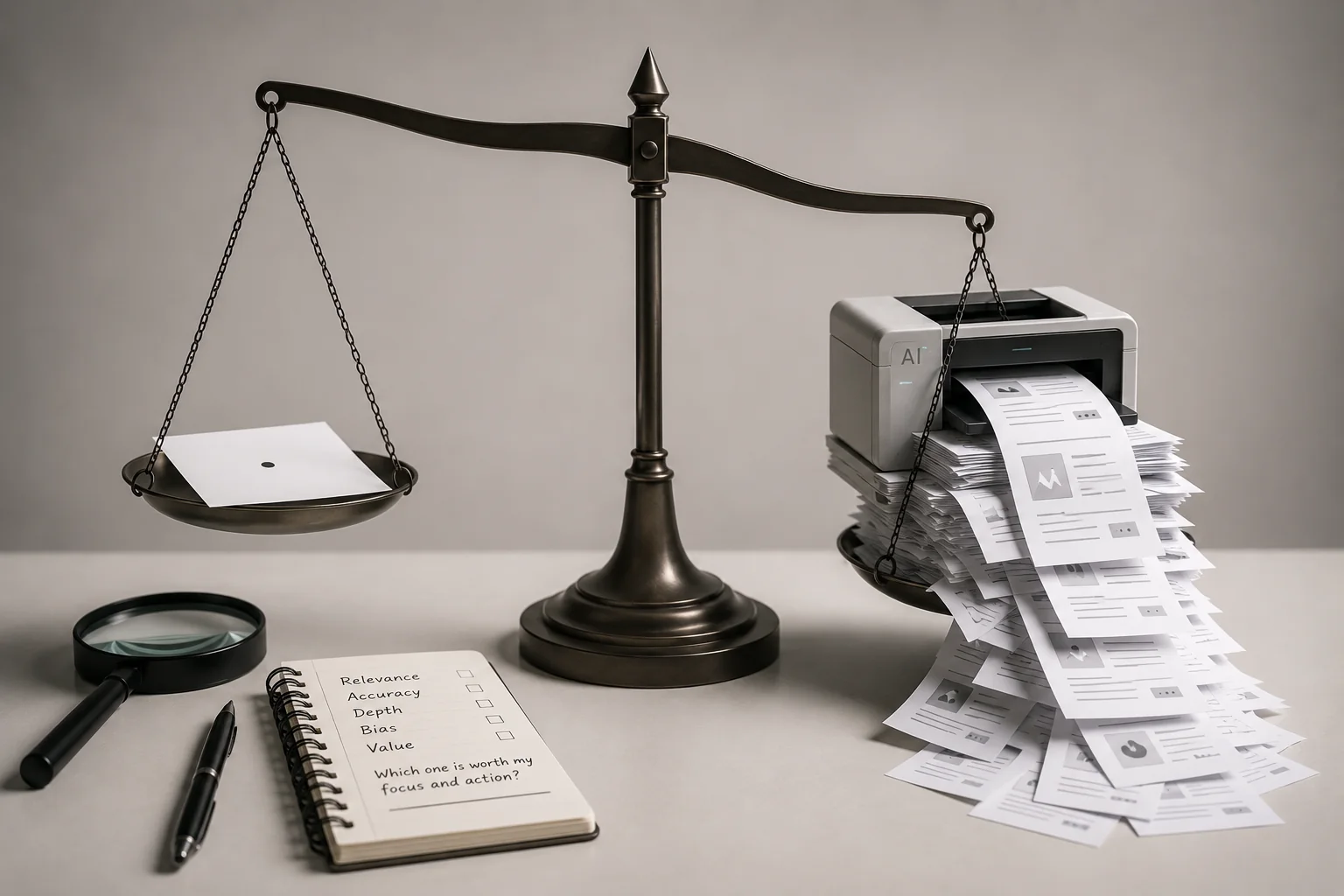
There is a newer version of this overload, and it is worth naming precisely, because most people are paying it without noticing. Every AI tool saves time at one stage of work and quietly relocates it to another. It lowers the cost of producing information while raising the cost of evaluating it. That trade rarely shows up on any balance sheet — but your attention pays it. Call it the AI cognitive tax: less effort spent creating, more effort spent deciding what deserves your attention.
This is the same shortage the whole article is about, wearing a new disguise. When a draft, a summary, or a plan can be generated in seconds, the bottleneck stops being production and becomes judgment — and judgment is expensive in exactly the currency that is already scarce: focused attention. You are no longer short on answers. You are short on the bandwidth to weigh them.
The early evidence lines up. In a 2025 study, Hao-Ping Lee and colleagues at Microsoft Research and Carnegie Mellon surveyed 319 knowledge workers about real AI use. The work, they found, shifts from gathering information to verifying it, from solving problems to integrating a machine’s response, and from doing the task to supervising it. There was a catch worth sitting with: the more people trusted the AI, the less critical thinking they reported applying — which is precisely how a tax goes unpaid, and how quality quietly slips.
Seen as a ledger, the shift looks like this:
| Before AI (production cost) | After AI (evaluation cost) |
| Search for information | Filter AI-generated information |
| Write one draft | Compare five AI drafts |
| Make one decision | Evaluate dozens of AI suggestions |
| Limited options | Unlimited possibilities to judge |
Notice that the right-hand column is where attention is spent — and where it fragments. Abundance is not free; it converts effort into evaluation and hands the bill to your focus. This is why “just use AI to save time” is only half an equation. The time saved in producing can be quietly re-spent, and then some, in deciding.
Which is exactly where a deliberate pause earns its place. The one-question stop described earlier is not nostalgia for slower work — it is the instrument for paying the evaluation tax on purpose instead of leaking it. Before you compare the five drafts, one honest question — what am I actually trying to decide here? — restores the judgment the abundance was quietly taxing away.
| MYME INSIGHT AI does not remove cognitive load. It relocates it — from producing answers to judging them. The scarce skill of the AI era is not generating options; it is deciding, with limited attention, which of them deserve it. |
Frequently Asked Questions
Isn’t this just meditation with extra steps?
It overlaps, but it is narrower and more accessible. Meditation trains sustained, open attention over time. A single reflective prompt asks one focused question for under a minute. You can do it at a desk, between meetings, with no training. The two are complementary, not competing.
Do I need to buy a set of cards to do this?
No. The mechanism — a brief, screen-free pause and an honest question — costs nothing. A notebook or a sticky note works. A pre-made card set is a convenience that makes the habit easier to remember and keep, not a requirement for it to work.
What is the “AI cognitive tax”?
It is the hidden cost of AI abundance: these tools lower the effort of producing information but raise the effort of evaluating it. You spend less time creating and more time deciding what deserves your attention — a bill paid in focus rather than money. A deliberate pause is how you pay it on purpose instead of letting it drain quietly.
Will this fix my short attention span?
Not by itself, and be wary of anything that promises it will. What the research supports is that repeated, deliberate pauses reduce mental noise and improve emotional regulation. Rebuilding sustained focus is a longer project involving how you manage notifications, sleep, and self-interruption. A pause is a useful part of that work, not a substitute for it.
MyMe SuperDigital Perspective
Access to information is effectively infinite now. That is exactly why the scarce, valuable capacity has moved elsewhere — to the Access to information has become extraordinarily abundant and inexpensive across many domains. As a result, the mental space required to evaluate, connect, and make sense of that information is becoming increasingly valuable. In a culture built around constant stimulation, the ability to deliberately create space for reflection can become both a practical advantage and a form of self-respect.
So the essential question is not simply how to consume information faster. It is this: how do we create enough space to think clearly about what we’ve already taken in? Clarity does not necessarily come from adding more input. Often, it begins with creating enough space to examine what is already there—and asking the right question within that space.
Continue Exploring This Topic
- The Efficiency Trap: How to Use AI Without Outsourcing Your Mind
- AI Thinks Faster. Are We Thinking Less?
- The Curiosity Engine: Why Asking Better Questions May Become Humanity’s Greatest AI Skill
- The AI Education Paradox: Why Schools Must Rethink Learning
References
Academic Research
Simon, H. A. (1971). Designing Organizations for an Information-Rich World. In M. Greenberger (Ed.), Computers, Communications, and the Public Interest (pp. 37–72). Johns Hopkins University Press.
Mark, G. (2023). Attention Span: A Groundbreaking Way to Restore Balance, Happiness and Productivity. Hanover Square Press. gloriamark.com
Lieberman, M. D., Eisenberger, N. I., Crockett, M. J., Tom, S. M., Pfeifer, J. H., & Way, B. M. (2007). Putting Feelings Into Words: Affect Labeling Disrupts Amygdala Activity in Response to Affective Stimuli. Psychological Science, 18(5), 421–428. doi.org/10.1111/j.1467-9280.2007.01916.x
Pennebaker, J. W., & Beall, S. K. (1986). Confronting a Traumatic Event: Toward an Understanding of Inhibition and Disease. Journal of Abnormal Psychology, 95(3), 274–281. doi.org/10.1037/0021-843X.95.3.274
Pennebaker, J. W. (1997). Writing About Emotional Experiences as a Therapeutic Process. Psychological Science, 8(3), 162–166. doi.org/10.1111/j.1467-9280.1997.tb00403.x
Lee, H.-P., Sarkar, A., Tankelevitch, L., Drosos, I., Rintel, S., Banks, R., & Wilson, N. (2025). The Impact of Generative AI on Critical Thinking: Self-Reported Reductions in Cognitive Effort and Confidence Effects From a Survey of Knowledge Workers. In Proceedings of the 2025 CHI Conference on Human Factors in Computing Systems. doi.org/10.1145/3706598.3713778
Background & Further Reading
Baikie, K. A., & Wilhelm, K. (2005). Emotional and Physical Health Benefits of Expressive Writing. Advances in Psychiatric Treatment, 11(5), 338–346.
Mark, G., et al. Research on interruptions and attention recovery, Department of Informatics, University of California, Irvine. universityofcalifornia.edu
Written by MyMe SuperDigital — exploring where technology meets the human mind.