| Estimated Reading Time | Last Updated | Category | Companion Documentary |
|---|---|---|---|
| 8 min read | July 2026 | AI Economy & Digital Finance | ▶ Watch Documentary |
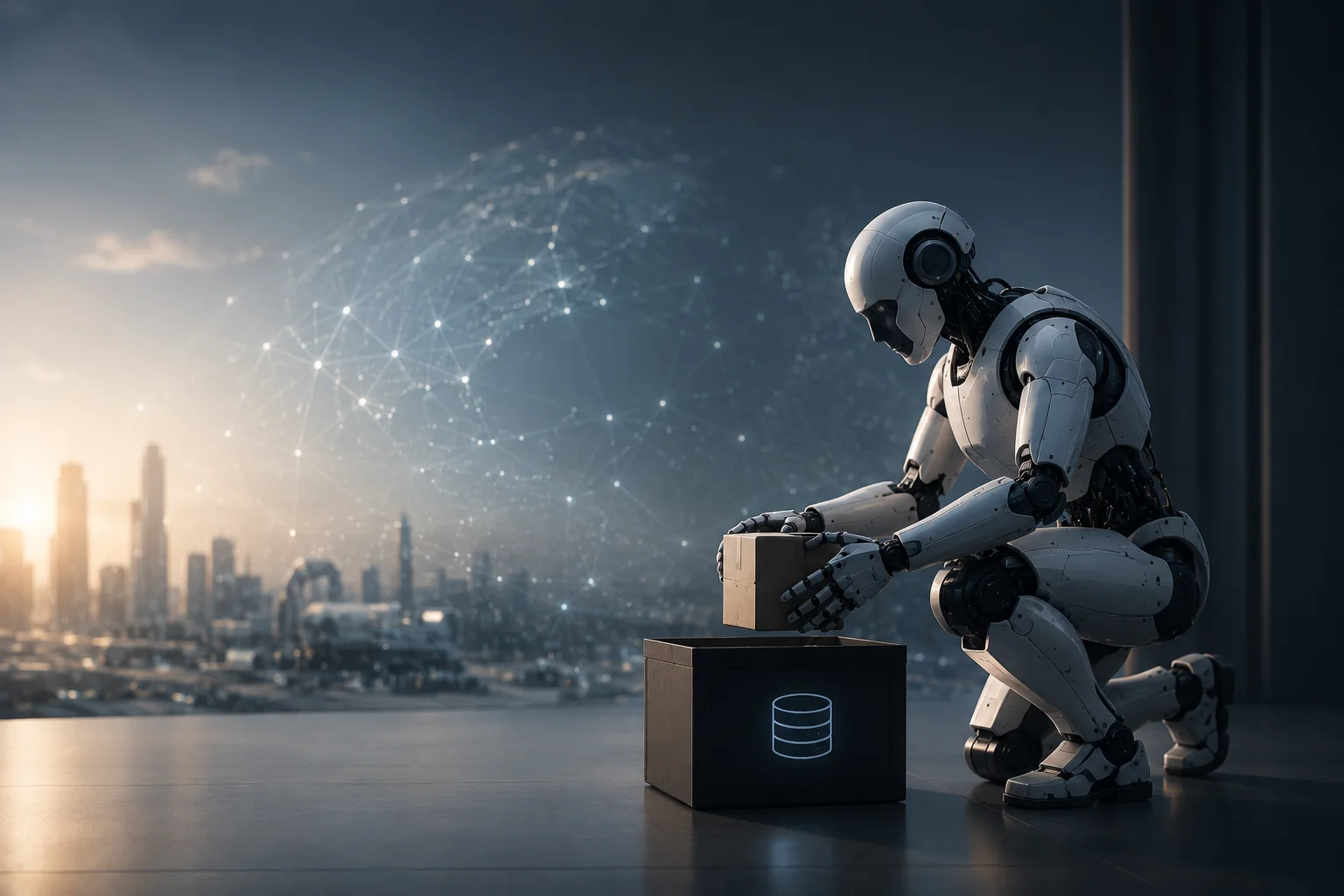
Artificial intelligence can now write software, diagnose diseases, and summarize entire libraries in seconds. Yet even some of today’s most advanced humanoid robots still struggle with everyday physical tasks such as navigating unfamiliar spaces or manipulating common household objects. The gap between digital intelligence and physical intelligence has never been more obvious.
If AI has become so intelligent, why does the physical world remain so difficult?
The answer reveals a challenge that extends beyond computer science and into economics. It may have less to do with intelligence itself and far more to do with building an economic system capable of producing the real-world experience that machines need to learn.
Intelligence Isn’t the Real Bottleneck
Most discussions about AI focus on larger models, faster chips, or more powerful algorithms. Physical AI introduces an additional constraint: intelligent machines must learn to perceive, reason about, and act within complex physical environments.
Unlike ChatGPT, which learned from enormous amounts of internet text, robots cannot learn how to navigate kitchens, offices, hospitals, warehouses, or construction sites by reading webpages.
They need experience.
| Physical AI Needs | Why It Matters |
| Real-world observations | Understanding dynamic environments |
| Sensor fusion | Combining vision, touch, motion, and audio |
| Continuous feedback | Improving decisions through interaction |
Why Real-World Data Is So Expensive
Collecting robotic data is fundamentally different from collecting digital information. Companies often need to:
- Deploy fleets of expensive physical robots.
- Build controlled testing environments.
- Maintain hardware and manage physical wear-and-tear.
- Label enormous amounts of multi-modal sensor data.
- Repeat the entire process for every new hardware iteration.
The result is an incredibly slow and costly pipeline that limits how quickly physical AI can improve. Unlike internet data, physical experience cannot simply be downloaded—someone has to create it.
The Hidden Economy Nobody Talks About
This reveals a problem that receives surprisingly little attention: teaching robots is not only an engineering challenge, it is an economic challenge.
- Every new dataset has a cost.
- Every mapped room has a cost.
- Every recorded movement has a cost.
This raises a fundamental question: if data has become the fuel of artificial intelligence, who will finance the production of the next generation of physical data?
Every successful interaction with the physical world represents value that someone must generate, verify, store, and eventually pay for. Physical AI doesn’t simply require better algorithms; it requires an entirely new economic model capable of producing these datasets continuously.
Could Decentralization Solve the Problem?
One emerging idea is to distribute this responsibility across thousands—or even millions—of independent participants.
Instead of relying solely on a handful of technology companies, decentralized networks propose allowing robot owners to contribute real-world telemetry and receive digital incentives in return. Rather than treating robotic experience as a private corporate asset, these systems attempt to transform it into a shared digital resource.
Case Study: RICE AI
One example of this emerging idea is RICE AI, a project exploring whether decentralized incentives could help solve the physical data shortage. Its concept is relatively straightforward:
| Step | Description |
| Collect | Robots contribute real-world telemetry. |
| Incentivize | Contributors receive protocol rewards. |
| Scale | More participants create richer datasets. |
Whether this particular implementation succeeds remains uncertain. The more important insight is the broader principle: Physical AI may eventually require functioning data markets rather than isolated corporate databases.
Watch the Documentary
To better understand the concepts discussed in this article, watch the accompanying documentary that explores the RICE AI ecosystem, decentralized robotics data, and the emerging economic model behind physical AI.
YouTube Documentary:
Beyond RICE AI: Why This Idea Matters
Even if RICE AI never becomes widely adopted, the underlying concept could influence the next generation of robotics.
Future autonomous vehicles, industrial robots, healthcare assistants, and smart city infrastructure may all depend on new ways of producing and sharing real-world training data.
In that sense, the larger story is not about one protocol. It is about the emergence of a new economic layer for physical intelligence.
The Rise of the Data Economy for Machines
If this model expands, data could become one of the world’s most valuable machine-native assets. Future economies may include entirely new professions and industries:
- Home robotics data contributors
- Industrial environment providers
- Warehouse mapping networks
- Autonomous driving telemetry marketplaces
- Smart city infrastructure contributors
If this transition happens, physical data may become as economically valuable as cloud computing became during the last decade. Organizations could begin treating real-world experience as a strategic digital asset rather than a by-product of operating machines.
In this vision, people may no longer contribute only computing power or financial capital—they may also contribute real-world experience.
Just as cloud computing became a foundational layer of the digital economy, physical experience could become a foundational asset of the AI economy. Organizations that generate, validate, and exchange high-quality real-world data may play a role similar to today’s cloud providers—powering intelligent machines rather than digital applications.
Challenges That Cannot Be Ignored
The idea is ambitious, but significant questions remain:
| Challenge | Why It Matters |
| Verification | Poor-quality data weakens AI models. |
| Privacy | Robots collect sensitive environmental information. |
| Adoption | Networks require large numbers of participants. |
| Competition | Centralized AI companies already own massive datasets. |
Key Takeaways
- The Bottleneck: Access to diverse, high-quality physical-world data is one of the major constraints on developing capable physical AI systems.
- The Cost: Collecting real-world robotic data is expensive, slow, and hard to scale.
- One Possible Approach:Decentralized incentive systems aim to crowd-source data collection and potentially reduce its cost.
- The Horizon: The long-term opportunity is the creation of a global economy built around physical machine-learning experience.
From Information Economy to Experience Economy
The digital economy was built on information. Search engines indexed it, social platforms monetized it, and language models learned from it. Physical AI introduces a different paradigm—an economy built not only on information, but on experience. Every movement, interaction, and observation generated by machines could become part of a new class of valuable digital assets.
MyMe SuperDigital Perspective
The conversation surrounding artificial intelligence often revolves around bigger models and faster processors. Physical AI shifts the discussion toward something more fundamental: Who creates the experiences that teach machines?
The future of robotics will not be determined solely by larger language models or more advanced hardware. It may instead depend on whether humanity can build a sustainable economic system for collecting real-world experience.
Today’s internet became valuable because billions of people generated digital data. Tomorrow’s robotic economy may require people, businesses, and cities to consciously contribute physical-world data through connected machines.
Projects such as RICE AI represent one possible direction—not necessarily the final solution. Whether decentralized data markets succeed or not, they highlight an important reality: intelligence alone is no longer enough. The next frontier is designing entirely new economic systems that allow intelligence to scale safely, ethically, and globally.
The internet created an economy for information.
Physical AI may require humanity to build an entirely new economy for experience.
Frequently Asked Questions
Q1: Why can’t robots simply learn from the internet?
Because physical intelligence requires experience in the physical world. Robots must understand movement, balance, touch, space, and cause-and-effect through sensor data that cannot be learned from text alone.
Q2: What is physical AI?
Physical AI refers to artificial intelligence operating in real-world machines such as humanoid robots, autonomous vehicles, drones, industrial systems, and service robots.
Q3: Why is collecting robotic data expensive?
Unlike digital information, physical data requires hardware, sensors, maintenance, testing environments, and continuous real-world operation, making it significantly more costly to gather.
Q4: What is RICE AI?
RICE AI is a decentralized protocol that proposes rewarding robot owners for sharing real-world telemetry used to train AI systems, creating a distributed marketplace for robotic data.
Q5: Could decentralized data markets accelerate robotics?
Potentially. If enough participants contribute diverse, high-quality data, decentralized systems could reduce development costs and expand access to training data. However, adoption, data quality, and privacy remain major challenges.
Continue Exploring This Topic
- Why AI Needs Money: How AI Agents Power the Machine Economy
- The AI Infrastructure Revolution: What If AI Needed a New Internet?
- Why AI Won’t Choose Just One Blockchain
- Crypto & AI: Financial Revolution or the World’s Smartest Bubble?
References
- NVIDIA. Physical AI and Robotics Research.
- Google DeepMind. Robotics Research.
- Stanford Human-Centered AI (HAI). Research on Human-Centered Artificial Intelligence.
- IEEE Spectrum. Robotics.
- MIT Technology Review. Artificial Intelligence.
- RICE AI
- RICE AI documentation and publicly available technical materials.
- Concepts discussed in the accompanying documentary transcript.
Last Reviewed
Last reviewed: July 2026
This article reflects publicly available information and research available at the time of publication. As physical AI, robotics, and decentralized technologies evolve rapidly, some details may change over time.
Disclaimer: This article is intended for educational and informational purposes only. It does not constitute financial, investment, legal, or professional advice. Any discussion of blockchain protocols, digital assets, or decentralized networks is presented solely to explain technological concepts and should not be interpreted as a recommendation or endorsement. Readers should conduct their own independent research before making financial or technological decisions.