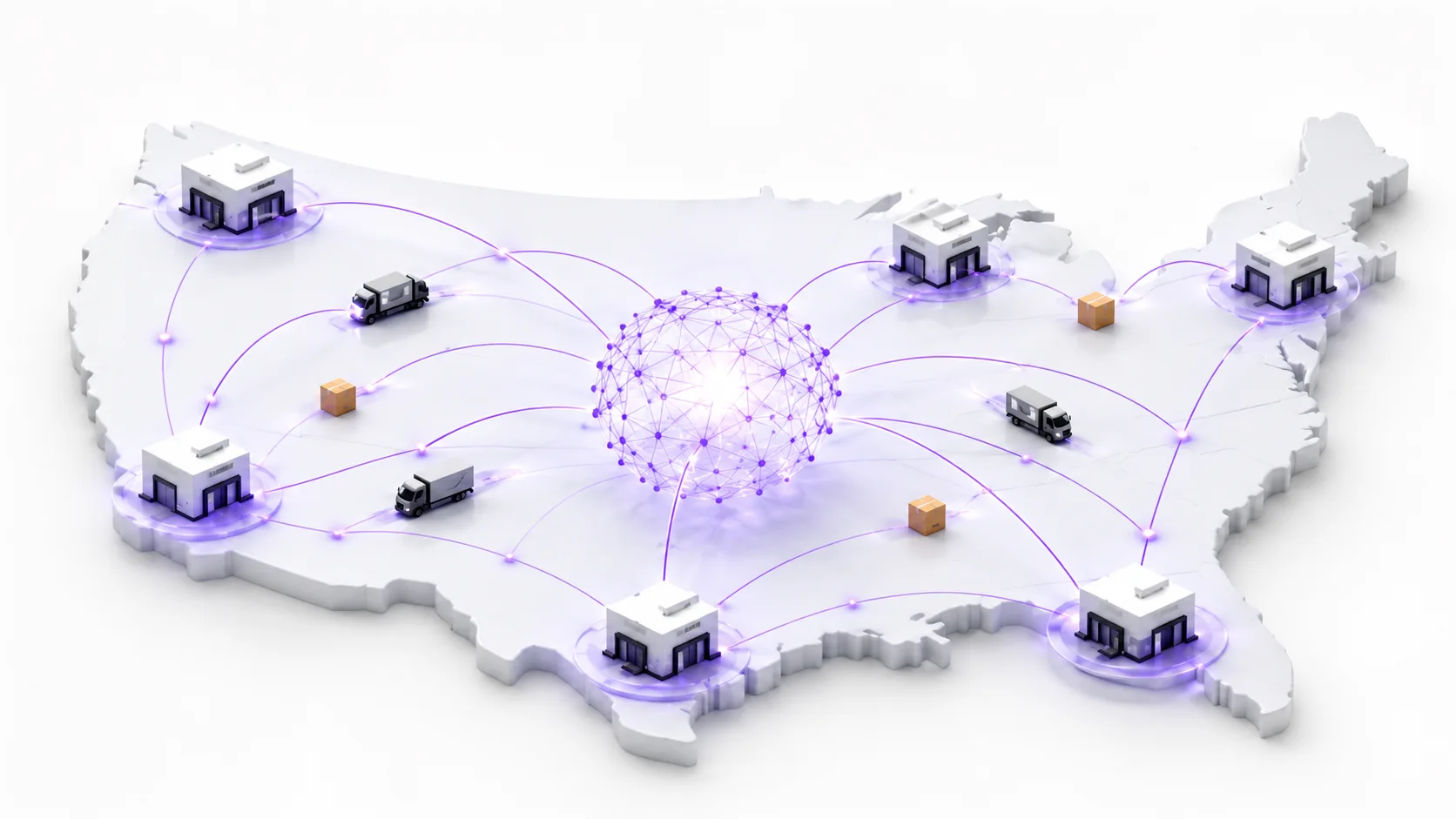
The Science of Predicting Demand Before Customers Place Their Orders
Estimated Reading Time Last Updated Category Companion Documentary 31 min read July 24, 2026 Artificial Intelligence Available ▶
Prepared by the MyMe SuperDigital Research Team
Amazon AI Forecasting is transforming modern retail by predicting customer demand before orders are placed. By combining machine learning, historical purchasing patterns, inventory data, and real-time signals, Amazon continuously optimizes its supply chain to improve efficiency and customer experience.
In March 2026, Amazon began delivering orders in one hour.
Not to a handful of test neighborhoods. To hundreds of American cities, across a catalog of more than 90,000 products, with three-hour delivery reaching more than two thousand cities beyond that.
Now consider what an hour actually requires. An order has to be received, located, picked, packed, sorted, loaded, routed, and driven to a doorstep — in a country where the average commute takes longer than that. No amount of speed inside a warehouse closes that gap. No robot closes it either.
The only way an hour works is if the product was already sitting a few miles from the buyer before the buyer decided to buy.
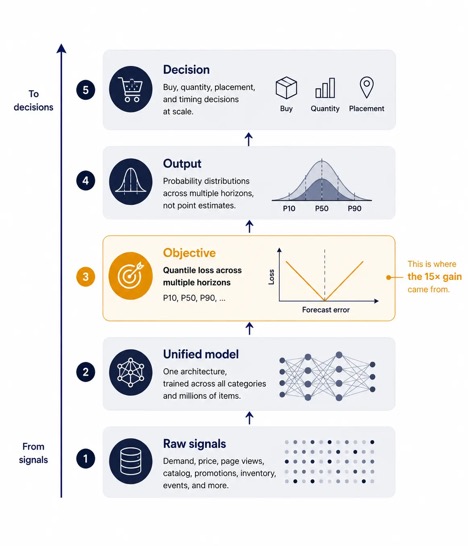
Which means the decisive machine at Amazon is not the one that moves boxes. It is the one that decided, weeks earlier, which building each box should be waiting in. That machine forecasts demand for more than 400 million products every day, and its single largest accuracy gain came not from a bigger neural network but from changing the question the network was asked to answer.
Operationally, Amazon’s biggest gains appear to have come from placing inventory closer to customers rather than accelerating warehouse operations.
This article traces that system across four layers: the forecasting science that predicts demand at continental scale; the network geometry that converts a forecast into physical proximity; the robotics layer, which is the least valuable of the four despite being the most photographed; and the shopping assistant that no longer merely predicts demand but has begun to participate in creating it.
It also examines where the system fails, what independent consumer research says about whether anyone actually wants this, and one document from December 2004 in which Amazon’s engineers wrote down the whole idea two decades before they could build it — including a passage almost nobody has read correctly.
Executive Summary
Amazon’s reputation for predicting purchases rests on a widely misreported patent. The reality is less mystical and more consequential: the company does not forecast what any individual will buy. It forecasts what a region will absorb, then positions inventory there in advance.
That forecasting runs through an internal organization called Supply Chain Optimization Technologies, covering more than 400 million products daily. Its decisive improvement — a fifteenfold gain in accuracy — came from training models on quantile loss, an objective that reflects the real asymmetry between overstocking and running out, rather than from deeper networks.
A forecast is only worth what can be done with it. In 2023 Amazon partitioned its United States network into eight interconnected regions, cutting distance to customers by 15 percent and lowering cost per unit for the first time since 2018. One-hour delivery is the visible consequence.
The newest layer appears to change the nature of the system. An AI assistant that recommends, tracks prices, and completes purchases does not simply observe demand — it shapes it. That possibility was described in Amazon’s own 2004 patent filing, though never legally claimed.
| Editorial Standards This article distinguishes between: • Verified facts supported by primary sources. • Evidence-based analysis prepared by the MyMe SuperDigital Research Team. • Reasoned interpretations, which are clearly identified as analysis rather than fact. Information reflects publicly available evidence as of the publication date. |
Key Figures
Every number below is drawn from a primary source listed in External Resources.
| Metric | Figure | Source and context |
| Products forecast daily | 400 million+ | Amazon Science — the scope of the SCOT forecasting system |
| Forecast accuracy improvement | 15× | Amazon Science — gain from adopting a unified deep-learning model trained on quantile loss; baseline not disclosed |
| US fulfillment regions | 8 | INFORMS — network partitioned in 2023; see Editorial Transparency |
| Reduction in distance to customer | 15% | INFORMS — measured after regionalization |
| In-region fulfillment rate | 62% → 76% | INFORMS — share of orders filled within the customer’s own region |
| Shipping cost, 2025 | $102.7 billion | SEC filing — against $95.8 billion in 2024 |
| Net sales, 2025 | $716.9 billion | SEC filing — audited full-year results |
| Robots deployed | 1 million+ | Amazon — across more than 300 facilities as of 2025 |
| Patent priority date | Dec 17, 2004 | USPTO — the origin of the anticipatory shipping concept |
| Consumers ranking cost above speed | 36% vs 23% | Metapack / Retail Economics — independent 2026 consumer research |
| WATCH THE COMPANION DOCUMENTARY This article and its companion documentary were developed as part of the same investigation. The documentary explains the operational story visually, while this article expands on the primary sources, technical evidence, patent analysis, and editorial analysis behind the findings. Watch: MyMe SuperDigital |
CHAPTER 1· THE FORECAST
How Amazon AI Forecasting Works
Before Amazon can deliver anything in an hour, something has to guess what a city will want.
The forecasting system has no public brand and no marketing budget. It is an internal organization called Supply Chain Optimization Technologies — SCOT — and its remit is total: what Amazon buys, how much of it, where it goes, and when it moves.
SCOT forecasts demand for more than 400 million products every day. Deep-learning models run across enormous datasets to determine what to stock, in what quantity, at which facility, while coordinating inbound inventory from millions of independent sellers.
The scale is easier to grasp in reverse. Each of those 400 million forecasts is a bet with two ways to lose.
- Understock — the customer buys elsewhere, and the promise of fast delivery collapses on the one occasion it mattered.
- Overstock — capital sits in a building losing value, occupying shelf space a faster-moving product needed.
Multiply that trade-off by hundreds of millions of items and hundreds of facilities, refreshed daily, and you have one of the largest continuous optimization problems any private company has attempted.
What makes it tractable is a decision most coverage of Amazon misses entirely: The company largely shifted its logistics forecasting from individual behavior toward regional demand patterns.
Why the individual shopper is the wrong unit
Individual behavior is noisy. Modeling one person accurately enough to justify moving a physical object across a country is, in almost every case, a losing proposition.
Aggregate behavior is different. Resolve demand to a region and a week, and it becomes remarkably tractable — stable enough to commit inventory and capital against.
So the forecast that produces one-hour delivery is not about you. It is about your postal code. That distinction explains nearly everything else about how the system is built.
CHAPTER 2 · THE BREAKTHROUGH
Amazon AI Forecasting Breakthrough
Amazon’s forecasting team tried deep learning. It lost to the system already in production.
That failure is the most useful thing in this story, and Amazon’s own scientists have published a candid account of it.
A museum of models
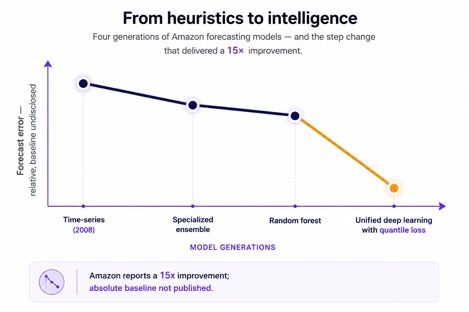
Around 2008, forecasting at Amazon ran on standard time-series methods. They worked when demand was stable and predictable. They failed precisely where the money was: new products with no sales history, sharply seasonal items, and anything caught by sudden public attention.
The response was to bolt on specialists — one component for seasonality, another for price elasticity, a third to model past errors and produce distributions rather than single numbers.
The result was accurate in patches and, by the team’s own description, extremely difficult to maintain.
Consolidation came from a deceptively plain observation: products in unrelated categories often behave alike. A new video game and a new laptop share a launch curve even though they share nothing else. That let a single model pool statistical strength across the entire catalog.
Then deep learning arrived, and lost
When the team first applied neural networks in the mid-2010s, the results underperformed the incumbent system.
The fix was not a larger model. It was a different question.
The team retrained the network to minimize quantile loss across multiple forecast horizons — optimizing directly for what the business actually cares about. Quantile loss matters in inventory because under-predicting and over-predicting do not cost the same. A stockout and an overstock are different failures with different price tags, and an error metric that treats them as equivalent is measuring the wrong thing.
Training on the metric that mattered, rather than a convenient proxy, produced a fifteenfold improvement in forecast accuracy.
According to Amazon’s published research, one of the largest reported improvements in its forecasting systems came from correctly specifying the optimization objective.
Evidence-Based Analysis: This generalizes far beyond Amazon. Teams routinely optimize the metric that is easy to compute rather than the one that reflects the real cost of being wrong — and then reach for more parameters when results disappoint. Amazon’s fifteenfold improvement is, at bottom, a story about asking a better question.
| ONE NUMBER WORTH TREATING CAREFULLY Amazon has never published the baseline this fifteenfold gain was measured against. A relative improvement over an undisclosed starting point is a real engineering result and an unfalsifiable public claim at the same time. It is reported here because Amazon’s scientists documented the method in technical detail. It is flagged because the magnitude cannot be independently checked |
Two later steps completed the architecture. In 2018, the team published a multi-horizon quantile forecaster that learned patterns directly from sequences, removing the need for hand-built features. In 2020, borrowing the attention mechanisms then reshaping language models, it published a forecaster that conditions on its own history of errors — a system that learns from its mistakes as well as from demand.
CHAPTER 3 · THE NETWORK
Amazon AI Forecasting Network
A perfect forecast is worthless if the network cannot act on it.
Until 2023, Amazon’s United States operation ran as a single national network. Any fulfillment center could, in principle, serve any customer.
Elegant on paper. Expensive in practice — because it meant goods routinely crossed the country to reach buyers who lived a few hundred miles from identical inventory.
After roughly eighteen months of network design work, Amazon partitioned the country into eight interconnected regions, each holding broad selection and largely serving its own customers. Full deployment completed in March 2023.
What changed, measured
| Measure | Change | What it means operationally |
| Distance to customer | −15% | Shorter final legs, less time in transit, lower fuel and labor cost per unit |
| Middle-mile touchpoints | −12% | Fewer handoffs between facilities, and therefore less variance in delivery time |
| In-region fulfillment | 62% → 76% | Three of four orders now never leave the customer’s own region |
| Cost to serve per unit | First decline since 2018 | Savings above $0.45 per unit in the United States |
Speed improved at the same time — which should not be intuitive. Cheaper and faster normally pull in opposite directions.
They stopped opposing each other because both were downstream of the same variable: distance.
Evidence-Based Analysis: Regionalization is what converts a forecast into an asset. A national network can absorb a mediocre forecast by shipping farther at higher cost. A regional network cannot — put the wrong inventory in the wrong region and the mistake becomes expensive and visible within days.
Amazon made its own forecasting quality load-bearing. That is a bet very few companies can afford to place.
It is also the reason the forecasting work in Chapter Two matters commercially rather than academically. The models and the map are a single system; neither delivers the result alone.
CHAPTER 4 · THE FLOOR
A Million Robots, and the One That Did Not Survive
The most photographed layer of Amazon’s operation is also the least decisive.
Amazon deployed its one millionth robot in 2025, at a fulfillment center in Japan, across a network spanning more than 300 facilities.
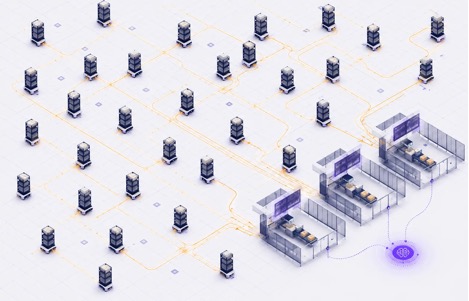
The fleet is not one machine repeated a million times. It is a taxonomy: mobile drive units, robotic arms for picking and sorting, containerized storage systems, and specialized handlers. In 2025 the company introduced Vulcan, a robot with a sense of touch, and DeepFleet, an AI model that coordinates large fleets of differently shaped robots moving through shared floor space.
In October 2025 came two more announcements. Blue Jay, a ceiling-mounted platform synchronizing multiple robotic arms into a single workstation. And Project Eluna, an agentic AI that reads real-time and historical building data and answers operators’ questions in plain language — where a bottleneck is forming, where staff should move — instead of requiring them to read dozens of dashboards.
Then, in February 2026, Amazon confirmed it was no longer using Blue Jay in operations.
A flagship launch, heavily publicized, withdrawn within four months.
Evidence-Based Analysis: The withdrawal is more revealing than either launch. It suggests hardware developed on software timelines: build fast, deploy into live operations, kill quickly when the economics do not clear. For any reader assessing robotics announcements from any company, the correct default is that a launch is a hypothesis. The capability is whatever survives its second year.
In June 2026, at an event in London, Amazon unveiled a next-generation Proteus that accepts plain-language instructions and operates across whole sites rather than dock areas alone, alongside a stated commitment of more than €10 billion to European fulfillment. Deployment is planned for the first half of 2027 — which is the date that will actually matter.
CHAPTER 5 · THE LOOP
When the Forecast Starts Shaping the Future It Predicts
Everything so far describes prediction in the ordinary sense. The newest layer is different in kind.
Amazon launched an AI shopping assistant, Rufus, in 2024. By 2025 the company reported that more than 300 million customers had used it to research, compare, and buy.
It then gained three capabilities in sequence. Account memory, so it accumulates a picture of a household’s habits across sessions. Price-history tracking with alerts. And agentic purchasing — buying on a customer’s behalf, including from retailers outside Amazon.
In May 2026, Amazon merged that product with its generative Alexa assistant and rebranded the result Alexa for Shopping, placing it directly inside search, product pages, and the cart.
Why this changes the category
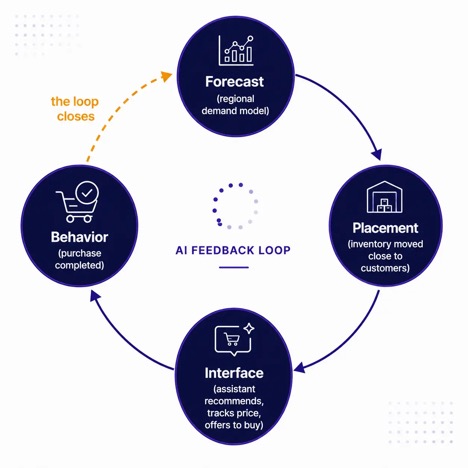
A forecasting system that only observes demand is subject to the world. It watches, infers, and commits inventory against its inference.
A system that also recommends, ranks, reminds, watches prices, and ultimately transacts has partial authorship of the demand it is forecasting.
If the model expects a region to consume a certain volume of an item, and the interface surfaces that item to precisely the households most likely to accept it, the forecast becomes partly self-fulfilling.
Evidence-Based Analysis: This is not an accusation of manipulation, and the loop carries real benefits — less friction, fewer stockouts, lower prices from higher utilization. But it changes what the word prediction means. The honest formulation is that Amazon is converging on a system that reduces the variance of consumer behavior until that behavior becomes cheaper to serve.
From an operational perspective, greater predictability generally reduces fulfillment costs.
Which raises an obvious question. Did anyone plan this, or did it emerge? The answer sits in a document filed in December 2004 — and it is not the document most people think it is.
CHAPTER 6 · THE ORIGIN
The Document That Anticipated Today’s System in 2004
Everyone has heard of Amazon’s anticipatory shipping patent. Few public analyses discuss the sections that are most relevant today.
The popular account dates the idea to 2012 or 2013. The patent record says otherwise.
US Patent 8,615,473 — Method and system for anticipatory package shipping — was granted on December 24, 2013 to Joel Spiegel, Michael McKenna, Girish Lakshman, and Paul Nordstrom, assigned to Amazon Technologies. But it is a divisional of an application filed in November 2011, itself a divisional of application 11/015,288, filed December 17, 2004.
The priority date is December 2004. The idea is more than twenty-one years old — conceived before Amazon had the data, the models, or the network to act on it.
| PATENT STATUS: A COMMON MISUNDERSTANDING One patent in Amazon’s anticipatory shipping family—U.S. Patent 8,615,473—is listed as expired after maintenance fees were not paid. However, this does not mean the entire patent family expired. |
What the patent actually describes
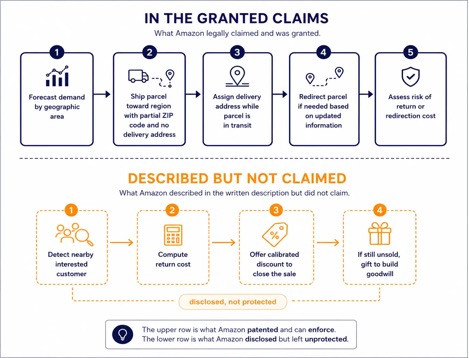
The core mechanism is as reported: package goods, ship them toward a geographic area identified by something as coarse as the first three digits of a ZIP code, and assign the full delivery address later — at a carrier hub, or even by radioing it to a driver already on a delivery route.
Three passages that receive relatively little public attention
First, the patent contains a forecasting model designed to predict demand both in aggregate and within particular geographic areas — the exact conceptual move that would later define Amazon’s real system. It also anticipates the cold-start problem and proposes solving it by analogy: predicting a new novel’s demand from the previous book in its series.
Second, it sets out what to do when the speculation fails. It walks through detecting a nearby customer’s potential interest in an item already in transit — by analyzing purchase history, browsing behavior, stated preferences, or demographics — then calculating what returning or redirecting that parcel would cost, and offering the item to that customer at a discount derived from that cost.
Where the economics still do not work, it proposes delivering the package as a gift, reasoning that goodwill from a valued customer may beat the cost of hauling it back.
Third, it describes surfacing in-transit inventory inside the shopping experience itself: when a customer views a product page, the system checks which speculative parcels are already near them.
The distinction that changes the story
Here reporting on this patent has consistently gone wrong, and the error is worth understanding because it recurs across technology journalism.
A patent has two distinct parts. The written description explains embodiments. The claims define the legal monopoly.
Patent attorneys deliberately describe broadly — to support future claims and to block competitors from patenting nearby ideas. Describing something is cheap. Claiming it is what costs money and signals intent.
So the question is whether the discount-and-gift mechanism is claimed.
For this article, all 26 granted claims of US 8,271,398 — the sibling patent issuing from the same December 2004 disclosure — were read in full. They claim: shipping a physical package to a geographic area while purposefully not specifying any delivery address; assigning that address in transit via a unique identifier; redirecting the package mid-route; predicting overall customer demand within the destination area; analyzing business variables including the risk that a package incurs return or redirection costs; and building a predictive shipping model from carrier tracking data.
| THE FINDING No claim covers offering a calibrated discount to an identified customer. No claim covers gifting. The mechanism appears in the description and nowhere in the claims. It was disclosed, and deliberately left unclaimed. |
Evidence-Based Analysis: The honest reading is narrower than the exciting one, and more useful. Amazon claimed the machinery of speculative movement and regional demand prediction — including, explicitly, the risk that a parcel comes back unsold. It disclosed, but declined to claim, the remedy for that risk. The company sought exclusivity over knowing where goods should go, not over persuading customers to take what had already gone.
Evidence-Based Analysis: What survives that narrowing still matters. In December 2004, engineers set down in a legal document the recognition that a speculative supply chain has two adjustable variables — the forecast and the customer — and sketched how to move the second when the first fails. They did not claim it, and there is no evidence they built it. But the design problem they articulated is precisely the problem an agentic shopping assistant solves. That is a continuity of logic, not a continuity of plan.
CHAPTER 7 · THE MONEY
Why a Fraction of a Cent Is Worth Billions
The economics make the engineering intelligible.
Amazon reported 2025 net sales of $716.9 billion, up 12 percent, with operating income of $80.0 billion. Shipping costs alone were $102.7 billion, against $95.8 billion the previous year. These are audited figures filed with the SEC.
Against a shipping bill that size, an improvement measured in cents per unit is a strategic event rather than an operational one.
Amazon’s own regionalization figures put the saving above $0.45 per unit domestically.
Separately — and on considerably weaker evidentiary footing — reporting in The New York Times on October 21, 2025, based on internal documents, described plans to automate roughly three-quarters of operations over time, avoid about 160,000 United States hires by 2027 and more than 600,000 by 2033, with savings of roughly thirty cents per item delivered. Amazon has publicly disputed that these documents represent company strategy, describing them as one team’s perspective.
Evidence-Based Analysis: Place the two figures side by side and the strategy resolves. Forecasting plus geography is worth roughly half a dollar per unit. Automation is worth roughly a third of that.
Based on the available financial and operational evidence presented in this article, Amazon’s forecasting systems appear to create greater economic value than warehouse robotics alone.
Prediction is the higher-margin layer, and it is the hardest to copy — because replicating it requires the science, the network geometry, and the transaction volume to train on. All three, simultaneously.
CHAPTER 8 · THE COUNTER-CASE
The Question the Industry Does Not Ask
An article about a speed race should test whether the race is worth running.
Independent research suggests the answer is more complicated than the industry’s framing.
| Finding | Source |
| Delivery cost is the single most important aspect of the online delivery experience, named by 36% of global consumers — ahead of speed at 23% and convenience at 17% | Metapack and Retail Economics, 2026 |
| More than 95% of shoppers prefer free standard delivery over paying for faster shipping | McKinsey consumer delivery survey |
| 70% of online shoppers have abandoned a cart over shipping costs | ICSC survey of 1,000 US consumers, May 2026 |
| Amazon ranks first in its online category with a score of 82, on metrics including delivery speed | American Customer Satisfaction Index, 2026 — based on 31,293 completed surveys |
The last row matters as much as the first three. It is third-party measurement rather than a company statement — the strongest independent evidence in this article that the customer experience genuinely improved.
Evidence-Based Analysis: The reconciliation is that speed and cost are not competing here. They are the same program. Regionalization delivered both simultaneously, which is precisely why it mattered.
Amazon is not selling one-hour delivery to the 95 percent who want free standard shipping. It is using the same proximity that makes one-hour delivery possible to make free standard shipping cheaper to provide.
The paid speed tier is the visible product. The less visible outcome is improved operating margin.
CHAPTER 9 · THE LIMITS
Where the Prediction Still Breaks
A system this large fails in structured, knowable ways. Being specific about them is the difference between analysis and advertising.
Cold starts
A product with no sales history is forecast by analogy — the technique the 2004 patent already proposed. Analogy works for a laptop launch and fails for genuine novelty, which is why Amazon’s own scientists still describe cold-start generalization as an open research frontier rather than a solved problem.
Correlated shocks
Regional models are trained on the assumption that regions differ. Events that move every region simultaneously — a pandemic, a currency shock, a viral trend — remove the diversity the system depends on.
Speed raises the price of error
In a two-day network, a misplaced unit is a routing inconvenience. In a one-hour network, it is an unfulfillable promise. Faster networks are less forgiving of identical forecast errors.
Concentration risk
When one company’s forecast determines what is stocked near a hundred million households, that forecast describes what those households can obtain within the hour — and therefore, in practice, much of what they will buy.
The human cost, unresolved
The automation figures above are disputed by Amazon and could not be independently verified for this article. What is not disputed: Amazon announced 250,000 seasonal roles for the 2025 holiday period and pledged 25,000 new European roles in June 2026, while simultaneously deploying its millionth robot.
Both trends are real. Their net effect is not yet measurable from public data, and any confident claim in either direction should be treated skeptically.
The Glossary
Terms used consistently throughout this article, defined once.
| Term | Definition |
| Anticipatory shipping | Amazon’s own term for shipping a package toward a region before the delivery address is known, completing the address in transit. Priority date December 2004. |
| Late-select addressing | The companion mechanism: assigning a full delivery address after shipment, at a carrier hub or by radio to a driver already en route. |
| SCOT | Supply Chain Optimization Technologies — the Amazon organization responsible end to end for what the store buys, in what quantity, where it is placed, and when it moves. |
| Quantile loss | An error measure that penalizes under-prediction and over-prediction differently. The correct objective for inventory, where a stockout and an overstock carry different costs. |
| Multi-horizon forecaster | A model that predicts demand across several future time windows at once, rather than producing a single next-period estimate. |
| Cold start | The problem of forecasting demand for a product with no sales history. Typically addressed by analogy to similar products. |
| Regionalization | The 2023 restructuring of Amazon’s United States network from one national system into eight interconnected regions. |
| Cost to serve | The all-in cost of delivering one unit to one customer — the metric regionalization moved for the first time since 2018. |
| Middle mile | Movement between facilities, before the final delivery leg. Fewer touchpoints means lower cost and less variance in delivery time. |
| DeepFleet | Amazon’s AI model for coordinating large fleets of differently shaped mobile robots operating in shared floor space. |
| Agentic commerce | Shopping in which an AI assistant performs purchase steps itself — comparing, monitoring price, adding to cart, or completing checkout on the customer’s behalf. |
| Claims (patent) | The numbered statements at the end of a patent that define its legal scope. Distinct from the description, which explains embodiments without granting exclusive rights. |
Reality Check
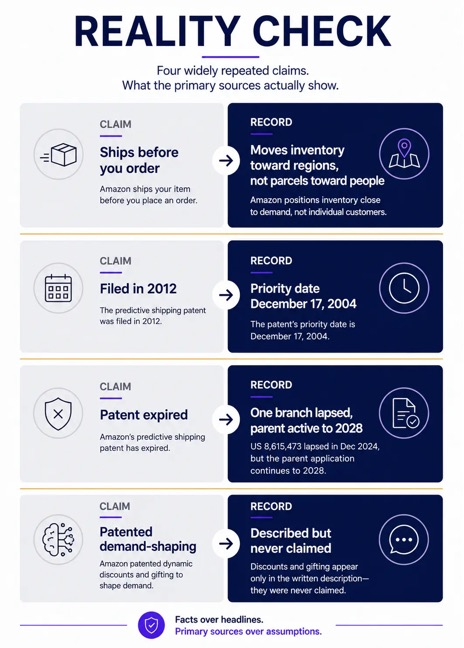
Eight commonly repeated claims about this subject, evaluated against primary sources. The comparisons below are based on publicly available evidence available at the time of publication and may be updated as new verifiable information becomes available.
| Claim | Evidence | Reality |
| Amazon ships products before you order them | Patent granted Dec 2013; no public deployment record | Amazon moves inventory toward regions in advance. There is no public evidence it dispatches individual parcels toward individuals who have not ordered. |
| The patent was filed in 2012 | USPTO record: application 11/015,288 | The priority date is December 17, 2004. The commonly cited patent descends from it. |
| The anticipatory shipping patent has expired | USPTO status for both family members | US 8,615,473 lapsed for unpaid fees. Its parent US 8,086,546 remains active to February 2028. One branch lapsed; the family did not. |
| Amazon patented demand-shaping | All 26 granted claims of US 8,271,398 read in full | No. The discount and gift mechanism appears in the description only. It was disclosed and left unclaimed. |
| The AI knows what you personally will buy | SCOT forecasts product and location across 400M items | The logistics forecast is aggregate. Individual personalization lives in recommendation and assistant surfaces, which are separate systems. |
| Delivery got faster because operations got faster | Amazon’s own public statements | Speed gains come primarily from placing products closer to customers. The picking, packing, and driving work is unchanged. |
| Deep learning was the breakthrough | Amazon Science account of model evolution | Early deep-learning attempts underperformed the incumbent system. The step change came from training on quantile loss — the objective, not the architecture. |
| Consumers demand ever-faster delivery | Metapack, McKinsey, ICSC research, 2026 | Independent research ranks delivery cost above speed, and over 95% of shoppers prefer free standard shipping to paid fast shipping. |
Expert Perspective
Positions stated publicly by named practitioners and researchers. No quotation here is reconstructed or paraphrased beyond recognition.
Ping Xu, forecasting science director within SCOT, has described the team’s growth from ten people with no scientists to close to two hundred, framing the scientific investment as what makes it possible to estimate the variability of future demand accurately enough to keep the store in stock.
Kari Torkkola, a senior principal research scientist who worked on Amazon’s forecasting systems for over a decade, has described the pre-unification architecture as a patchwork that became extremely hard to maintain, and identified the insight behind consolidation: products across unrelated categories often behave alike, so pooling them in one model gains statistical strength.
Ruofeng Wen, an applied scientist on the same team, has noted that hand-engineered features carried an unmeasurable cost — nobody could tell how far from optimal they were, and some were redundant — motivating architectures that learn features directly from sequences.
Tye Brady, chief technologist for Amazon Robotics, frames the robotics program around making work safer, smarter, and more rewarding for frontline employees, and has said publicly that the real story is about people rather than robots.
Andy Jassy, chief executive, told analysts that regionalization had more impact than the company optimistically expected, and that shorter distances and fewer touches produced both lower cost to serve and faster delivery. This remains the strongest corroboration of the regionalization figures available outside Amazon’s own paper, because earnings-call statements carry legal consequence.
Daron Acemoglu, the MIT economist and Nobel laureate, provided the sharpest counterweight, telling The New York Times that nobody else has the same incentive as Amazon to find the way to automate — and warning that once the company works out how to do it profitably, the practice spreads, potentially turning one of the largest American employers into a net destroyer of jobs rather than a creator.
Evidence-Based Analysis: Read together, the practitioners describe an engineering culture that consolidates aggressively and retires its own work without sentiment. The outside economist describes an incentive structure that culture cannot opt out of. Both accounts are credible, and they do not conflict. They describe different layers of the same system.
Editorial Note: Expert opinions quoted in this section represent their publicly stated views and do not necessarily reflect the editorial position of MyMe SuperDigital.
Looking Ahead
The following are future scenarios. None is sourced to Amazon, none is a prediction of record, and each carries a stated trigger a reader can watch for.
The neighborhood becomes the warehouse
The path from two-day to one-hour delivery came from shrinking the radius, not accelerating the vehicle. If Amazon keeps converting delivery stations into stock-holding hybrid hubs, the effective unit of inventory placement becomes the neighborhood rather than the region.
The forecasting problem then becomes granular enough that individual household patterns start to matter — the point at which the 2004 patent’s original intuition finally becomes operationally sensible, arrived at from the opposite direction.
Watch for: hybrid-hub conversions expanding from rural markets into dense urban ones.
Replenishment stops being a decision
Once an assistant holds account memory, tracks prices, and can transact autonomously, routine repurchasing has no obvious reason to remain a conscious act. The plausible next step is standing authority for consumables, where the forecast and the order become the same event.
This would be the first genuine anticipatory purchasing at scale — achieved through consent rather than speculative shipping, and succeeding precisely where the 2004 patent failed.
Watch for: auto-purchase permissions expanding from price-triggered to schedule- or inference-triggered buying, and how prominently the opt-out is presented.
Forecasting becomes a product, not a moat
Amazon has repeatedly converted internal infrastructure into external services; that is the origin story of its cloud business. Demand-forecasting and inventory-placement capability is the most obvious remaining candidate.
If that happens, the competitive question shifts from who has the best model to who has the best data to feed it — consolidating advantage further toward whoever already sees the most transactions.
Watch for: supply-chain forecasting offered as a managed service to third-party sellers and external enterprises.
Counter-scenario: the correction
The failure mode for all three is identical — a demand shock that removes regional diversity, arriving in a network too tightly optimized to absorb it. Systems tuned for a 15 percent distance reduction hold less slack than systems that were not.
The Blue Jay withdrawal is a small, healthy example of the correction mechanism working. The macro version has not been tested.
Frequently Asked Questions
Does Amazon really ship products before you order them?
Not in the way the headlines implied. Amazon moves inventory into regions and local facilities ahead of demand, based on aggregate forecasts. There is no public evidence that it dispatches individual parcels toward individual customers who have not ordered.
How does Amazon deliver in one hour?
By shortening the distance rather than accelerating the work. Regionalization cut the distance between facilities and customers by 15 percent and raised in-region fulfillment from 62 to 76 percent, so the product is already nearby when the order arrives.
What is Amazon SCOT?
Supply Chain Optimization Technologies — the internal organization that forecasts demand for more than 400 million products daily and decides what Amazon buys, in what quantity, and where to place it.
How accurate is Amazon’s demand forecasting?
Amazon has not published an absolute accuracy figure. It has published a relative one: a fifteenfold improvement after moving to a unified deep-learning model trained on quantile loss. Without a disclosed baseline, the magnitude cannot be independently assessed.
When was Amazon’s anticipatory shipping patent filed?
Its priority date is December 17, 2004. The commonly cited patent, US 8,615,473, was granted in December 2013 but descends from that 2004 application. It has since lapsed for unpaid maintenance fees, while its parent remains active until February 2028.
What is the difference between a patent’s description and its claims?
The description explains how an invention might work, often expansively, because attorneys draft broadly. The claims define the legal monopoly and are what the patent office actually grants. Something described but not claimed is disclosed without exclusive rights attached — weak evidence of intent and no evidence of practice.
Does Amazon use my browsing data to decide what to stock near me?
Aggregate behavioral signals inform demand forecasts; individual signals inform recommendations and assistant responses. These are distinct systems. The 2004 patent did explicitly propose using individual purchase history to decide who to offer an in-transit parcel to, so the boundary is a design choice rather than a technical limit.
How many robots does Amazon operate?
More than one million, across over 300 facilities as of 2025. Not every system persists: the Blue Jay platform was withdrawn from operations in February 2026, four months after launch.
Is faster delivery what customers actually want?
Independent 2026 research suggests cost matters more. Delivery cost was named most important by 36 percent of global consumers against 23 percent for speed, and more than 95 percent preferred free standard shipping to paid fast shipping.
What does this mean for smaller retailers?
The competitive gap is not delivery speed but forecast quality combined with network geometry, and neither can be bought outright. The realistic strategies are narrow assortment with deep local knowledge, or renting logistics infrastructure rather than rebuilding it.
Final Thought
There is a version of this story in which a company learns to read minds. It is the version that traveled, and it is wrong.
The real version is quieter and stranger. Amazon looked at the problem of knowing what people want, decided it was unsolvable at the resolution of a single human being, and walked away from it. Then it rebuilt a continent so that it would not need to know.
What replaced mind-reading was geography. Not insight into you, but proximity to you. The system does not understand your desire. It has simply arranged the world so that whatever you happen to want is already a few miles away, waiting, at a price that reflects how much it would cost to take it back.
And that is where the 2004 document becomes uncomfortable rather than merely interesting. Amazon’s engineers understood, two decades before they could act on it, that a speculative supply chain has two variables. One of them is the forecast. The other is you.
They wrote down how to adjust the second when the first came out wrong. They never claimed it. There is no evidence they built it. But twenty-two years later the interface exists anyway — it remembers your household, watches prices on your behalf, and offers to complete the purchase before you have finished deciding whether to make it.
When the goods arrive before the wanting does, and the price adjusts until the wanting appears, how much of the wanting was ever yours?
The honest answer is that nobody knows, including Amazon. That is not a reassurance. It is the reason to keep watching.
Think Further
Five questions this article deliberately leaves open. They are offered for discussion rather than as rhetorical flourishes — each has a defensible answer on both sides.
- If a forecast becomes accurate partly because the price was adjusted to make it accurate, is it still a forecast? And should regulators evaluate it under a different standard than a passive prediction?
- A company that describes an idea in a patent without claiming it has told the world something. But what, exactly? How much weight should any reader place on corporate documents drafted for a purpose other than disclosure?
- Regionalization improved cost and speed together by removing slack. Every efficient system is more fragile than the inefficient one it replaced. Who should decide how much fragility is acceptable in infrastructure a hundred million households depend on?
- Amazon’s largest accuracy gain came from changing what it measured, not from a better model. Think of one number you personally track — grades, income, followers, hours worked. Is it the thing you actually care about, or the thing that was easiest to count?
- If consumers consistently rank delivery cost above delivery speed, why does the entire industry compete hardest on speed? Whose interest does the speed race actually serve?
Which of these five is worth arguing about? Leave your answer in the comments — the best objections tend to arrive from readers, not editors.
Watch the companion documentary
The MyMe SuperDigital video investigation covers the operational story of Amazon’s delivery network. This article extends it with primary-source patent analysis, financial records, and the independent consumer research that complicates the picture.
Continue Exploring This Topic
The AI Infrastructure Revolution: What If AI Needed a New Internet?
Why AI Needs Money: How AI Agents Power the Machine Economy
AI + Human Expertise: The Future of Real Estate Isn’t What Most People Think
Will AI Replace Real Estate Websites? Or Simply Change the First Decision We Make?
About the Author
The MyMe SuperDigital Research Team produces long-form investigations into artificial intelligence and its effects on technology, economics, and society.
The Library follows one working rule: claims are traced to primary documents, or they are labeled as unverified. For this article that meant reading the granted patent claims rather than the press coverage, and disclosing three limitations the research could not resolve.
Questions, corrections, and source challenges are welcome through the contact page. Corrections received are published, not quietly absorbed.
External Resources
Official and primary sources only. Every figure in this article traces to one of the following.
Patent record
• USPTO — US 8,615,473 B2, Method and system for anticipatory package shipping
• USPTO — US 8,086,546 B2, the parent application filed December 17, 2004
• USPTO — US 8,271,398, full granted claims read for this article
Financial filings
• US Securities and Exchange Commission — Amazon.com, Inc. full-year 2025 results
Scientific and academic sources
• Amazon Science — The history of Amazon’s forecasting algorithm
• Amazon Science — A Multi-Horizon Quantile Recurrent Forecaster (2018)
• MQTransformer — Multi-Horizon Forecasts with Context Dependent and Feedback-Aware Attention (2020)
Institutional and independent sources
• MIT News Office — record of Prof. Daron Acemoglu’s remarks, October 21, 2025
• eMarketer — Metapack, Retail Economics, McKinsey and ICSC consumer research, 2026
• Axios — independent coverage of Amazon’s same-day network scale, March 2026
• Supply Chain Dive — earnings-call statements on regionalization and inventory placement
Company sources
• About Amazon — Blue Jay and Project Eluna, including the February 2026 withdrawal update
• About Amazon — One-hour and three-hour delivery launch, March 2026