
| Estimated Reading Time | Last Updated | Category | Companion Documentary |
|---|---|---|---|
| 13 min read | July 2026 | Smart Real Estate & Smart Cities | ▶ Watch Documentary |
For generations, buying a home has started with the same four words: Where should I look?
That question shaped the entire industry. Classified ads became property magazines. Magazines became online marketplaces. Marketplaces became sophisticated platforms holding tens of millions of listings, satellite imagery, price histories, and virtual tours. Each leap made finding faster.
One thing barely moved. People still spend weeks with a dozen browser tabs open, cross-referencing floor plans against school catchments and commute times, quietly worried they’ve missed something better hiding one search away.
Finding information got easier. Making the decision did not.
Artificial intelligence is now pressing on exactly that gap — not by producing more listings, but by changing how people reason about the ones that already exist. Which makes the headline question more interesting than it looks. “Will AI replace real estate websites?” is the easy version. The harder, more useful question is: what happens to a portal when the search no longer happens on the portal?
Prefer watching instead of reading? This article accompanies our documentary exploring how AI may reshape the future of digital real estate.
More Information Rarely Means Better Decisions
The digital era solved real estate’s oldest problem — access. A buyer can tour a hundred homes from a phone before breakfast. On paper, buyers have never been better informed.
In practice, many feel paralysed, and there is decades of research explaining why. In a now-famous 2000 study, psychologists Sheena Iyengar and Mark Lepper set up a tasting booth in a California grocery store. When shoppers were offered 24 jams, 3% bought a jar. When they were offered only 6, roughly 30% did. More choice drew a crowd but produced fewer decisions — the effect Barry Schwartz later popularised as the paradox of choice.
Real estate amplifies this to an extreme, because a home is never chosen on square footage alone. It stands in for schools, careers, safety, community, family plans, and the largest financial commitment most people ever make — all weighed at once, mostly by amateurs doing the analysis themselves. Traditional search engines were built to organise information. They were never built to understand a person. That is the seam AI is working its way into.
Search Is Becoming a Conversation
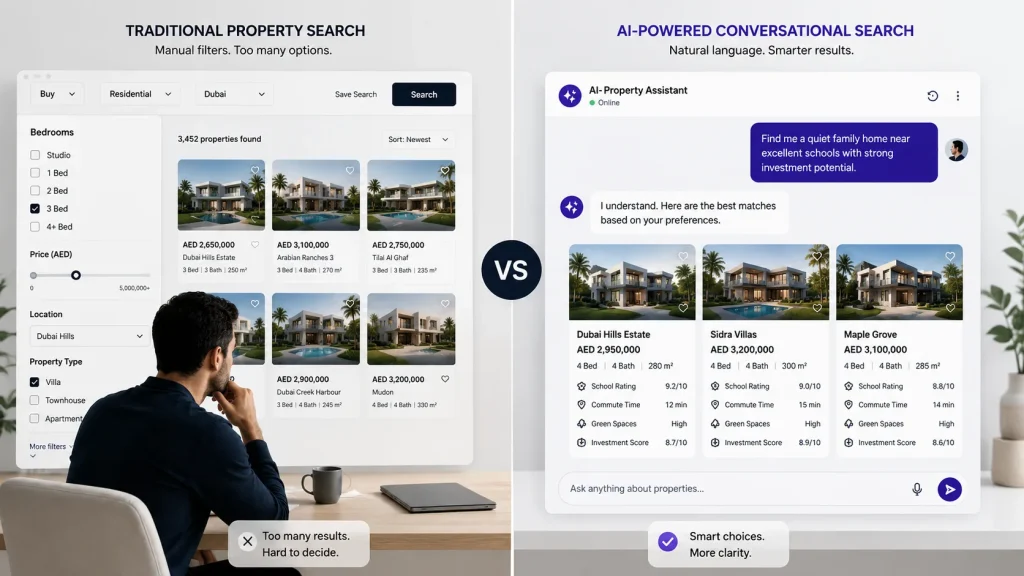
For decades, property search followed one grammar: translate your life into numbers. Minimum bedrooms. Maximum budget. Postcode. Property type. The database filtered accordingly and handed back a grid.
Large language models invert the exchange. Instead of forcing users to compress their priorities into dropdowns, conversational systems let them describe what they actually mean:
“We’re expecting our first child. Somewhere peaceful, near highly rated schools, with room to grow over the next ten years.”
No filter captures that. “Peaceful” has no universal value; neither does “room to grow.” A capable model can hold those soft constraints, connect them to hard data — school-performance reports, transaction histories, noise and green-space metrics, planning applications — and return options that reflect intent rather than isolated keywords. The interaction starts to feel less like querying a database and more like briefing an experienced advisor. That shift is arguably the most significant since listings first moved online.
Integration, Disintermediation, or Both?
It is tempting to assume conversational AI will make today’s websites obsolete. History says transitions rarely erase the layer beneath them — they build on top of it. Streaming didn’t end filmmaking; online banking didn’t end banks; the cloud didn’t end software companies.
Property platforms also hold something a language model cannot conjure: trusted, verified inventory. Listings, professional photography, pricing history, ownership records, agent networks, regulatory compliance, market coverage — assets built over years of investment and relationships. Generative AI has extraordinary reasoning ability and no inventory of its own. So the obvious future is integration: an AI interface sitting on top of the existing databases, portals evolving from searchable directories into decision-support platforms.
But there is a sharper possibility the comfortable “integration” story tends to skip. If a single assistant can query every portal at once and hand the user a synthesised answer, the portals risk becoming interchangeable plumbing — the way aggregators and search once turned many publishers into commodity feeds. The competitive moat quietly moves from who holds the inventory to whose reasoning the buyer trusts. Portals that own only data may find themselves upstream of the relationship with the customer. Portals that own the trusted reasoning layer keep it. The likeliest outcome is a contest over which of those two things becomes the scarce asset — and incumbents will not surrender the customer relationship without a fight.
A cautionary note sits underneath all of this. Owning data is not the same as predicting a market. In November 2021 Zillow — data-rich, brand-dominant, algorithmically confident — shut down its home-buying arm, Zillow Offers, after its pricing models mispriced homes at scale. The company took a write-down of more than $500 million, its home-flipping segment lost roughly $881 million that year, and about 2,000 people — a quarter of staff — lost their jobs. CEO Rich Barton conceded that forecasting home prices had proven far less predictable than expected. The lesson is not that algorithms are useless; it is that they work on averages while homes sell street by street. Any AI layer promising confident valuations inherits that same humility problem.
From Silicon Valley to the Gulf: A Global Shift
The cautionary tales above are largely American, but the transformation is unmistakably global — and in some markets the future is arriving faster than in the ones that invented the technology. The Gulf is a case in point. The UAE’s dominant portals have already crossed the line from filters to conversation: Bayut launched BayutGPT, described as the region’s first conversational property assistant, letting users ask in plain language — “a family-friendly community near the metro with rental yields above 7%” — and receive matched listings with explanations rather than a raw grid. In December 2025, Property Finder rolled out an AI-assisted home-valuation tool that blends models with human review, moving beyond the backward-looking automated valuations of the past.
The regulator is moving too. The Dubai Land Department now pairs its official Mo’asher price index with portal data, and runs AI systems to flag duplicate listings, exaggerated prices, and non-compliant ads — effectively cleaning the data before it reaches the recommendation engines. That is a quietly important model: a government using AI to guarantee the integrity of the inventory that private AI then reasons over, all under the umbrella of Dubai’s Real Estate Strategy 2033 and its ambition to become a global proptech laboratory.
Europe and Asia are on parallel tracks, from Rightmove and idealista to portals across Singapore and India layering language models over verified stock. The direction of travel is the same everywhere; only the pace and the regulatory posture differ. For a global audience, the takeaway is that this is not a distant American experiment — it is already shaping how homes are found in Dubai, Abu Dhabi, and beyond.
The Risks: Hallucination and the Explainability Gap
Every breakthrough imports new responsibilities, and AI depends entirely on the quality of what it is fed. Feed it something incomplete or stale, and the conclusion inherits the flaw.
The most discussed failure mode is hallucination — a model stating something false with total confidence. In real estate that could mean inventing a zoning rule, misreading a planning restriction, or confidently describing infrastructure that doesn’t exist. On a six- or seven-figure decision, a small fabrication is not a small problem.
Then there is transparency. A traditional results page shows you exactly why a listing appeared. An AI recommendation often doesn’t — you receive an excellent suggestion without knowing which factors drove it or which alternatives were silently excluded. As models take on higher-value decisions, explainability becomes as important as accuracy. Trust cannot rest on intelligence alone; it rests on accountability.
Algorithmic Bias Is the Risk With Actual Legal Teeth
The gravest risk in real estate AI is not a hallucinated fact — it is a discriminatory pattern learned from history and applied at scale. Housing is one of the few domains where biased algorithms already carry documented legal consequences, and the cases are recent.
In November 2024 a US federal judge approved a roughly $2.3 million settlement against SafeRent Solutions, whose tenant-screening algorithm was alleged to assign disproportionately low scores to Black and Hispanic applicants and to housing-voucher holders — partly by leaning on credit data while ignoring the voucher’s value. The suit invoked the federal Fair Housing Act; the US Department of Justice had filed a supporting brief. As part of the settlement, SafeRent agreed to stop using its score to evaluate certain voucher applicants at all.
It is not an isolated case. The Justice Department settled a landmark matter with Meta in 2022 — originating in a 2019 HUD complaint — over ad-delivery systems that let housing ads be targeted in discriminatory ways, forcing Meta to rebuild how those ads are served. In 2024, the DOJ sued the property-software firm RealPage over algorithmic rent-pricing tools alleged to inflate rents across markets.
The through-line is simple and uncomfortable: an algorithm need not be told to discriminate. As one plaintiff’s attorney in the SafeRent case put it, data that merely correlates with race can produce the same effect as an instruction to discriminate. A property assistant trained on decades of housing data — data shaped by redlining, appraisal gaps, and exclusion — can quietly reproduce those patterns while appearing perfectly neutral. Any serious deployment has to be tested for disparate impact, not just accuracy, and the industry that ignores this will meet it in court.
Data Privacy May Be the Defining Battleground
Genuine personalisation needs context, and a lot of it: not only budget and neighbourhood, but family size, work routines, commuting patterns, schooling plans, financial goals, even future aspirations. That depth is what makes the convenience remarkable — and what makes the privacy questions urgent.
Who stores that intimate profile? How long is it kept? Can it be sold or shared? How is it secured against breach? These questions now run through every industry adopting generative AI, but real estate combines financial records and family detail in a way few others do. The companies that earn durable trust may not be those with the cleverest model, but those with the clearest governance, the strongest security, and the most honest account of what happens to a user’s data.
Will AI Replace Real Estate Agents?
The prediction is common; the reality is more nuanced. Technology has historically automated the repetitive and raised the value of human judgment, negotiation, and trust.
Home-buying is stubbornly human. Families reject the statistically “optimal” property because it doesn’t feel right. Investors back a neighbourhood on conviction about its future, not its current numbers. A skilled agent reads emotion, local culture, negotiation dynamics, and soft market signals that rarely appear in a dataset.
AI can prepare the information, compare alternatives, and translate a contract into plain language. It cannot supply the reassurance of walking a property with someone who knows the street, or the confidence of a professional who shares responsibility for the decision. The future is unlikely to belong to AI alone — it will belong to the professionals who use AI best.
What Could Buying a Home Look Like by 2035?
Imagine opening a search with a conversation instead of a filter. You state your goals once. An assistant then monitors the market continuously, flags suitable opportunities as they appear, compares financing options, summarises legal documents, schedules viewings, and surfaces risks before you think to ask.
Instead of you chasing listings across five websites, the search follows you. As your circumstances change, the recommendations change with them. Platforms feel less like catalogues and more like long-term advisors.
Whether that arrives depends on far more than model quality. It needs reliable data, responsible governance, transparent regulation, and public trust. Technology alone never transforms an industry — the surrounding ecosystem decides how far it gets.
A Smarter Future, Not a Different Industry

The most disruptive technologies rarely delete what came before. They reset expectations. Buyers once accepted travelling between agencies; then they expected online listings; then virtual tours. Tomorrow they may expect intelligent guidance — which feels less like revolution than the next turn of a long evolution.
Real estate websites probably won’t vanish. They may instead become almost invisible — operating quietly beneath conversational interfaces that help people understand a complex decision rather than merely display options. The greatest value of AI here may not be finding more properties. It may be helping people find the right one with more confidence, less uncertainty, and a clearer view of the trade-offs in front of them.
Technology changes remarkably fast. Trust does not. The future of real estate will depend on holding both at once.
The first generation of property websites helped us find homes. The next generation may help us understand which home truly fits our lives. That is a far more profound transformation than replacing a website — and a far more human one.
Key Takeaways
- The bottleneck moved. Digital portals solved access to listings; they never solved decision-making. AI is aimed squarely at that gap — the decision fatigue that too much choice creates.
- Search is becoming a conversation. Language models let buyers describe intent (“peaceful, near good schools, room to grow”) instead of translating their lives into dropdown filters.
- Replacement is the wrong frame. Portals own verified inventory and market trust that models can’t generate. The real contest is over who owns the trusted reasoning layer — and whether AI disintermediates portals or upgrades them.
- It’s already global. BayutGPT, Property Finder’s AI valuation, and the Dubai Land Department’s AI governance show the Gulf moving faster than the markets that built the technology.
- The biggest risk has legal teeth. Algorithmic bias — as in the 2024 SafeRent fair-housing settlement — matters more than hallucination or privacy because it already carries real consequences. Even data giants like Zillow proved that owning data isn’t the same as predicting a market.
- Humans stay central. AI prepares information and explains contracts; negotiation, local judgment, and shared accountability remain human. The future belongs to professionals who use AI well.
Related reading: Is Hudayriyat Island Really a Smart City? — how the UAE’s smart-city ambitions connect to the data ecosystems this shift depends on.
Frequently Asked Questions
Will AI completely replace property websites?
Probably not outright — portals own verified inventory, agency relationships, and market data that models cannot generate. The real contest is subtler: whoever owns the trusted reasoning layer between buyers and that data may capture the customer relationship, which is why incumbents are racing to build AI into their own platforms rather than cede the front door.
Can AI recommend better properties than traditional filters?
In some cases, AI can produce more personalised property recommendations than traditional filters by interpreting natural language and connecting patterns across multiple datasets. However, the quality of those recommendations depends heavily on the underlying data and system design, and AI can still present inaccurate conclusions with misleading confidence.
Could AI replace real estate agents?
It will automate research, document analysis, and comparison. Negotiation, local knowledge, emotional judgment, and shared accountability remain human — and arguably become more valuable as the routine work disappears.
What’s the single biggest risk?
Algorithmic bias, because it already carries legal consequences. Fair-housing cases such as the 2024 SafeRent settlement show that discriminatory patterns learned from historical data can violate the law even when no one intended them. Accuracy, transparency, and data privacy sit close behind.
MyMe SuperDigital Perspective
Artificial intelligence should be judged not by how many tasks it automates, but by whether it helps people decide better. Real estate has always run on information, trust, and human judgment. AI can strengthen all three — but only if it stays transparent, accountable, testable for bias, and firmly centred on the people it is built to serve.
Continue Exploring This Topic
- AI + Human Expertise: The Future of Real Estate Isn’t What Most People Think
- Is Hudayriyat Island Really a Smart City?
- Inside Amazon’s AI Forecasting System
- Why AI Needs Money: How AI Agents Power the Machine Economy
References
- Iyengar, S. & Lepper, M. (2000), “When Choice is Demotivating” — the jam-tasting study on choice overload (Journal of Personality and Social Psychology)
- Schwartz, B. (2004), The Paradox of Choice
- Zillow shuts home-buying business, ~2,000 layoffs and >$500M write-down (Nov 2021) — GeekWire
- Louis v. SafeRent Solutions — 2024 Fair Housing Act settlement (~$2.3M) — Fortune · Cohen Milstein
- Meta (2022 DOJ settlement, from a 2019 HUD complaint) and RealPage (2024 DOJ action) — context via American Bar Association · eWeek
- BayutGPT conversational property assistant and TruEstimate™ valuation — Bayut
- Property Finder AI home valuation (Dec 2025), Dubai Land Department AI governance, and Dubai Real Estate Strategy 2033 — AI Gents Realty analysis
- UAE PropTech market context (Property Finder, Bayut, Huspy as commercialization hub) — Dubai Future District Fund
- National Association of REALTORS® (NAR); MIT Center for Real Estate; McKinsey & Company; Deloitte Insights; World Economic Forum; Stanford Institute for Human-Centered AI (HAI) — general PropTech and generative-AI context
Source Note
This article combines publicly available research on artificial intelligence, digital property platforms, and PropTech trends with specific, documented legal and market cases cited above. Forward-looking scenarios represent evidence-based analysis of current developments, not confirmed product roadmaps.