| Estimated Reading Time | Last Updated | Category | Companion Analysis |
|---|---|---|---|
| 11 min read | July, 2026 | AI Economy & Digital Finance | Available ▶ |
In a single year, the cryptocurrency market can erase more than $2 trillion in value — a sum comparable to the entire annual output of a major national economy. It happened in 2022, when the collapse of Terra/LUNA, the freezing of lenders like Celsius, and the implosion of the FTX exchange turned a routine correction into a full-blown crypto winter. And it happened again: after peaking above $4 trillion in late 2025, the market shed roughly $2 trillion once more in the months that followed.
For institutions, those swings are line items. For ordinary investors, they are years of savings vanishing in days.
Now a new force has entered the equation: artificial intelligence.
Supporters believe AI can finally make crypto markets more efficient, more rational, and less emotional. But there is another possibility — that instead of preventing bubbles, AI is quietly learning to build them larger and faster than any human crowd ever could.
The real question is no longer whether AI can predict the market. The question is whether AI is changing the market itself.
Watch the full breakdown (video):
The diagrams in this article — the “smart bubble” cycle and the herd-behavior model — are visualized step by step in the video.
How AI Is Already Changing Cryptocurrency
Artificial intelligence is no longer an experimental add-on in digital finance. It already shapes how the market moves, in three distinct ways.
1. High-Frequency Algorithmic Trading. AI systems execute buy and sell orders in fractions of a second, reacting to price signals at speeds no human trader could ever match. In a 24/7 market that never closes, machines don’t sleep — and increasingly, they don’t wait for humans either.
2. Sentiment Analysis. Machine-learning models scan millions of social-media posts, news articles, and forum threads to estimate the mood around assets like Bitcoin and Ethereum. The premise is simple: if you can measure crowd emotion before it moves the price, you can trade ahead of it.
3. AI-Powered Blockchain Projects. A newer wave of projects is hard-wiring AI directly into blockchains — automating smart contracts, powering decentralized data marketplaces, and, most recently, deploying autonomous AI agents that trade on-chain without a human clicking the button.
Together, these technologies promise faster decisions, greater efficiency, and lower human error.
At least in theory.
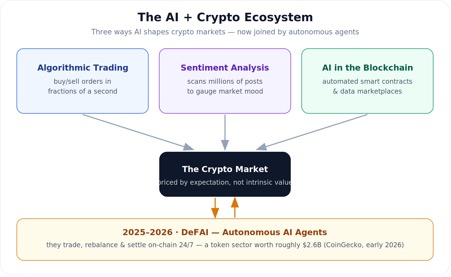
The AI + crypto ecosystem: three ways AI shapes crypto markets, now joined by a DeFAI layer of autonomous agents.
The Hidden Problem Nobody Talks About
Here is the flaw buried inside the optimism: AI can analyze enormous amounts of market data, but it cannot independently determine an asset’s fundamental value when that value itself is contested or driven heavily by expectations and narratives.
That distinction matters.
Traditional assets usually have measurable fundamentals — earnings, cash flow, dividends, physical output. You can argue about the multiple, but there is something underneath the price. Cryptocurrencies are different. Their prices are driven overwhelmingly by expectations, narratives, adoption, and investor psychology — by what people believe other people will pay tomorrow.
In other words, AI is being asked to calculate the value of something that humans themselves cannot objectively define. Processing massive amounts of data is not the same as uncovering the truth of what an asset is worth. A model can measure sentiment with stunning precision and still be measuring nothing more than collective mood.
The “Smart Bubble”: When Predictions Create Reality
This is where AI stops being a neutral observer and becomes a participant. Follow the loop:
- The prediction. An AI model analyzes market data and forecasts that Bitcoin is about to rise.
- The capital. Thousands of investors trust the algorithm and start buying to catch the expected upswing.
- The self-fulfilling prophecy. That sudden influx of real money actually pushes the price up — appearing to validate the AI’s guess.
- The second wave. The system broadcasts its “successful” call. Media coverage grows, confidence spreads, and a larger wave of investors piles in, swelling the market into a fragile bubble.
- The reversal. Eventually the math stretches too far. The same AI detects weakening momentum and begins to sell.
- The cascade. Other AI systems reading similar signals detect the same weakness. Within seconds, automated selling accelerates the collapse.
The market crashes — not because AI predicted reality, but because AI helped create it. The model didn’t forecast the bubble so much as construct it, then detonate it, turning the confidence of everyone who trusted the prediction into the fuel for their own losses.
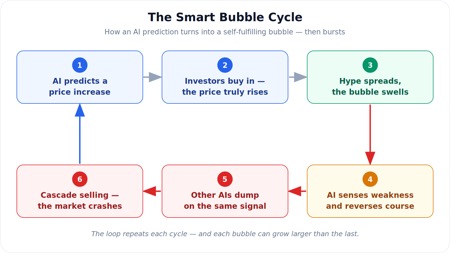
The Smart Bubble cycle: a prediction attracts capital, the price validates it, the bubble swells — then the AI reverses and the market crashes, and the loop repeats larger.
The Rise of Algorithmic Herd Behavior
The greatest systemic risk isn’t necessarily a single rogue AI. It may emerge when many automated systems respond to the same market signals at roughly the same time.
When trading systems rely on overlapping datasets, indicators, and strategies, they can respond to market conditions in similar ways and within very short time windows. Instead of necessarily dampening volatility, widespread automated reactions can amplify price movements when many systems move in the same direction.
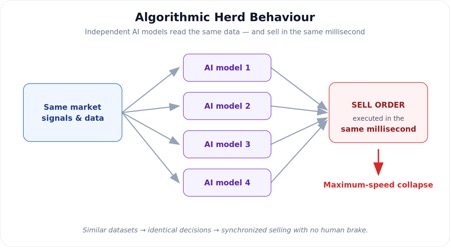
Algorithmic herd behaviour: independent models read the same data and sell in the same millisecond, producing a maximum-speed collapse.
Consider the crucial difference in tempo:
- Human panic spreads gradually. Fear passes through phone calls, headlines, and hesitation. That friction acts as a natural brake on a crash.
- Algorithmic panic spreads instantly. There is no hesitation, no brake — only code executing in unison.
Economists increasingly describe this as algorithmic herd behavior: a scenario in which automation removes the human cushion that once slowed collapses, effectively guaranteeing maximum speed on the way down.
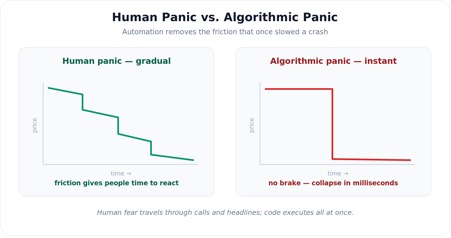
Human panic declines gradually with natural friction; algorithmic panic drops instantly, like a cliff with no brake.
Can AI Really Know What Bitcoin Is Worth?
To see why these models are on shaky ground, look at how little agreement exists about the asset they’re pricing.
Crypto delivered some genuine technical wins — cheaper cross-border transfers, functional smart contracts, and settlement that doesn’t require a traditional intermediary. But it fell short on other core promises: it never achieved day-to-day price stability, and it has not shielded small investors from the large institutional holders (the “whales”) who still dominate many markets.
That mixed record has produced a fierce, unresolved debate about Bitcoin’s very identity:
- The “failed currency” view. Some economists argue Bitcoin failed its original purpose because you still can’t easily buy groceries with it. Everyday spending remains marginal.
- The “digital gold” view. Advocates counter that Bitcoin was never meant to replace cash — it’s a scarce store of value designed to protect wealth against inflation, more comparable to gold than to a dollar.
If the world’s top economists cannot agree on what Bitcoin is for, can any AI model accurately calculate its long-term value? Almost certainly not. AI can estimate probabilities. It cannot resolve a philosophical disagreement about worth.
AI Doesn’t Remove Human Psychology — It Amplifies It
The most seductive claim about AI investing is that it removes emotion. In practice, it often relocates emotion rather than eliminating it.
When investors stop doing independent analysis and start trusting the algorithm, their faith doesn’t disappear — it concentrates. And when enough people follow the same AI recommendations, the market becomes increasingly dependent on machine-generated confidence. The technology is new; the herd instinct is ancient. We’ve simply handed it a faster engine.
The 2026 Reality: When the Traders Are No Longer Human
What changed in 2025–2026 was not the existence of automated trading itself, but the growing role of autonomous AI agents capable of interacting directly with on-chain financial infrastructure.
A new category emerged that the industry calls DeFAI — the fusion of decentralized finance (DeFi) and AI. Instead of a human watching a chart, autonomous AI agents now execute swaps, manage yield strategies, rebalance portfolios, and settle transactions with other agents, around the clock, without continuous human input. By early 2026, tokens tied to this sector traded with a combined market capitalization of roughly $2.6 billion, according to CoinGecko data cited by industry trackers.
Several developments made this possible:
- Agent frameworks matured. Open-source systems like ElizaOS and Autonolas, and agent-economy platforms like Virtuals Protocol, made it far easier to build and deploy autonomous traders.
- Wallets learned to delegate. Ethereum’s EIP-7702 upgrade and “session keys” let a user grant an agent temporary, tightly scoped permission to transact — execute one trade, then the permission expires — without ever handing over the private key.
- Infrastructure tokens attracted capital. Networks and projects positioned as the “compute layer” for agents — such as Bittensor (TAO), NEAR, and the Artificial Superintelligence Alliance (FET) — drew growing institutional interest.
The upside is real: agents can hunt arbitrage across dozens of blockchains, compound yield hourly, and act on new information faster than any person.
But the risks in this article stop being purely hypothetical. As autonomous agents gain permission to interact with wallets, protocols, and persistent memory, the attack surface expands: compromised credentials, poisoned memory, manipulated inputs, insecure integrations, or excessive permissions can turn software failures into financial risk. The “smart bubble” dynamic adds another dimension. AI agents can also influence human market behaviour through the narratives they generate and amplify—as the Truth Terminal and GOAT episode demonstrated, when the agent’s online activity helped propel attention around a memecoin that subsequently reached a substantial market valuation. As these systems become more autonomous, they also raise a difficult accountability question: when an agent initiates a harmful financial action, responsibility ultimately has to be traced back through the humans, organisations, permissions, and infrastructure behind it.
The Human Cost, in One Sentence
Strip away the diagrams and the jargon, and this is what the risk looks like on the ground: an ordinary investor losing three years of life savings in a single week — someone who followed the algorithm’s buy signals, trusting the math to time the market better than any human could.
A line of code executes coldly and silently. The financial ruin it leaves behind is anything but.
The Future of AI and Digital Finance
Artificial intelligence will almost certainly become a permanent fixture of cryptocurrency markets. Trading will get faster. Automation will deepen. Analysis will sharpen.
But intelligence alone does not eliminate uncertainty. Financial markets are, at bottom, social systems — they run on trust, expectations, regulation, and human decisions. AI can optimize those systems. It cannot replace them.
MyMe SuperDigital Perspective
The next crypto bubble may not be created by human greed alone. It may emerge from millions of AI agents negotiating, trading, and reacting to one another faster than any regulator — or investor — can follow. The question is no longer whether AI participates in markets. It is whether markets will slowly become ecosystems in which humans are merely observers.
Perhaps the greatest danger isn’t that AI makes bad predictions. It’s that millions of people may believe those predictions without ever questioning them.
Technology can process information faster than any human. But it still cannot answer one timeless question:
What is something truly worth?
Until that question has a universally accepted answer, AI may keep making cryptocurrency markets smarter — while simultaneously making their bubbles bigger.
So the next time you follow an AI’s investment advice, ask yourself honestly: are you buying a well-researched financial asset — or are you buying blind trust in a machine that doesn’t understand true value either?
Frequently Asked Questions
Can AI predict cryptocurrency prices?
AI can identify statistical patterns and market signals, but it cannot reliably predict future prices. Cryptocurrency markets are largely speculative and driven by human expectations, so a model can measure sentiment accurately and still be wrong about value.
Does AI reduce crypto market volatility?
Not necessarily. In some cases AI-driven trading increases volatility, because many algorithms respond to the same signals at the same moment — a pattern known as algorithmic herd behavior.
What is DeFAI?
DeFAI is the combination of decentralized finance (DeFi) and AI, in which autonomous AI agents trade, manage yield, and rebalance portfolios on-chain without continuous human input. It emerged as a distinct crypto sector through 2025–2026.
Is AI replacing human investors?
Increasingly it automates execution, but it does not replace judgment. Sound investing still requires human risk management and an understanding of broader economic conditions that models cannot supply.
Is AI good for blockchain?
It can improve automation, fraud detection, smart contracts, and overall efficiency. But it cannot eliminate market uncertainty or investment risk — and autonomous agents introduce new security risks of their own.
What was the 2022 crypto crash?
Over 2022, the total crypto market lost a little over $2 trillion, falling from a peak near $3 trillion in late 2021 to under $1 trillion, driven by the Terra/LUNA collapse, failures of lenders like Celsius, and the bankruptcy of the FTX exchange.
Continue Exploring This Topic
- Why AI Won’t Choose Just One Blockchain
- Why AI Needs Money: How AI Agents Power the Machine Economy
- The AI Infrastructure Revolution: What If AI Needed a New Internet?
- The Missing Economy Behind Physical AI: Who Pays to Teach Robots?
References
- CNBC — Bitcoin lost over 60% of its value in 2022 (the ~$2 trillion crash): cnbc.com
- Newsweek — Crypto crash deepens: $2 trillion wiped from market (2025–2026): newsweek.com
- RZLT — DeFAI in 2026: What AI Agents in Decentralized Finance Actually Are (~$2.6B sector figure via CoinGecko): rzlt.io
- Ethereum — EIP-7702: Set Code for EOAs, official specification: eips.ethereum.org
- CoinGecko — What Is Goatseus Maximus (GOAT)? on the “Truth Terminal” AI agent: coingecko.com
Disclaimer:This article is for educational purposes only and is not financial advice. Cryptocurrency is a highly volatile, speculative asset. Never invest more than you are willing to lose, and consult a qualified financial professional before making investment decisions.