
| Estimated Reading Time | Last Updated | Category | Companion Documentary |
|---|---|---|---|
| 6 min read | July 2026 | AI Economy & Digital Finance | ▶ Watch Documentary |
Artificial intelligence is becoming smarter every year—but what if intelligence is no longer the biggest challenge? What if the future of AI depends on the infrastructure that powers it?
Watch the Companion Documentary
Explore the concepts discussed in this article through the companion documentary on YouTube.
Artificial intelligence has become a competition of models.
Every few months, a new system captures global attention. OpenAI releases a more capable GPT model. Google introduces a new version of Gemini. Anthropic improves Claude. Meta expands the Llama family. Headlines compare benchmarks, reasoning abilities, and coding performance as if the future of AI depends solely on which model is smarter.
But while the world debates intelligence, something far more fundamental is happening behind the scenes.
Artificial intelligence is placing rapidly growing demands on the infrastructure that powers it.
The intelligence we interact with is only the visible layer. The real engine of artificial intelligence is infrastructure.
As AI becomes more capable, infrastructure is becoming an increasingly significant challenge for the industry. Training frontier models requires enormous amounts of computing power, while deploying AI to millions of users demands continuous access to GPUs, networking, storage, and energy.
This raises an important question:
What happens if artificial intelligence grows faster than the infrastructure designed to support it?
AI Has a Scaling Problem
AI can scale by adding computing resources, but modern AI workloads place unusually intensive demands on specialized hardware, networking, memory, storage, and energy.
Modern AI systems require specialized hardware, massive GPU clusters, enormous energy consumption, and high-speed networking. Training a frontier model may take thousands of GPUs operating continuously for weeks or months.
The next generation of autonomous AI agents will increase these demands even further, creating one of the largest infrastructure challenges the technology industry has ever faced.
The Hidden Concentration Behind Modern AI
Although AI feels decentralized to users, much of its underlying infrastructure is concentrated among a handful of hyperscale providers.
Amazon Web Services, Microsoft Azure, Google Cloud, and NVIDIA collectively provide much of the cloud capacity and computing power that modern AI depends on.
Their infrastructure has enabled today’s AI revolution. Yet increasing dependence on a small number of providers raises an architectural question:
Can the next generation of AI continue scaling if computing resources remain highly concentrated?
Why Blockchain Suddenly Makes Sense
Blockchain is often associated with cryptocurrencies, while artificial intelligence is associated with machine learning.
Viewed through the lens of infrastructure, however, blockchain solves a different problem.
Blockchain-based networks can provide coordination, incentive, and settlement mechanisms that allow independent participants to contribute and exchange computing resources without relying entirely on a single intermediary.
Instead of replacing today’s cloud providers, decentralized infrastructure seeks to create an additional marketplace where computing power, storage, GPUs, and AI services can be shared globally.
From Infrastructure to Intelligence
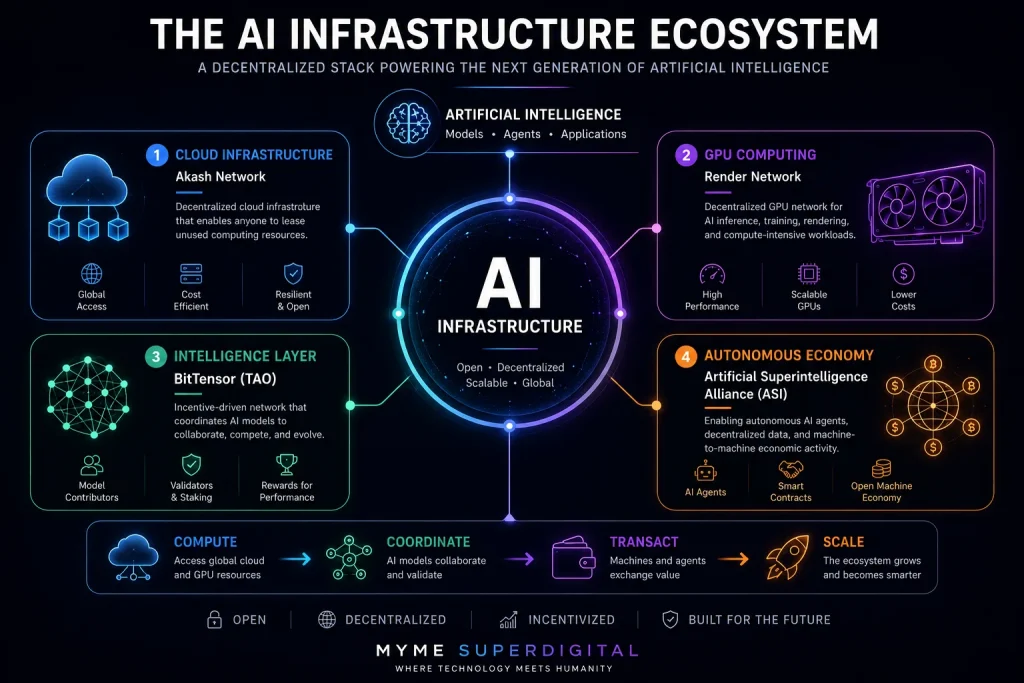
Supporters of decentralized AI believe artificial intelligence will eventually require multiple infrastructure layers working together.
Rather than one project solving every problem, different networks may specialize in cloud computing, GPU resources, intelligence coordination, and autonomous economic activity.
Together these layers form what could become an AI infrastructure stack.
Layer One: Expanding the Cloud Beyond Traditional Data Centers
Projects such as Akash Network attempt to create decentralized cloud marketplaces by allowing organizations and individuals to lease unused computing resources.
Instead of building entirely new data centers, existing infrastructure can become available to developers around the world.
The concept resembles Airbnb—connecting existing resources rather than constructing new ones.
Layer Two: The Real Fuel of AI Is Computing Power
Cloud infrastructure alone is not enough.
Artificial intelligence runs on GPUs.
Projects such as Render Network aim to provide decentralized GPU computing capable of supporting AI inference, machine learning, rendering, and other computational workloads.
Together, cloud marketplaces and GPU networks focus on one objective:
Expanding global computing capacity.
Layer Three: Intelligence Needs Coordination
Infrastructure does not create intelligence by itself.
Different AI models specialize in different tasks, requiring mechanisms for coordination.
Bittensor (TAO) introduces an incentive-driven machine learning network where specialized AI models contribute knowledge, validators assess performance, and contributors receive rewards based on the value they provide.
Rather than one universal model, intelligence becomes a distributed ecosystem.
Layer Four: When AI Becomes an Economy
Future AI agents may negotiate contracts, purchase computing power, exchange data, and collaborate without human supervision.
Such systems require an economic layer.
The Artificial Superintelligence Alliance (ASI) seeks to create an ecosystem where autonomous agents, decentralized data, and AI services interact through an open machine economy.
Instead of simply generating intelligence, AI begins participating in economic activity.
Putting the Pieces Together
| Layer | Example | Primary Purpose |
|---|---|---|
| Cloud Infrastructure | Akash | Distributed cloud computing |
| GPU Computing | Render | Decentralized GPU computing |
| Intelligence | Bittensor | AI coordination |
| Autonomous Economy | ASI | Autonomous AI agents |
Can This Architecture Compete with Big Tech?
Decentralized infrastructure should not currently be viewed as a replacement for hyperscale cloud providers.
AWS, Microsoft Azure, and Google Cloud continue to offer unmatched reliability, security, compliance, and global scale.
A more realistic future is coexistence, where decentralized infrastructure complements traditional cloud providers by expanding computing capacity and enabling new AI-native economic interactions.
The Bigger Question
The most important question is not whether one project will outperform another.
The real question is whether artificial intelligence can continue growing while relying primarily on centralized infrastructure.
History suggests that every technological revolution eventually evolves beyond its original architecture.
Artificial intelligence may now be approaching that transition.
Key Takeaways
- AI’s next bottleneck may be infrastructure rather than algorithms.
- Decentralized AI is an architectural approach, not a replacement for cloud computing.
- Akash, Render, Bittensor, and ASI solve different infrastructure layers.
- Centralized and decentralized systems are likely to coexist.
- The future AI economy may depend on globally distributed computing resources.
MyMe SuperDigital Perspective
At MyMe SuperDigital, we view decentralized AI infrastructure as an architectural discussion rather than a competition between blockchain projects and hyperscale cloud providers.
History shows that transformative technologies rarely replace existing systems overnight. Instead, new architectures emerge alongside established ones, expanding capabilities rather than eliminating them.
Whether decentralized AI becomes mainstream remains uncertain. However, the ideas it introduces—distributed computing, open AI marketplaces, machine-to-machine payments, and autonomous collaboration—are already influencing how the next generation of intelligent systems is being designed.
Understanding these architectural shifts today is more valuable than predicting which individual project may dominate tomorrow.
Frequently Asked Questions
What is decentralized AI infrastructure?
It distributes computing resources across independent participants instead of relying entirely on centralized cloud providers.
Why does AI require so much computing power?
Modern AI models perform billions of calculations every second, making GPUs, networking, storage, and energy essential.
Why are blockchain and AI becoming connected?
Blockchain enables decentralized coordination, incentives, trust, and machine-to-machine payments for distributed AI systems.
What role does Akash Network play?
It provides a decentralized cloud marketplace for unused computing resources.
How is Render Network different?
Render focuses on decentralized GPU computing for AI and compute-intensive workloads.
What makes Bittensor unique?
It creates an incentive-driven ecosystem where specialized AI models collaborate and compete.
What is the Artificial Superintelligence Alliance (ASI)?
An alliance focused on enabling autonomous AI agents, decentralized data, and machine-to-machine economic activity.
Will decentralized AI replace AWS, Azure, or Google Cloud?
Most likely not. The more probable outcome is coexistence between centralized and decentralized infrastructure.
Continue Exploring This Topic
- The Missing Economy Behind Physical AI: Who Pays to Teach Robots?
- Why AI Needs Money: How AI Agents Power the Machine Economy
- Why AI Won’t Choose Just One Blockchain
- Crypto & AI: Financial Revolution or the World’s Smartest Bubble?
References
- Akash Network. Official Documentation. https://akash.network/docs/
- Bittensor. Official Documentation. https://docs.learnbittensor.org/
- Render Network. Official Documentation. https://docs.rendernetwork.com/
- Artificial Superintelligence Alliance (ASI). Official Website. https://superintelligence.io/
- NVIDIA. AI Enterprise Documentation. https://docs.nvidia.com/ai-enterprise/
- Amazon Web Services (AWS). Artificial Intelligence. https://aws.amazon.com/ai/
- Google Cloud. AI Infrastructure. https://cloud.google.com/ai
- Microsoft Azure. Azure AI Services. https://azure.microsoft.com/products/ai-services
Research & Industry Reports
- Stanford University. AI Index Report 2025.
- McKinsey & Company. The State of AI (latest available edition).
- Deloitte Insights. AI Infrastructure and related research publications.
Disclaimer
This article is intended for educational and informational purposes only. It does not constitute financial, investment, legal, or professional advice.
The projects discussed are referenced solely to explain emerging approaches to AI infrastructure and should not be interpreted as endorsements or investment recommendations. Artificial intelligence and decentralized computing continue to evolve rapidly, and readers should consult official documentation and conduct independent research before making technical, business, or investment decisions.