Artificial Intelligence Is Changing More Than the Classroom — It Is Changing What “Being Educated” Means
| Reading Time | Last Updated | Category | Companion Video |
| 14 min read | August, 2026 | Education | Available ▶ |
For over a century, education rewarded people for what they knew. Artificial intelligence is quietly rewarding something entirely different. The promise of AI in education is real — and so is the disruption most schools are not yet built to absorb. Here is what is actually shifting beneath the surface.
Watch the Companion Video
This article accompanies the short explainer *The AI Education Paradox: What Schools Aren’t Ready For*, which traces how a simple homework tool sets off a chain reaction that reaches all the way into the labour market — with the frameworks, data, and caveats behind the argument.
For a hundred years, education has behaved like an assembly line: stamp in the facts, ship out the student. The paradox of AI is that it makes information more accessible than ever — while quietly draining the value of simply owning it.
An Education System Built for a World That No Longer Exists
Artificial intelligence is already part of everyday learning. Students use it to research topics, draft essays, solve mathematical problems, write code, and get instant explanations that once cost hours of study. Teachers, in turn, are testing AI for lesson planning, automated grading, and personalised learning platforms. The public debate that followed has fixed almost entirely on plagiarism, academic integrity, and whether teachers will be replaced.
Those are real questions. But they all sit inside the classroom, and they miss a larger one: what happens when artificial intelligence changes the value of education itself?
For more than a century, schools have run on a familiar model. Students attend classes, absorb information, complete assignments, and prove what they learned through examinations. That system was designed during an industrial era that rewarded standardised knowledge and predictable skills — where success depended largely on acquiring information and applying it consistently across a career.
AI challenges that foundation directly. Today’s systems retrieve facts, summarise books, generate reports, write software, and translate languages in seconds. As those capabilities improve, knowledge alone stops being a durable advantage. Remembering things still matters — but it is no longer the defining trait of an educated person.
This is the AI education paradox: technology is making information more accessible than ever, while simultaneously lowering the economic value of merely possessing it. As machines take over routine intellectual tasks, human value shifts toward what they struggle to replicate — judgment, creativity, collaboration, ethical reasoning, and the ability to connect ideas across disciplines. The real challenge for schools is not adopting AI tools. It is preparing students for a world where intelligence is shared between humans and machines.
| KEY TAKEAWAYS AI is changing more than classroom technology — it is changing the skills society rewards.The value of memorising information is falling; the value of interpreting, applying, and connecting it is rising.The World Economic Forum estimates 39% of workers’ core skills will change by 2030, with analytical thinking, resilience, creativity, and systems thinking among the fastest-rising.AI works best as a learning partner, not a replacement for learning — the goal is to build capabilities machines cannot easily copy.This is not the end of teachers or of foundational knowledge. It is a shift in priorities: from delivering information to developing adaptable, thoughtful, ethical learners. |
Looking Beyond AI Tutors
Most conversations about AI in schools concentrate on the visible applications: personalised AI tutors, adaptive platforms that adjust to each learner’s pace, automated grading, instant feedback. These are genuinely useful. But they are only the surface layer of a much deeper transformation — and focusing on them alone risks missing the bigger change taking place across society.
Technology never exists in isolation. Every major technological shift changes human behaviour, then economic incentives, then entire labour markets. Education is no exception. AI is not simply another digital tool bolted onto existing classrooms; it is reshaping the very environment that education was designed to serve.
That wider view reframes the whole debate. The argument over whether students should use AI largely misses the point — they already do, and so does the workforce they are heading into. The sharper question is whether educational systems are evolving fast enough to prepare students for an economy where AI is a permanent partner in knowledge work.
| MYME INSIGHT Never analyse a classroom tool in isolation. Change the tools, and you change behaviour; change behaviour, and you eventually change labour markets and society itself. A homework bot is never just a homework bot. |
The Three Stages of Educational Transformation
The impact of AI on education is not a single event. It unfolds as a chain of connected stages, each triggering the next — and the later stages matter far more than the one making headlines today.
Stage One — Automation of Routine Tasks
This is the most visible stage. Students generate written content, organise research, and solve technical problems with AI; teachers streamline planning, assessment, and admin. It dominates public discussion because it is already everywhere.
Stage Two — A Shift in Student Incentives
Quieter, but more consequential. When a machine can produce a well-structured essay or solve an equation in seconds, learners naturally reconsider where their effort is best spent. Motivation drifts toward skills that stay uniquely human. AI doesn’t just change the answers students get — it changes the why of learning in the first place.
Stage Three — Structural Change in the Labour Market
This reaches beyond education entirely. As new graduates arrive with different capabilities, employers adjust expectations. Critical thinking, interdisciplinary problem-solving, communication, and strategic judgment rise in value, while routine knowledge-based tasks keep declining. Over time, this becomes a feedback loop that reshapes economic priorities and, ultimately, the shape of society.
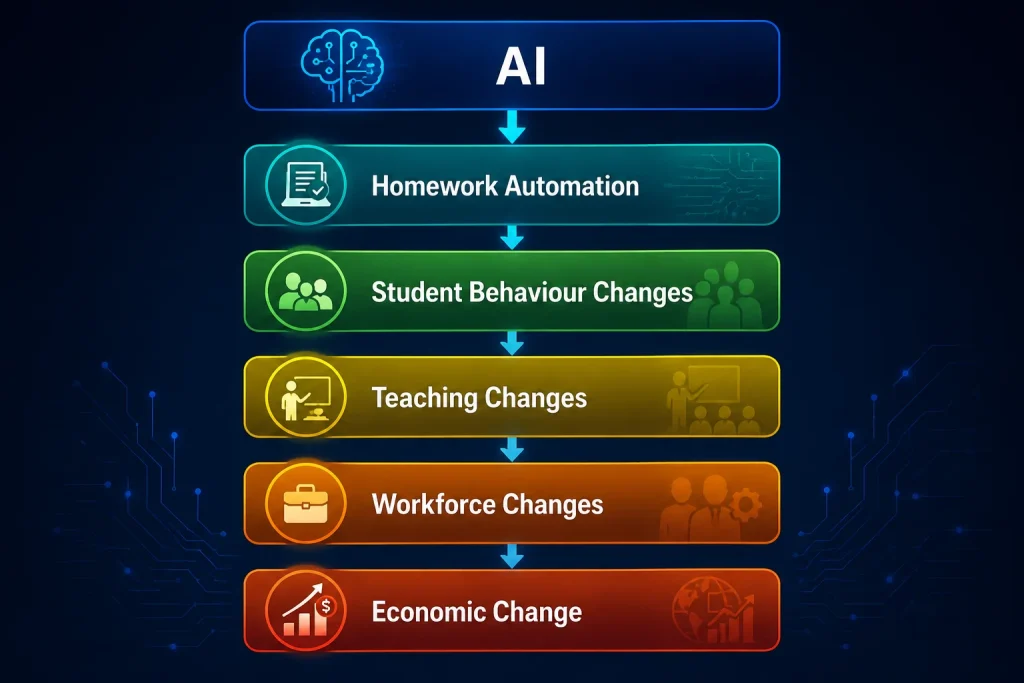
The full causal chain: a single classroom tool traces a straight line all the way to structural economic change.
| QUICK GLOSSARY Systems thinking: understanding how different fields and forces influence one another, rather than studying each subject in isolation.First / second / third-order effects: the immediate result of a change, then the behaviour it triggers, then the structural consequences that follow.Ecosystem navigation: treating education as learning to move through and shape complex, AI-integrated systems — not as accumulating isolated facts.Human-in-the-loop skills: the judgment, ethics, and creativity that direct AI toward valuable ends. |
What the Evidence Actually Shows
This is no longer speculation — the labour-market data is already pointing the same direction. In its Future of Jobs Report 2025, the World Economic Forum surveyed more than 1,000 employers representing over 14 million workers across 55 economies. Its central finding: roughly 39% of workers’ core skills will change by 2030, and about 59% of the global workforce will need meaningful training over that period.
The details matter more than the headline number. Analytical thinking remains the single most sought-after core skill, cited as essential by around seven in ten employers. The fastest-growing skills are led by AI and big-data literacy — but the report is explicit that technical skills are necessary, not sufficient. Alongside them, creative thinking, resilience and adaptability, curiosity and lifelong learning, leadership, and systems thinking are all rising. At the other end, purely routine and procedural abilities are the ones losing ground.
The OECD reaches a parallel conclusion from the education side. Its 2025 work on teaching in an age of powerful AI argues that as machines take over the “what,” schools must shift emphasis toward the “why” and the “what if” — reassessing which competencies still deserve priority when routine tasks are automated. Read together, the two bodies of evidence say the same thing from opposite ends of the pipeline: the skills that create lasting value are moving away from recall and toward interpretation, judgment, and connection.
The Skills That Now Create Value
If routine knowledge is losing its edge, five capabilities stand out — the ones AI struggles to replicate.
- Systems thinking. Modern problems rarely belong to one discipline. Climate policy, healthcare, cybersecurity, and finance now depend on AI while being shaped by economics, law, ethics, and human behaviour. Solving them requires connecting ideas across domains, not mastering one in isolation.
- Critical judgment. AI produces convincing answers in seconds, but cannot reliably tell whether they are accurate, biased, or appropriate. Evaluating information — asking the right questions, weighing evidence, reading context — becomes a core academic skill.
- Creativity. Machines remix existing patterns; meaningful innovation still depends on people who identify new problems and imagine solutions that never existed. Creativity shifts from producing content to directing technology toward valuable ends.
- Communication and emotional intelligence. As AI automates technical work, the ability to explain complex ideas, collaborate across fields, and build trust becomes a decisive advantage. Machines have no empathy, and business still runs on human relationships.
- Ethical reasoning. When machines can execute, humans must guide. Decisions about fairness, responsibility, and social impact remain human work — and grow more important as AI spreads, not less.
Winners and Losers in the AI Economy
Every major technological shift creates new opportunities while devaluing older skills, and AI is no different. The advantage is expected to go to those who treat AI as a tool that extends their capabilities — combining technical fluency with creativity, communication, and cross-disciplinary thinking to solve problems automation cannot handle alone. Those who rely on memorisation or narrow procedural skills face a harder road: when a task can be done faster, cheaper, and more accurately by a machine, its market value falls.
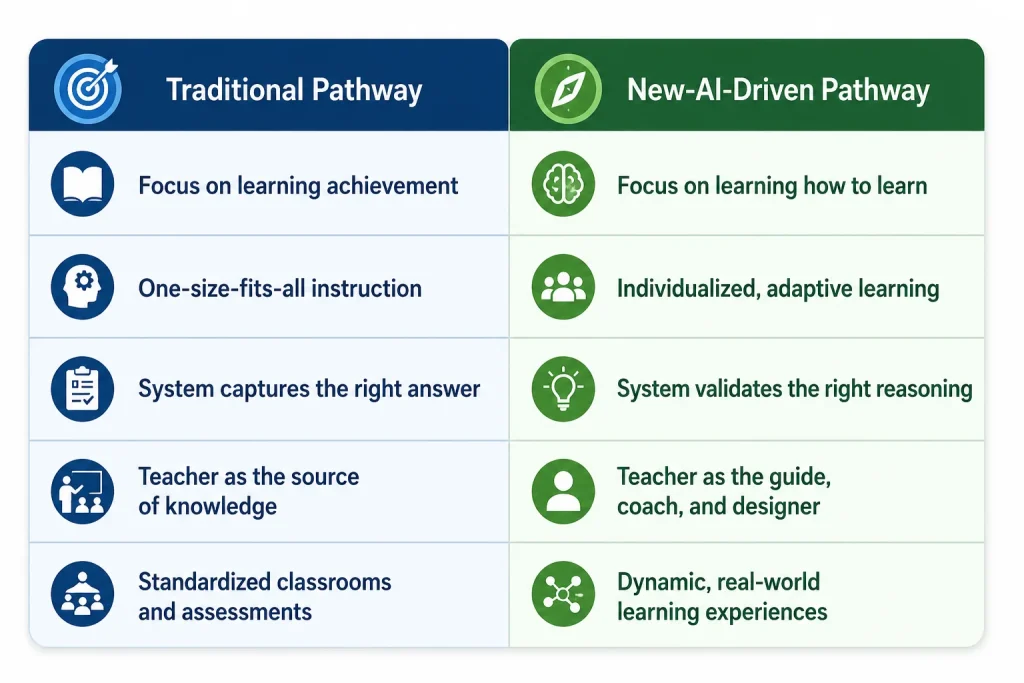
The dividing line is not “technical vs. non-technical.” It is adaptable, connective thinking vs. isolated, routine skill.
At a glance, the shift in what education rewards looks like this:
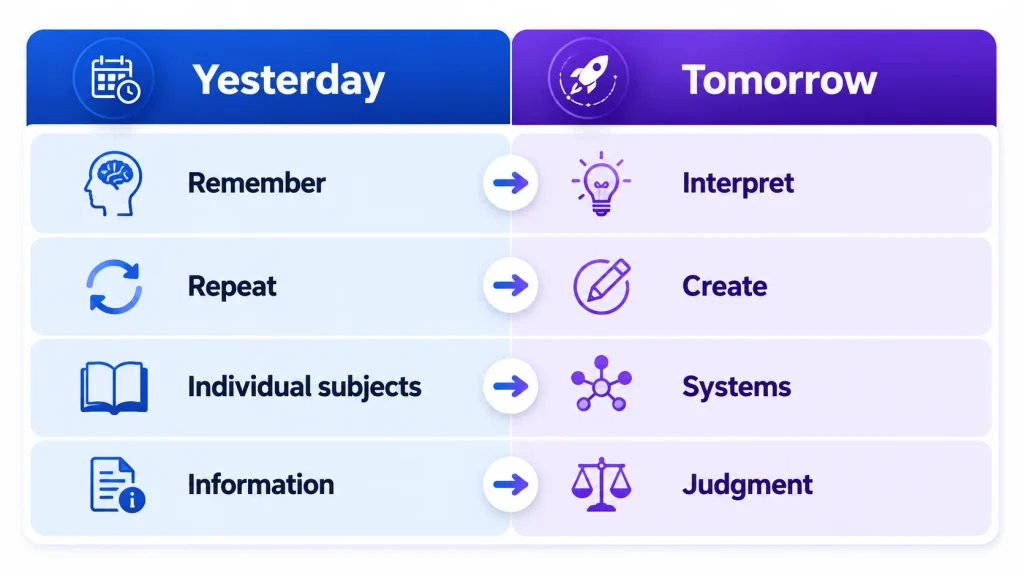
The centre of gravity moves from the left column to the right — and AI now owns most of the left.
The same logic applies to institutions. Schools that integrate AI while deliberately strengthening uniquely human skills will prepare students more effectively. Those that keep emphasising routine knowledge without adapting may struggle to meet the expectations of students and employers alike. None of this replaces teachers or diminishes education — it changes which skills deserve the most attention.
Education Is Becoming Ecosystem Navigation
The role of education is expanding beyond teaching students to find the right answer. In an AI-driven world, success increasingly depends on understanding how systems interact. A single business decision may involve AI, cybersecurity, privacy law, sustainability, finance, and consumer psychology at once. A clinician using AI diagnostics still needs ethics, communication, and legal awareness. An engineer building autonomous systems needs public-policy and risk literacy alongside technical skill.
This is the deeper shift: from information retrieval to ecosystem navigation. You no longer go to school to become a walking filing cabinet of facts — AI already holds the facts, and all of them. Human intelligence is no longer measured by storage capacity. It is measured by the ability to connect the dots, synthesise very different pieces of information, and engineer new solutions with AI as the baseline tool. The lesson is to pilot the ship, not memorise the map.
The Honest Limits — What This Shift Doesn’t Mean
It would be easy to overstate the case. Reliability means naming the caveats as clearly as the promise.
- Foundational knowledge is not obsolete. You cannot think critically about a subject you understand nothing about. Reading, writing, mathematics, and core knowledge remain essential — not as final goals, but as the building blocks higher-order thinking is built on.
- “AI does it instantly” is not the same as “no one needs to learn it.” Offloading a skill entirely can erode the very judgment needed to check the machine’s work. The OECD explicitly warns that reduced engagement with complex tasks — even in low-stakes settings — can quietly weaken capability over time.
- Access is unequal. Personalised AI can widen gaps as easily as close them; students without reliable technology or digital literacy risk being left further behind. Equity has to be designed in, not assumed.
- The future is a projection, not a certainty. Skill forecasts describe a likely direction, not a guarantee. They are a reason to adapt thoughtfully — not to abandon what works.
None of this cancels the shift. It frames it. AI is a powerful new front door to learning, most valuable when it extends human capability rather than standing in for it.
| MYME INSIGHT Education is shifting from knowing the answer to knowing how the systems connect. AI already knows the answers. The enduring human advantage is synthesis — connecting ideas across fields and engineering solutions with AI as a starting point, not a substitute. |
Frequently Asked Questions
Will AI replace teachers?
More likely, it will support them. AI can absorb repetitive work — grading, lesson planning, content generation — freeing educators for the parts machines cannot do: instruction, mentoring, and human connection. The classroom’s centre of gravity moves toward guidance and judgment, not away from teachers.
What skills will matter most in the AI era?
Analytical and systems thinking, creativity, critical judgment, communication, emotional intelligence, ethical reasoning, and interdisciplinary problem-solving. These are precisely the capabilities the World Economic Forum and OECD identify as rising as AI automates routine cognitive work.
Should schools allow students to use AI?
Used responsibly, AI is a valuable learning tool. Rather than only restricting it, schools can teach students to use it critically — verifying its outputs, recognising bias, protecting personal data, and applying it ethically. Digital and AI literacy is becoming a core competency in its own right.
Is memorisation still important?
Foundational knowledge remains essential — you cannot analyse or connect what you do not understand. But education is shifting beyond memorisation toward understanding, evaluation, and applying knowledge in new situations, with AI as a supporting tool rather than a replacement for learning.
| MYME INSIGHT The goal is no longer to fill a mind with answers, but to build one that knows which questions to ask, which answers to trust, and how the pieces fit together. That is the part of education AI makes more valuable — not less. |
MyMe SuperDigital Perspective
For a century, education optimised for a scarce resource: information. Schooling was largely about loading facts into human memory and testing how well they stuck. Artificial intelligence has made that resource abundant and nearly free — and in doing so, it has quietly changed what education is for.
The temptation is to treat this as a crisis of cheating. It isn’t. The deeper story is that the value of knowing is being unbundled from the value of thinking — and schools built entirely around the first are exposed. The encouraging news is that the same shift points to a more human definition of education: one centred on judgment, creativity, ethics, and the ability to see how complex systems connect.
AI is not making education less important. If anything, it makes educational decisions more consequential than ever. The question is no longer whether AI belongs in the classroom — that has been answered. It is whether education evolves quickly enough alongside the world it serves. And it leaves every educator, parent, and student with a question worth sitting with: if artificial intelligence can execute all of our legacy skills, what does it truly mean to be an educated human in the next era?
AI may know more than any student ever will. Education’s future will depend on teaching students what AI can never truly understand.
Continue Exploring This Topic
- The Hidden Risks of Personal AI Accounts in Schools
- AI Thinks Faster. Are We Thinking Less?
- The Hidden Cost of Cognitive Overload — and the AI Tax on Your Attention
- The Efficiency Trap: How to Use AI Without Outsourcing Your Mind
References
Labour Market & Skills
World Economic Forum (2025). The Future of Jobs Report 2025. Geneva: WEF. weforum.org/publications/the-future-of-jobs-report-2025
World Economic Forum (2025). Skills Outlook chapter, The Future of Jobs Report 2025. weforum.org/…/in-full/3-skills-outlook
OECD (2025). OECD Skills Outlook 2025: Building the Skills of the 21st Century for All. OECD Publishing, Paris. doi.org/10.1787/26163cd3-en
AI & Education
OECD (2025). “What should teachers teach and students learn in a future of powerful AI?” OECD Education Spotlights, No. 20. OECD Publishing, Paris. doi.org/10.1787/ca56c7d6-en
OECD. Artificial Intelligence and Education & Skills (topic hub). oecd.org — AI and education & skills
AI Capabilities
OECD. Artificial Intelligence and the Future of Skills (project & AI Capability Indicators). oecd.org — AI and the future of skills
Written by MyMe SuperDigital — exploring where technology meets the human mind.