Schools Are Adopting AI Faster Than They Are Governing It
| Reading Time | Last Updated | Category | Companion Video |
| 13 min read | August, 2026 | Education | Available ▶ |
Walk into almost any school today and you will find generative AI already in use — drafting lesson plans, summarising reports, answering student questions. The tools arrived faster than the rules to govern them. The promise is real, but so is a quiet risk hiding in plain sight: not AI itself, but the uncontrolled use of personal, consumer-grade AI accounts for work involving real students. Here is what that actually means — and how to fix it.
Watch the Companion Video
This article accompanies the short explainer *Is AI Being Used Safely in Schools? The Hidden Risks of Personal AI Accounts*, which traces what happens to student information the moment it enters a personal AI prompt — and the practical steps that make the safe option easier than the unsafe one.
Every school has already adopted AI. The only question left is whether it can still see where its students’ data goes.
Schools Are Adopting AI Faster Than They Are Governing It
Generative AI has entered education at remarkable speed. Teachers use it to draft lesson plans, simplify complex texts, create quizzes, outline rubrics, write parent communications, and cut administrative workload; students use it to research, revise, generate ideas, and get explanations on demand. The appeal is obvious — when a tool can turn an hour-long task into a few minutes, using it feels less like experimentation and more like a practical response to an overloaded day.
The scale is no longer marginal. In a 2025 Gallup and Walton Family Foundation survey, 60% of U.S. K–12 public-school teachers reported using AI tools during the 2024–25 school year, and regular users saved an average of nearly six hours a week. But RAND’s nationally representative research found the same thing every district is now discovering: adoption has outpaced governance. As of spring 2025, fewer than half of principals reported having any school or district AI policy, and most students said no one had taught them how to use AI for schoolwork.
In other words, much of this adoption happened before schools established clear policies, approved platforms, data-protection procedures, or staff training. That gap is the real subject of this article. Schools may be using AI widely — but are they using it safely?
| KEY TAKEAWAYS The central risk is not AI itself — it is the unmanaged use of personal, consumer-grade accounts for institutional work involving students.60% of U.S. teachers used AI in 2024–25 (Gallup), yet school policies and training lag far behind adoption (RAND).Consumer AI plans may use your inputs to improve models unless you opt out; business, enterprise, and education plans generally do not train on your data by default.Entering identifiable student data into a personal account can move it beyond the school’s visibility and control — a governance gap and a possible FERPA / GDPR risk, though not an automatic violation.The fix is structural: approved tools, a written governance policy, human verification, and training — not a blanket ban. |
The Rise of Shadow AI in Education
Cybersecurity professionals use the term shadow IT for software adopted by employees without their organisation’s approval, oversight, or management. In schools, the same pattern is now forming around generative AI. A teacher creates a personal ChatGPT, Claude, or Gemini account to prepare resources. A middle leader pastes a spreadsheet in to summarise attainment. An administrator drops an email chain into an assistant to draft a reply.
These actions are rarely malicious — they are driven by efficiency and good intentions. The problem is that personal accounts sit outside the school’s approved digital environment. The institution often cannot see:
- which platform is being used, and under which account type;
- what information is being uploaded, and how long it is retained;
- whether inputs may be reviewed by humans or used to improve services;
- which jurisdiction processes the data;
- whether the school can audit, retrieve, or delete it; and
- whether the account carries the contractual safeguards required for student records.
The result is an invisible layer of educational data the school no longer fully controls.
| MYME INSIGHT The real risk begins the moment a personal productivity tool quietly becomes an unofficial institutional database — one the school cannot see, audit, or delete. |
What Happens When Student Information Enters AI?
Consider a realistic example. A teacher copies part of a student’s essay into a personal AI account and asks for feedback. The essay may carry the student’s name, personal experiences, learning needs, or other identifying details. The information leaves the school-controlled environment and is processed by an outside provider. What happens next depends on the provider, the account type, the user’s privacy settings, whether history and model-improvement are enabled, and the contract in place.
That distinction matters, and it is where the popular telling gets oversimplified. For example, OpenAI states that inputs and outputs from ChatGPT Business, Enterprise, Edu, and its API are not used for model training by default, while consumer plans may be used to improve models unless the user opts out. Google likewise advises people using personal Gemini apps not to enter confidential information, noting that some conversations are read by human reviewers and that reviewed chats can be retained for up to three years — even after deletion.
So the accurate conclusion is not that every prompt is instantly and permanently baked into a public model. It is more precise, and more useful, to say this:
Schools cannot assume that information entered through a personal AI account receives the privacy protections, retention controls, deletion rights, or contractual safeguards that educational data requires.
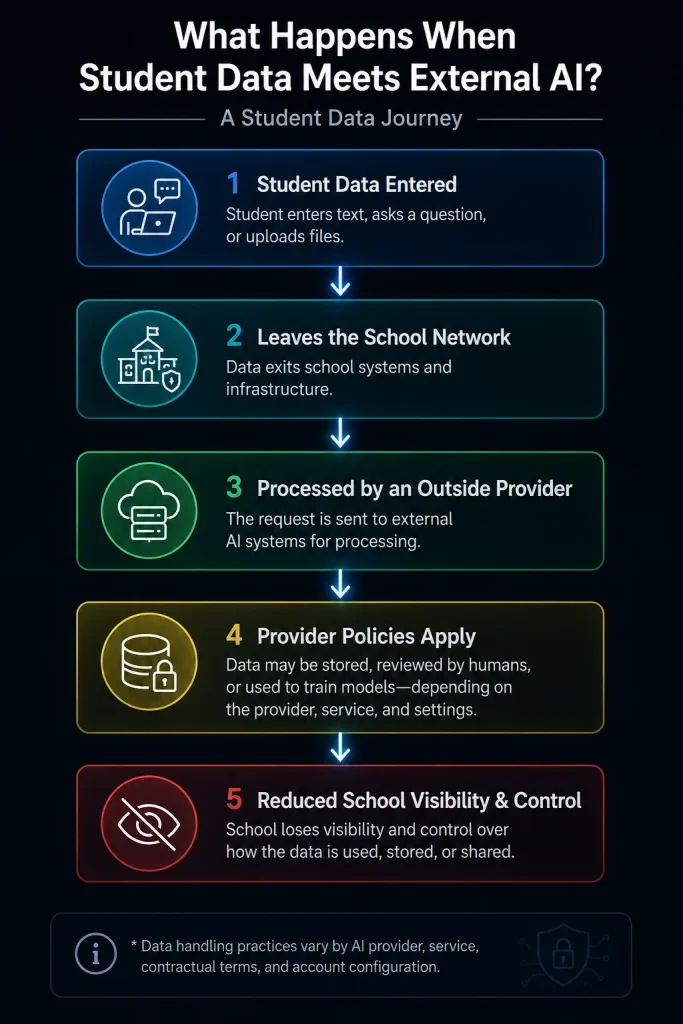
The data journey from a single personal prompt — and the point where the school’s control quietly ends.
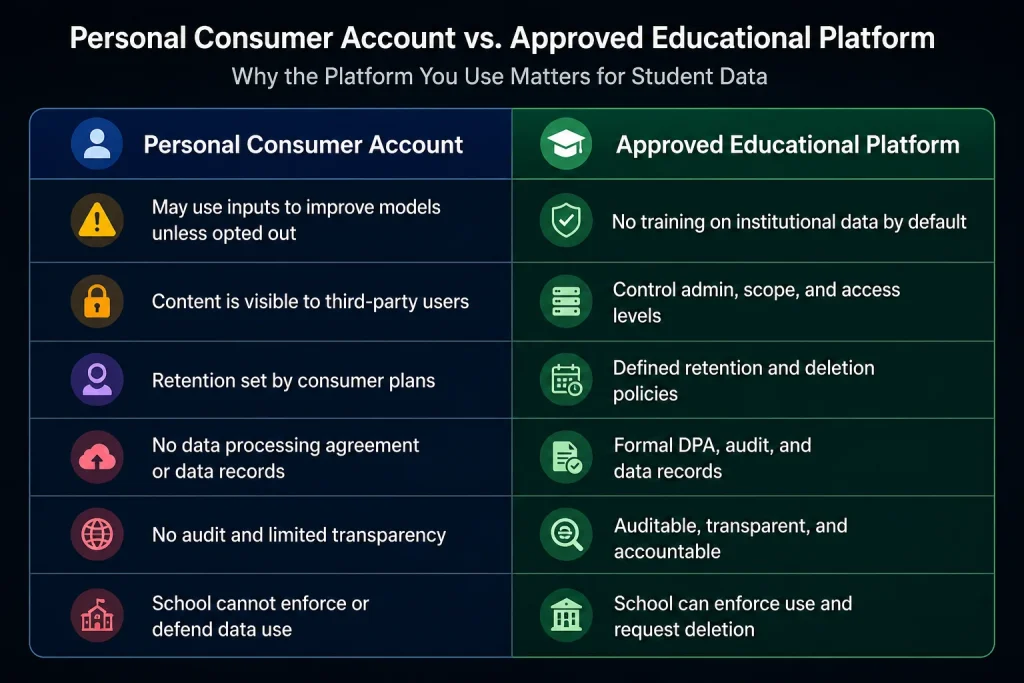
The difference is not the technology — it is the terms, the controls, and who is accountable for the data.
| QUICK GLOSSARY Shadow AI (shadow IT): tools adopted by staff without the organisation’s approval, oversight, or management.PII (personally identifiable information): any detail — or combination of details — that can identify a specific student.Re-identification: piecing together “anonymous” records until an individual becomes identifiable again.Data-processing agreement (DPA): the contract binding a provider to handle institutional data under agreed legal safeguards.Data isolation (closed-loop): an architecture where inputs are walled off and not used to train public models.Human-in-the-loop: a qualified person verifies every AI output before it informs a real decision. |
The Most Sensitive Data at Risk
Not all school information carries the same risk. Asking AI for five generic questions about photosynthesis is worlds away from uploading identifiable student records. The high-risk categories include:
- student names and identification numbers; assessment records and predicted grades;
- individual education plans, medical or disability information, and counselling notes;
- safeguarding notes, behaviour and disciplinary records, and attendance data;
- parent communications, staff performance or HR documents; and photographs, recordings, or biometric information.
Crucially, removing a name is not always enough. A rare medical condition, a year group, a family circumstance, and a specific incident can combine to make a supposedly anonymous record identifiable again. Under FERPA, personally identifiable information includes both direct identifiers and indirect ones that, in context, could single a student out.
Privacy Law: Risk, Not Automatic Violation
It is tempting to say that pasting student data into a personal AI tool automatically breaks FERPA in the United States or the GDPR in Europe. The concern is valid, but the wording matters. Using AI does not automatically violate either law. The risk depends on the nature of the data, whether disclosure is authorised, the school’s legal basis for processing, the provider’s role, contractual safeguards, data minimisation, security, transparency, and retention.
The U.S. Department of Education notes that FERPA does not mandate one specific set of technical controls, but institutions are expected to take reasonable steps to safeguard student records — and a security failure can become a privacy breach and a possible violation. GDPR-style frameworks add principles of lawful processing, purpose limitation, data minimisation, transparency, security, and accountability. Translated into a single operational rule:
| THE OPERATING RULE Staff should never upload identifiable or sensitive student information into an AI service unless the school has approved the platform and confirmed the necessary legal, contractual, and technical safeguards. |
When AI Hallucinations Enter Official Records
Privacy is only half the risk. Generative AI can produce incorrect, fabricated, incomplete, or misleading output — Google itself warns that Gemini can generate inaccurate responses and advises users to verify them. That becomes dangerous when AI is used to summarise student progress, draft individual education plans, interpret assessment data, write behavioural or safeguarding reports, or recommend interventions. A plausible-sounding error can be copied into an official record without anyone noticing.
The safeguard is a strict human-in-the-loop rule: AI may help draft or organise, but a qualified employee must verify every factual claim, decision, and recommendation before it enters an official record. AI should never be the final decision-maker on assessment, discipline, safeguarding, admissions, special educational provision, or student welfare.
Academic Integrity Becomes Harder to Define
Unmanaged adoption also breeds inconsistency. One teacher allows AI for brainstorming; another bans it outright; a third permits AI drafts but requires students to document their revisions. Without a shared policy, students face contradictory expectations, and the line between legitimate help and outsourced learning blurs.
The answer is not detection software — those tools remain unreliable and can trigger false accusations. The durable fix is assessment that makes learning visible: drafts, discussion, oral explanation, reflection, practical application, and evidence of the student’s own reasoning.
Why a Total Ban Will Not Work
Faced with these risks, some schools are tempted to block generative AI entirely. The impulse is understandable, but a network blockade is nearly impossible to enforce: anyone with a phone, mobile data, a browser extension, or an app with built-in AI can reach it anyway. A block does not remove use — it makes use less visible, pushing shadow AI further underground while the school loses its chance to train, oversee, and offer safer alternatives.
The better strategy is controlled adoption: make the safe option easier than the unsafe one.
A Three-Step Roadmap for Safer AI Use
Institutional safety comes from structure, not from network-wide blocks. Three foundations do most of the work.
The goal is not less AI — it is AI the school can see, govern, and trust.
Step 1 — Provide Approved Institutional Tools
Identify platforms with genuine educational or enterprise protections, so educators get a safer environment while the school keeps oversight. Key requirements include: no model training on institutional data by default; clear retention controls; administrative management and single sign-on; role-based access; audit logs; a data-processing agreement; security documentation; defined deletion procedures; and appropriate regional compliance support.
Step 2 — Establish a Written Governance Policy
The policy should define approved and prohibited tools, acceptable educational uses, and the data that must never be uploaded; anonymisation requirements; rules for assessment and student disclosure; human-review expectations; incident-reporting procedures; staff and student responsibilities; consequences for misuse; and how the policy is reviewed as technology changes. It must be practical enough for daily use — concrete examples, not abstract statements.
Step 3 — Train Staff and Students
Policies fail when people do not understand them. Training should cover how AI platforms process information; the difference between personal and institutional accounts; how to remove identifying details; how to verify outputs and recognise hallucinations and bias; when AI should not be used; how to document AI assistance; how to report accidental disclosure; and how to design assessments for an AI-enabled classroom.
The Honest Limits
Secure institutional platforms reduce risk — they do not erase it. Reliability means naming the caveats as clearly as the promise.
- “Not used for training” does not always mean “never retained.” Retention, access, and review still need checking.
- Enterprise contracts do not eliminate human error — the wrong file can still be pasted into the right tool.
- Anonymised information can sometimes be re-identified through context and combined details.
- AI output can remain inaccurate even inside a secure platform, so human review still matters.
- Approved tools can still be misused, and laws and provider terms keep changing.
- Smaller schools may struggle with cost, procurement, and specialist expertise.
Security therefore depends on layers: technology, contracts, policy, training, human review, and ongoing monitoring — not any single control.
| MYME INSIGHT Safety here is not a setting you switch on. It is knowing exactly where student data goes, who can see it, how long it lives, and who is accountable when something goes wrong. |
Frequently Asked Questions
Can teachers use personal ChatGPT or Gemini accounts for schoolwork?
They can be fine for generic, non-confidential tasks. But staff should not enter identifiable student, parent, staff, safeguarding, or medical information unless the school has formally approved the service and its data arrangements.
Are enterprise AI accounts completely private?
They generally offer stronger contractual and administrative protection, and several providers state that enterprise inputs are not used for training by default. Even so, schools must still review retention, security, access, deletion, and legal terms.
Is anonymising student information enough?
It reduces risk — but only when the information genuinely cannot identify the student through context or combined details. Removing a name alone is often not sufficient.
Should schools ban AI?
A total ban is hard to enforce and tends to push use underground. Approved tools, clear rules, redesigned assessments, and practical training are a more sustainable answer.
Can AI make decisions about students?
AI may support analysis or drafting, but consequential decisions about learning, discipline, safeguarding, admissions, or welfare should stay under accountable human control.
MyMe SuperDigital Perspective
The central question is not whether schools adopt AI. They already have. The real divide is between unmanaged adoption and intentional integration.
Personal AI accounts can deliver immediate efficiency, but they can also move sensitive educational work beyond the institution’s visibility and control. Approved platforms alone are not enough; schools also need clear rules, staff training, human verification, and assessment designed for an AI-enabled world. Used well, AI can help teachers personalise learning, cut repetitive work, and give more time back to students — but only when those gains do not come at the cost of privacy, accuracy, trust, or accountability.
| “ The safest school will not be the one that uses the least AI. It will be the one that knows exactly where, why, and under what safeguards AI is being used. |
Continue Exploring This Topic
- The AI Education Paradox: Why Schools Must Rethink Learning
- Can Artificial Intelligence Help You Grow? The Truth About AI Coaching
- The Efficiency Trap: How to Use AI Without Outsourcing Your Mind
- AI Thinks Faster. Are We Thinking Less?
References
AI Adoption & the Governance Gap
Gallup & Walton Family Foundation (2025). Teaching for Tomorrow: Unlocking Six Weeks a Year With AI. gallup.com — teacher AI use 2024–25
RAND Corporation (2025). AI Use in Schools Is Quickly Increasing but Guidance Lags Behind. rand.org/pubs/research_reports/RRA4180-1
Provider Data Policies
OpenAI. Enterprise privacy (Business, Enterprise, Edu, and API not used for training by default). openai.com/enterprise-privacy
OpenAI. How your data is used to improve model performance (consumer plans may be used unless opted out). help.openai.com — data & model training
Google. Gemini Apps Privacy Hub (don’t enter confidential information; human review; retention). support.google.com/gemini
Student Data & Privacy Law
U.S. Department of Education, Student Privacy Policy Office. Protecting Student Privacy While Using Online Educational Services (FERPA). studentprivacy.ed.gov
U.S. Department of Education. FERPA Frequently Asked Questions (school-official / contractor exception). studentprivacy.ed.gov/frequently-asked-questions
European Union. General Data Protection Regulation (Regulation (EU) 2016/679). eur-lex.europa.eu — GDPR
Written by MyMe SuperDigital — exploring where technology meets the human mind.