
Why Education Must Change Before Teachers Do
| Reading Time | Last Updated | Category |
| 15 min read | August, 2026 | Education |
The future of education is usually debated in the language of technology — smarter models, personalised learning at scale, systems that explain, assess, and adapt in real time. And one question dominates the conversation: will artificial intelligence replace teachers? It is an understandable question. It is also the wrong one. This article makes a simple argument: every educational system in history has been organised around its scarcest cognitive resource, and AI does not change the purpose of education — it changes what is scarce.
When answers become effortless, thoughtful questions become the true measure of intellectual maturity.
The Wrong Question
Questions shape the boundaries of our thinking. When we ask whether teachers will be replaced, we quietly assume the purpose of education is the efficient transfer of knowledge — that teaching is an information service that survives only until a more efficient system appears. History offers little support for that assumption.
Educational institutions have never been organised simply around transmitting knowledge. They have been organised around whatever cognitive resource was hardest for society to produce and distribute. Knowledge happened to be that scarce resource for much of human history — but scarcity changes, and when it changes, educational systems change with it. AI is not disrupting education because machines got better at explaining ideas. It is disrupting education because it changes what has become scarce. The debate, then, should not begin with teachers. It should begin with education itself.
| KEY TAKEAWAYS: – “Will AI replace teachers?” is the wrong question—it assumes education is primarily about transferring information. – Each technological era has changed how learners access knowledge and expertise, reshaping what schools and teachers need to provide. – AI is making on-demand explanation dramatically easier to access, increasing the relative value of interpreting, evaluating, and applying knowledge. – Judgment becomes increasingly important in AI-rich learning environments: deciding what to trust, how to act when evidence is incomplete, and how to navigate situations where values or priorities conflict. – The future teacher is not simply a deliverer of information but an architect of thinking—designing the conditions in which information can become understanding, reasoning, and responsible action. |
Every Educational System Is Built Around Scarcity
Historians usually describe schooling through curriculum, pedagogy, or governance. A simpler force sits beneath all three: scarcity. Institutions emerge to solve scarcity problems. Markets exist because resources are limited; laws exist because trust cannot be assumed; educational systems exist because certain forms of knowledge and intellectual capability have historically been hard to acquire.
In the manuscript age the scarce resource was obvious: books were extraordinarily expensive, literacy was uncommon, and access to scholarly texts ran through monasteries, courts, and a handful of universities. The printing press made books dramatically more accessible — yet expertise stayed scarce, so schools organised learning around teachers because expert interpretation, not printed information, became the new constraint. Centuries later the internet made information abundant, but reliability did not follow; schools responded with research skills, information literacy, and digital citizenship. The scarce resource was no longer information, but confidence in its quality.
Artificial intelligence is the next turn of this same wheel. AI is making on-demand explanation far more abundant and accessible. Large language models can explain complex ideas, generate examples, translate technical language, compare competing perspectives, and answer follow-up questions almost instantly—although the quality and reliability of those responses can vary. Their significance for education lies not only in computational capability, but in how dramatically they reduce the time and effort required to access explanations.
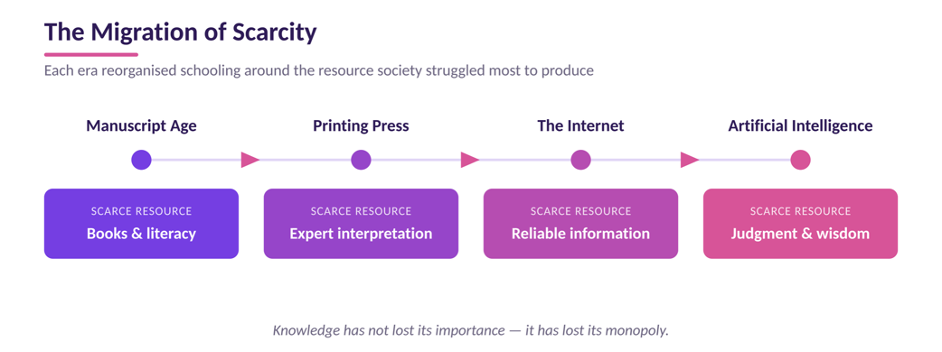
The migration of scarcity: schooling reorganises each time its defining resource becomes abundant.
Economists call this value migration: competitive advantage rarely disappears, it relocates. When electricity became universal, value shifted from access to electricity toward how organisations used it; when connectivity became commonplace, advantage moved to the business models built on top of it. Education follows the same logic. For generations, educational advantage depended on privileged access to knowledge. Increasingly, knowledge behaves less like an advantage and more like infrastructure — indispensable, like electricity or broadband, yet no longer a differentiator. AI does not reduce the importance of education; it reveals that education has been optimising for a resource that is losing its monopoly.
| MYME INSIGHT Knowledge is becoming the starting point of education, not its destination. When explanation is free, the advantage moves to what you can do with it — interpret, judge, and act. |
When Knowledge Lost Its Monopoly
This does not mean knowledge has become less valuable. It means knowledge has become less exclusive — and the distinction is fundamental. For much of modern history, educational excellence was tied to informational advantage: students who knew more generally performed better; professionals established authority through specialised expertise; universities drew influence from concentrating knowledge unavailable elsewhere.
AI weakens that relationship. A student in Nairobi, Singapore, São Paulo, or London can now summon a sophisticated explanation of an advanced concept in seconds. Real gaps in opportunity remain, but the cost of obtaining high-quality explanations has fallen sharply, and the institutional monopoly over explanation has begun to erode. This is not the democratisation of expertise, though. Explanation is not expertise. Access is not mastery.
The research points the same way. The OECD’s Learning Compass 2030 argues that future education must cultivate agency, responsibility, and the capacity to navigate complexity — not merely accumulate information. John Hattie’s synthesis of thousands of studies shows that deep learning depends far more on feedback, metacognition, deliberate practice, and visible thinking than on passive exposure. Daniel Willingham makes the complementary point: knowledge remains indispensable for reasoning — but only when learners connect, organise, and apply it rather than merely recall it. AI changes none of these cognitive principles. It changes the economics around them.
Labour-market analysis converges on the same conclusion. The World Economic Forum repeatedly ranks analytical thinking, creativity, resilience, and curiosity among the fastest-rising capabilities. McKinsey finds that generative AI pushes automation deepest into knowledge work: its estimate of the technical potential to automate the *application of expertise* jumped by 34 percentage points once generative AI was accounted for, while human value shifts toward decision-making, collaboration, adaptability, and responsible oversight. These are often read as a case for teaching “AI skills.” They imply something larger — that labour markets are beginning to reward the very capabilities educational philosophy has always claimed to value but rarely managed to prioritise.
Knowledge has not disappeared. Its monopoly has.
The Teacher as an Architect of Thinking
If the central resource of education is changing, the teacher’s profession must be understood differently — not because AI diminishes educators, but because it reveals what their role has always been beneath the surface. Teachers have been called instructors, facilitators, mentors, assessors, and learning designers. Each captures part of the job; none names its deepest function. The defining responsibility of the future teacher is not the delivery of knowledge. It is the architecture of thinking.
Information enters the mind; thinking organises it. Knowledge accumulates; thinking interrogates it. AI excels at accelerating the first process. Education increasingly exists to cultivate the second. The metaphor of architecture fits because architects rarely manufacture their materials — their expertise lies in arranging relationships. Teachers increasingly do the same: they design questions before students seek answers, sequence intellectual experiences rather than information, introduce disagreement before consensus, and create productive tension before resolution. The quality of a classroom depends less on the quantity of information delivered than on the quality of thinking it consistently demands.
This is a real departure from the industrial model. Industrial economies rewarded efficiency, consistency, and standardisation, helping make knowledge transfer a central feature of mass education. AI can now perform many standardised explanatory tasks quickly and at scale. Human teachers create distinctive value not by competing with machines on information delivery, but by designing intellectually demanding social environments where ideas collide, assumptions become visible, and reasoning develops through dialogue. The teacher’s expertise therefore extends beyond answering questions to creating the conditions in which students learn to ask better ones.
Judgment Becomes Education’s Greatest Outcome
Educational philosophy has long separated knowing something from understanding it. The age of AI demands one further distinction: neither knowledge nor understanding is education’s highest achievement. Judgment is. The progression forms a hierarchy — information provides facts, knowledge organises them, understanding explains their relationships, judgment decides which understanding deserves action, and wisdom is sound judgment exercised consistently over time.
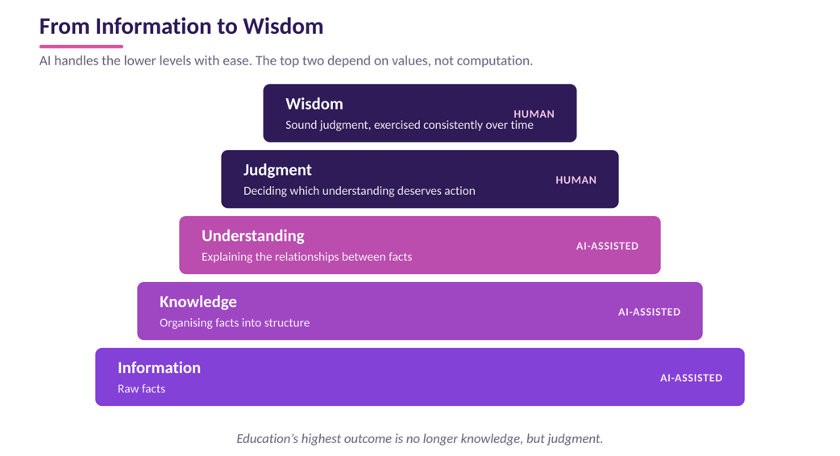
AI supports the lower three levels with extraordinary capability. The top two depend on values, not computation.
Judgment is required precisely where computation runs out: when evidence is incomplete, objectives conflict, or ethics outweigh technical optimisation. Consider a physician choosing between equally effective treatments with different implications for quality of life; a judge balancing precedent against social consequence; a policymaker regulating AI without suppressing innovation; a school leader deciding whether predictive analytics should shape decisions about individual students. None of these is an optimisation problem. Each is a judgment problem.
Educational research reaches the same place. The OECD Learning Compass identifies responsible agency as a central objective; UNESCO’s guidance on generative AI emphasises human-centred decision-making and ethical oversight over technological dependence. The future of education is not about producing students who know more than intelligent systems. It is about producing graduates who can decide responsibly when intelligent systems disagree, when evidence evolves, or when efficiency collides with ethics. This changes assessment itself: examinations have traditionally rewarded certainty; the future increasingly rewards justification. Students will not merely defend answers — they will defend reasoning.
The Classroom as a Laboratory of Uncertainty
Perhaps the greatest misconception about expertise is that experts possess certainty. In reality, genuine expertise is defined by disciplined uncertainty. Scientists revise theories, engineers redesign solutions, economists update forecasts, doctors adjust diagnoses. Experts do not avoid uncertainty; they manage it responsibly. Schools have often taught the opposite — rewarding correct answers and treating a changed mind as weakness rather than growth.
AI makes that model inadequate. Generative systems can produce several persuasive answers to the same question, each backed by plausible evidence and coherent reasoning — and confidence is not the same as truth. Students therefore need a capability traditional curricula have neglected: the ability to evaluate uncertainty without being paralysed by it. Future classrooms should resemble research laboratories more than examination halls, where hypotheses stay provisional, evidence evolves, and conclusions improve through revision rather than permanence. Such environments cultivate intellectual humility — increasingly recognised in cognitive science as essential for adaptive reasoning.
This does not mean abandoning standards or objective knowledge. It means distinguishing the certainty appropriate to established facts from the uncertainty appropriate to complex human decisions. Climate policy, biomedical ethics, AI governance, and geopolitical strategy cannot be mastered by memorisation alone, because each pairs competing evidence with competing values. Students must learn to identify assumptions, compare explanations, tolerate ambiguity, and revise conclusions when stronger arguments appear — capacities that cannot be outsourced to algorithms, because they concern how societies decide, not merely what they know. Paradoxically, AI raises the importance of education precisely because it raises the availability of information: abundance elevates the value of discernment.
The Institution That Slows Thinking Down
Here is the uncomfortable implication most reform conversations avoid. If machines make thinking faster, cheaper, and more fluent, then the rarest — and therefore most valuable — thing a school can offer may be the opposite of speed.
Schools may soon become the only institutions deliberately designed to slow human thinking down.
Everywhere else, the incentives run toward acceleration: instant answers, autocomplete, one-tap summaries, and the frictionless closing of open questions. Yet cognitive science suggests that some forms of effort can be valuable for learning. Daniel Kahneman distinguished fast, intuitive processes from slower, more deliberate forms of thinking, highlighting why complex judgments often benefit from reflection rather than immediate response. John Sweller’s cognitive-load research shows that working memory has limited capacity and that effective learning depends on managing cognitive load rather than simply maximizing or eliminating difficulty. Robert Bjork’s work on “desirable difficulties” similarly shows that certain challenges can strengthen long-term learning. Herbert Simon observed that an abundance of information consumes attention, making attention increasingly valuable. And Gary Klein’s research on expertise highlights how reliable professional intuition can develop through experience, feedback, and repeated exposure to meaningful patterns.
Put together, these findings invert the efficiency instinct. The school of 2035 competes with AI not by matching its speed but by protecting the slow processes machines are designed to eliminate: sustained attention, productive struggle, the pause before the answer, the deliberate friction in which judgment is actually formed. Its value is counter-cyclical — the more instant the outside world becomes, the more precious the one place built to decelerate thought.
| MYME INSIGHT In a world optimised for speed, the school’s rarest offering becomes friction — the deliberate slowness in which attention, struggle, and judgment are formed. Education stops competing with AI on velocity and starts competing on depth. |
Seen this way, the argument comes full circle. Scarcity is not just an idea about history — it is a chain, and each link pulls the next.
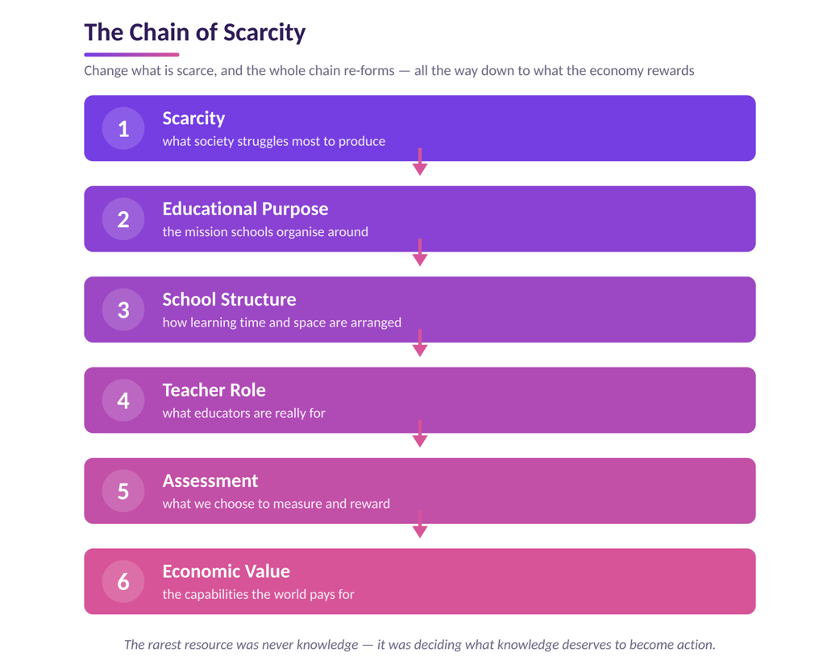
The chain of scarcity: shift the scarce resource, and purpose, structure, the teacher’s role, assessment, and economic value all re-form in turn.
The Honest Limits
This is an argument about direction, not a finished blueprint — and reliability means naming the caveats as clearly as the promise.
- Foundational knowledge is not optional. You cannot judge, interpret, or synthesise what you do not understand; “judgment over knowledge” presumes a base of knowledge to reason with.
- Judgment is hard to teach at scale — and hard to assess. Rewarding reasoning over recall demands richer, slower assessment and far more teacher time than a multiple-choice exam.
- Access remains unequal. Cheaper explanations do not erase gaps in teachers, connectivity, or support; without deliberate design, AI can widen the very divides it appears to close.
- “Architect of thinking” is a demand, not a gift. It requires investment in teacher training and working conditions that many systems have not yet made.
None of this weakens the thesis. It frames it: the shift toward judgment is a direction to build toward carefully, not a switch to flip.
| MYME INSIGHT The classroom of 2035 will not be judged by the sophistication of its technology, but by the quality of human judgment it helps cultivate—because the ultimate value of AI in education depends on how wisely people learn to use it. |
Frequently Asked Questions
Will AI replace teachers?
Unlikely — but it will change what teaching is for. As explanation becomes abundant, the teacher’s value moves from delivering information to designing the conditions in which information becomes understanding and judgment. That work is harder to automate, not easier.
If AI can explain anything, why still learn facts?
Because reasoning runs on knowledge. As Willingham argues, you cannot think critically about a subject you understand nothing about. Knowledge becomes the starting point for interpretation and judgment, not the finish line.
What does “judgment” actually mean here?
The capacity to decide responsibly when evidence is incomplete, objectives conflict, or ethics outweigh efficiency — the situations that are judgment problems, not optimisation problems, and where values matter more than computation.
How would assessment change?
It shifts from rewarding certainty to rewarding justification. Instead of only defending answers, students defend their reasoning — through explanation, revision, and visible thinking rather than one-shot recall.
Isn’t this just “teaching AI skills”?
No. The deeper point is that labour markets and learning science now reward the same human capabilities — analytical thinking, creativity, discernment, responsible judgment — that education always claimed to value but struggled to prioritise.
MyMe SuperDigital Perspective
Educational history is a history of changing scarcity. Manuscripts gave way to printed books; printed books to expert interpretation; expert interpretation to digital information. Artificial intelligence begins another such transition — and the scarce resource of the coming decades is unlikely to be information itself. It will be the human capacity to interpret information wisely, exercise sound judgment under uncertainty, and act responsibly inside increasingly intelligent societies.
So the purpose of education stays remarkably constant even as its methods change. Schools have never existed simply to distribute knowledge; they exist to cultivate the intellectual and moral capacities required to use knowledge well. AI is not forcing education to abandon that purpose. It is forcing education to remember it.
| “ Every century reorganises education around a new scarcity. Artificial intelligence has not changed the purpose of education. It has simply revealed that the rarest resource was never knowledge itself — it was the human capacity to decide what knowledge deserves to become action. |
Continue Exploring
→ The AI Education Paradox — why schools must rethink learning when knowing becomes free.
→ The Efficiency Trap — how to use AI without outsourcing your own thinking.
→ The Hidden Cost of Cognitive Overload — the AI tax on your attention — the scarce resource Simon foresaw.
→ The Curiosity Engine — why asking better questions may become humanity’s greatest AI skill.
References
Education Frameworks
OECD (2019). The OECD Learning Compass 2030 (Future of Education and Skills 2030). oecd.org — Learning Compass 2030
UNESCO — Miao, F. & Holmes, W. (2023). Guidance for Generative AI in Education and Research. UNESCO Publishing. doi.org/10.54675/EWZM9535
Learning Science
Hattie, J. (2009, updated). Visible Learning — syntheses on feedback, metacognition, and deliberate practice. visible-learning.org
Willingham, D. T. (2009). Why Don’t Students Like School? — on knowledge as a prerequisite for reasoning. danielwillingham.com
Cognitive Science of Judgment
Kahneman, D. (2011). Thinking, Fast and Slow — System 1 vs System 2 and the limits of intuition. Farrar, Straus and Giroux
Klein, G. (1998). Sources of Power: How People Make Decisions — expert intuition under uncertainty. MIT Press
Simon, H. A. (1971). “Designing Organizations for an Information-Rich World” — attention as the scarce resource. digitalcollections.library.cmu.edu
Sweller, J. (1988). “Cognitive Load During Problem Solving” — effortful processing and understanding. doi.org/10.1207/s15516709cog1202_4
Future of Work & Skills
World Economic Forum (2025). The Future of Jobs Report 2025 — rising skills: analytical thinking, creativity, resilience, curiosity. weforum.org — Future of Jobs 2025
McKinsey Global Institute (2023). The economic potential of generative AI: the next productivity frontier. mckinsey.com — economic potential of gen AI
Written by MyMe SuperDigital — exploring where technology meets the human mind.