When Execution Can Be Delegated to a Machine, Where Does Human Authorship Begin and End?
| Reading Time | Last Updated | Category |
| 14 min read | August, 2026 | Future Society |
A person sits before a blank screen with an idea that has no form yet — an argument, a strategy, a lesson, a line of code, the first sentence of an essay. They describe it to an AI system, and seconds later polished paragraphs appear, sometimes containing connections they had not consciously considered. Something has clearly been produced. But who — or what — intended it? That question may matter more than the familiar debate over whether AI can “think.”
Sophisticated language used to be evidence of a thinking mind. It no longer is — which forces a different question about who is authoring what.
The Problem of the Digital Cogito
Generative AI has unsettled one of the oldest assumptions about human cognition: that fluent language implies a thinking mind behind the words. Large language models now produce explanations, arguments, stories, code, and dialogue with a flexibility that would have seemed extraordinary a few years ago. Yet the appearance of intelligent language does not settle what is happening behind it — and it raises a second question that may matter even more: when execution can be delegated to a machine, where does human authorship begin and end?
This is the problem of the Digital Cogito. Not whether machines can produce thought-like outputs, but what remains of human agency when the distance between wanting something and producing it becomes increasingly automated.
| KEY TAKEAWAYS: • Fluent language is no longer a reliable boundary between human and machine — so it can no longer stand in for authorship. • Intelligence, understanding, and intentionality are different questions. Purposeful-looking output does not prove a subjective purpose behind it. • Generative AI separates intention from execution — the human moves upstream (deciding what should exist) and downstream (judging what was produced). • A prompt is an interface, not an intention. As interfaces change, the durable human advantage is forming and maintaining an intellectual objective. • When production becomes cheap, the scarce act is choosing, judging, and taking responsibility — not generating more. |
Descartes Meets the Generative Machine
In 1637, René Descartes published the Discourse on the Method, home to the line that became inseparable from his name: I think, therefore I am. Less famously, Descartes also considered machines. He imagined mechanical systems that could imitate human actions and even utter words — and proposed a test that leaned partly on language: a machine might be built to produce particular verbal responses, he argued, but would lack the general capacity to arrange language appropriately across the indefinite variety of situations in which humans communicate.
Nearly four centuries later, that particular test has become far less comfortable. Today’s models respond to questions they were never individually programmed to answer; they reformulate arguments, shift register, explain at several levels, generate code, imitate genres, and sustain conversations across unfamiliar combinations of topics. This does not prove Descartes wrong about consciousness. It shows something more interesting: linguistic performance is no longer a simple boundary marker between human and machine. A system can now generate an impressive performance of language without settling whether there is any subjective thinker behind it. The old boundary has blurred — so we need a different question.
Intelligence Is Not the Same Question as Intentionality
In everyday debate, several ideas get compressed into one word: intelligence. But intelligence, consciousness, understanding, agency, and intentionality are not interchangeable. A system can perform superbly at a task without that performance telling us everything about its subjective status — a distinction with a long history in the philosophy of mind.
In his 1980 paper Minds, Brains, and Programs, John Searle introduced the Chinese Room argument against what he called “strong AI” — roughly, the claim that running the right program could itself be sufficient for understanding. Searle argued that formal symbol manipulation was not, by itself, enough to establish understanding or intentionality. His argument remains contested — and that is precisely the point: the relationship between computation, understanding, and consciousness is a live philosophical dispute, not something to declare settled because modern AI produces fluent sentences. We should be as wary of “AI thinks” as of sweeping claims about what no future system could ever possess.
For today’s systems, a more defensible observation is available. They produce outputs that look purposeful because they operate within goals, instructions, and contexts supplied by their design and by users. But purposeful-looking output does not, on its own, demonstrate a subjective purpose experienced by the system producing it. Call that the intentionality gap — and it matters, because generative AI is changing not only what machines can produce, but what humans must contribute to production.
| MYME INSIGHT: The question is quietly shifting from “Can the machine produce this?” — increasingly, it can — to “Who intended it, judged it, and will answer for it?” |
The Great Separation: Intention From Execution
For most of history, intention and execution were tightly bound. To write an essay, you wrote the sentences; to draw, you made the marks; to build software, you wrote the code. Tools helped — the word processor, the calculator, the search engine — but you still performed the act. Generative AI introduces something different in degree, and in some contexts perhaps in kind: a person can specify an intended outcome while delegating substantial parts of its execution.

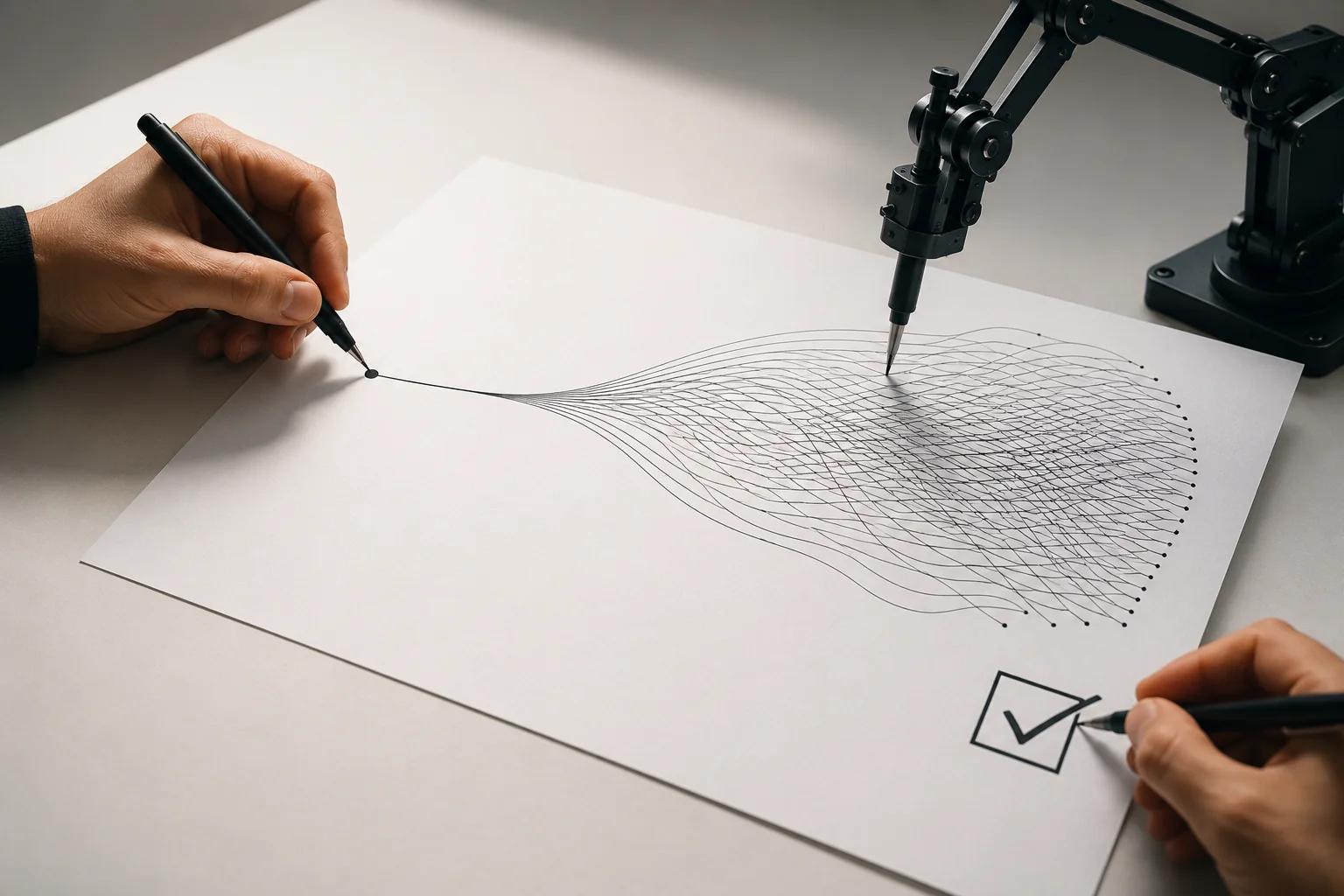
The emerging workflow: the human moves upstream to decide what should exist, and downstream to judge whether it is acceptable.
The significance is easy to underestimate. The human may no longer personally produce every sentence, image, or line of code — yet part of the human role moves upstream (deciding what should exist) and downstream (deciding whether what was produced is acceptable). This neither automatically makes the human the author of everything the machine generates, nor makes the machine the author. Research suggests ordinary judgments of authorship become more complicated as assistance increases: a 2024 experimental study (N = 602) found that assessments of a human author’s authorship, creatorship, and responsibility varied with the degree of assistance received during a writing task (Formosa et al., 2024).
That points to a problem “human versus AI” cannot capture. Authorship increasingly becomes a matter of how human agency is distributed across the process: Who chose the objective? Who supplied the constraints? Who rejected alternatives? Who verified the claims? Who decided the work was finished — and who is prepared to take responsibility for it? Those questions lead past text generation and toward intentionality.
A Prompt Is Not an Intention
This is why “prompt engineering” should not be mistaken for the essence of human agency. A prompt is an interface; intention is what precedes it. Consider the instruction “Make this better.” Technically it is a prompt. Intellectually it says almost nothing. Better how — more accurate, more persuasive, more ethical, more concise, more original? Better for whom, by which values?
Now picture a person who can say exactly what is wrong with an argument, identify the audience, separate evidence from speculation, specify what must remain uncertain, spot misleading framing, and reject an elegant answer because its reasoning is weak. The valuable capacity is not typing instructions into a box. It is forming and maintaining an intellectual objective. Interfaces will change — today’s carefully written prompts may give way to voice, persistent agents, multimodal interaction, or systems that infer what users now specify by hand. If human advantage rests merely on writing better prompts, it is temporary. Intentionality is deeper: deciding what is worth asking, what outcome is desirable, what trade-offs are acceptable, what evidence counts, what to doubt, and when to reject an answer that merely sounds convincing.
Better prompts sometimes produce better answers. But the deeper principle is simpler: better intention gives direction to capability.
When the Machine Surprises the Human
There is a complication. Generative AI does not always behave like a passive instrument. A hammer proposes no other building; a calculator rarely questions the point of the sum. Generative systems can offer alternatives a user never anticipated — structures, analogies, and combinations that change the direction of the work itself. So the relationship is more tangled than “human commands, machine executes.” The output can feed back into human intention: you begin with idea A, the system generates B, B makes you reconsider A, you develop C, the system generates D — and the finished work emerges from the loop rather than from a fully formed plan that existed at the start.
This is why calling AI merely a “tool” can hide what is genuinely new. These are tools, but tools able to take part in iterative symbolic processes that influence the people using them. Still, influence should not be confused with intention. A generated suggestion can change my decision without possessing a decision of its own — and that distinction becomes critical.
Who Is the Author?
Suppose a novelist builds a character, plot, moral conflict, and ending, then asks an AI for alternative lines of dialogue before selecting and rewriting portions. Now suppose another person types “Write me a 70,000-word thriller,” and publishes the result largely unchanged. Calling both “AI-assisted authors” conceals an enormous difference. Scholarship on generative AI and authorship is grappling with exactly this — examining how AI complicates contribution, responsibility, disclosure, and attribution rather than assuming a simple human/machine binary can resolve them.
The crucial measure of authorship, then, may not be the share of words a person physically typed. Typing is execution. Authorship has always involved more — selection, judgment, revision, purpose, responsibility — and intention may be what connects them. That gives us not a tidy formula, but something more useful: a better set of questions.
| Execution — can be delegated | Authorship — must be earned |
| Produce sentences, images, code | Choose what is worth making |
| Generate many alternatives | Reject the elegant-but-wrong one |
| Follow the instruction given | Decide which question matters |
| Optimise fluency | Decide what evidence counts |
| Answer the prompt | Take responsibility for what follows |
Execution can be delegated. Authorship must still be earned — AI can take the left column, but the right column is a human act, not an automatic entitlement
The Digital Cogito
Descartes sought something that could survive radical doubt. The AI age hands us a different uncertainty: we increasingly meet artifacts whose visible form tells us little about how much human cognition produced them. A paragraph no longer proves a human wrote the sentences; an illustration no longer proves a human drew the lines; software no longer proves its owner wrote the code. Even sophisticated reasoning on a screen cannot, by appearance alone, reveal how it was produced. So the digital transformation of the Cogito is not I generate, therefore I think — generation is no longer exclusively human. Nor is it I prompt, therefore I think — prompting is only a temporary interface. A more durable proposition may be this:

Generation and prompting are no longer uniquely human; forming purpose, judging, and taking responsibility still are.
“Author” here is not merely the legal sense, where copyright rules and institutional policies may define authorship differently. It means being an originating agent within a chain of creation: forming purposes, weighing possibilities, making choices, accepting consequences, and deciding what the output is ultimately for. Even this has limits. Intention alone cannot turn every machine-generated artifact into meaningful human authorship; someone who presses a button and accepts whatever appears has supplied an intention but little authorship. The Digital Cogito therefore requires more than desire — it requires intentional judgment. The more execution we delegate, the more that judgment is worth.
The Scarce Resource After Intelligence
For decades, digital technology made information abundant. Generative AI is now making certain forms of production abundant too: text almost instantly, images in seconds, code on demand, ideas multiplied faster than any person could pursue them. When production becomes cheap, producing more is not the valuable act. Choosing is. Knowing what deserves attention, which question matters, when a plausible answer is wrong, and what should not be automated — and deciding what all this capability should ultimately serve.
So the defining challenge of the AI age may be less about competing with machines to produce outputs, and more about preserving the human capacity to originate, evaluate, and take responsibility for purposes. AI dramatically expands the space of what can be generated; it does not tell us what ought to be. That boundary — between the possible and the worthwhile — may become one of the most important of the coming decades. The Digital Cogito is not a declaration of human superiority over machines. It is a demand for clarity about the human role inside increasingly machine-mediated cognition.
The Honest Limits
This argument has edges worth marking as clearly as its centre.
• “Intention” is not a magic word. Accepting whatever a system outputs is a thin form of authorship; the claim only holds when real judgment is exercised.
• The philosophy is unsettled. Searle’s argument is contested, and honest accounts should resist declaring the machine-mind question closed in either direction.
• Authorship has many definitions. Legal, academic, and ethical frameworks (for example, the ICMJE authorship criteria) draw the line differently; “originating agent” is a philosophical lens, not a legal ruling.
• Distributed agency cuts both ways. If a machine’s suggestion reshapes the work, sole human authorship becomes harder to claim — and easier to overstate.
None of this dissolves the argument. It sharpens it: the point is not that humans author everything, but that authorship now has to be earned through judgment, not assumed from output.
| MYME INSIGHT AI can generate the possibilities. Deciding what they mean, and what they are for, is the part that still has to be authored — and that is where the Cogito survives. |
Frequently Asked Questions
Does the “Digital Cogito” claim AI can’t think?
No. It deliberately sidesteps that unsettled question. Its point is narrower and more practical: fluent output no longer reveals how much human cognition produced it, so authorship must be judged by intention and responsibility, not appearance.
Isn’t writing good prompts the real skill?
It helps, but interfaces change — voice, agents, inferred context may replace hand-written prompts. What lasts is the ability to form an intellectual objective: deciding what is worth asking and when to reject a convincing-but-wrong answer.
If AI helped, am I still the author?
It depends on the distribution of agency. Choosing the objective, rejecting alternatives, verifying claims, and taking responsibility are authorship; accepting whatever appears is not. Research finds people’s authorship judgments shift with the degree of assistance.
Does calling AI a “tool” settle it?
Not quite. These tools can propose directions their users never intended, feeding back into human intention. Influence, though, is not intention — a suggestion can change your decision without having a decision of its own.
What becomes most valuable as production gets cheap?
Choosing well: knowing what deserves attention, which question matters, when a plausible answer is wrong, and what should not be automated — and taking responsibility for the purpose behind it all.
MyMe SuperDigital Perspective
As generative systems grow more capable, “Can the machine produce this?” becomes a weaker question by the month — increasingly, it can. The harder questions do not go away; they sharpen. Why are we producing it? Who chose the objective? Who judged the result? Who takes responsibility for what follows?
The machine can generate the possibilities. The human still has to decide what they mean — and to answer for the choice. That is not a claim of superiority; it is a description of a role that does not disappear just because execution can be delegated. Authorship, in the AI age, is less about who typed the words and more about who intended, judged, and stood behind them.
| I intend, therefore I remain the author — not because I produced every word, but because I chose the purpose, judged the result, and take responsibility for what it becomes. |
Continue Exploring
→ The Classroom of 2035 — why education’s scarce resource is shifting from knowledge to judgment.
→ Your Mind Needs More Silence — why mental space, not information, is the AI age’s scarce resource.
→ The Efficiency Trap — how to use AI without outsourcing your own thinking.
→ The Curiosity Engine — why asking better questions may become humanity’s greatest AI skill.
References
Philosophy of Mind
Descartes, R. (1637). Discourse on the Method (Part V, on machines and language).
Searle, J. R. (1980). “Minds, Brains, and Programs,” Behavioral and Brain Sciences, 3(3), 417–457. doi.org/10.1017/S0140525X00005756
Authorship & Generative AI
Formosa, P., Bankins, S., Matulionyte, R. & Ghasemi, O. (2024). “Can ChatGPT be an author? Generative AI creative writing assistance and perceptions of authorship, creatorship, responsibility, and disclosure,” AI & Society. doi.org/10.1007/s00146-024-02081-0
International Committee of Medical Journal Editors (ICMJE). Defining the Role of Authors and Contributors. icmje.org — authorship criteriaWritten by MyMe SuperDigital — exploring where technology meets the human mind.