
| Estimated Reading Time | Last Updated | Category | Companion Documentary |
| 10 min read | July 28, 2026 | AI Economy & Digital Finance | Available ▶ |
Why AI Needs Money begins with a simple paradox: the most capable software ever built cannot pay for anything on its own.
You can ask a modern AI system to find the cheapest cloud server, compare thousands of suppliers, and design an efficient plan — and it will do all of it in seconds. But the moment the plan requires an actual payment, the process has, until very recently, simply stopped. A human still had to press the button.
That gap matters because every meaningful action in the digital economy eventually reaches a transaction: a subscription, an API call, a licensing fee. An AI that can decide but cannot pay is intellectually powerful yet economically dependent. The more interesting question is no longer whether AI is capable. It is this: What happens when software can decide what to buy — but not complete the purchase?
Over the course of 2025 and into 2026, that question stopped being hypothetical. The payments industry began building infrastructure specifically for autonomous software — and how it is being built is one of the more consequential technology stories of the decade.
Watch the Companion Documentary
This article is accompanied by a short companion documentary that explores the same ideas through visual storytelling and real-world examples. If you prefer a visual introduction, watch it before continuing.
▶ Watch the Companion Documentary on YouTube
From Tools to Agents: What Is Actually Changing
For decades, software behaved like a calculator — it acted only after a human specified each step. AI agents work differently. You hand them a goal, such as “build and launch a working website by tomorrow,” and they break it into the dozens of smaller tasks required to reach it.
To finish that job, an agent needs to rent hosting, buy access to data, and pay for software APIs. Most of those capabilities already exist. The missing piece was the payment itself. Picture an agent trying to push a fraction-of-a-cent charge through a legacy card gateway: the request halts, the system asks for a human’s ID or verified address, the machine has none, and the transaction fails. We had built capable digital workers and forgotten to give them a wallet.
Why Traditional Banking Was Built for People
Modern finance assumes every participant is a person or a registered organization. Opening an account means government ID, proof of address, and compliance with Know Your Customer and Anti-Money-Laundering rules. Those safeguards protect the system — but an AI has no passport, no permanent address, and no legal identity, and it cannot sign a contract or accept liability.
Even if that barrier disappeared, the payment infrastructure would still face a speed mismatch. Traditional payment methods can involve multiple intermediaries, authorization steps, and settlement periods, while an AI agent can make a purchasing decision almost instantly. The challenge, therefore, is not simply how fast AI can decide, but whether the payment rail can execute and settle the transaction at a comparable pace. The mismatch is structural, and it is easiest to see side by side:
| Traditional Finance | AI / Machine Economy |
| Human identity (ID, KYC) | Tokenized or cryptographic agent identity |
| Business hours | 24 / 7, always on |
| Settlement can take minutes to days | Potentially near-instant settlement |
| Human approval required | Autonomous execution |
| Built around one large payment | Built around millions of tiny ones |
Two Roads Out of the Sandbox
Through 2025, the payments industry stopped theorizing and started shipping — along two very different roads.
The first keeps the familiar card rails. Mastercard’s Agent Pay, announced in April 2025, issues an “agentic token” scoped to a specific agent, merchant, and spending policy, so a model can check out without ever touching the raw card number. On 29 September 2025, Mastercard processed what it described as the first live agentic transaction — a real AI agent buying a real product, not a pilot. Visa followed in October with its Trusted Agent Protocol, and Google, Stripe, PayPal, and OpenAI each shipped their own frameworks the same year.
The second road takes a different approach. Launched by Coinbase in May 2025, x402 revives a long-dormant corner of the web—the HTTP 402 “Payment Required” status code—to enable software, including AI agents, to pay directly for digital resources over ordinary web requests. Cloudflare later partnered with Coinbase to establish the x402 Foundation and support the protocol’s development. Rather than requiring a traditional account, subscription, or API key for every interaction, x402 is designed to support programmatic payments at internet scale. Its rapid adoption since launch points to growing demand for payment infrastructure built for software as well as people.
The twist is that these roads are converging rather than competing. Visa says its Trusted Agent Protocol is designed to complement the Agentic Commerce Protocol (ACP), while the company is also collaborating with Coinbase to improve interoperability with x402. The real question was never “cards or crypto.” It is which layer each approach contributes—and which proves cheapest, safest, and easiest for a cautious enterprise to trust.
| KEY INSIGHT AI doesn’t need money because it wants wealth. AI needs money because autonomous work requires autonomous payment. |
The Machine Economy Ecosystem
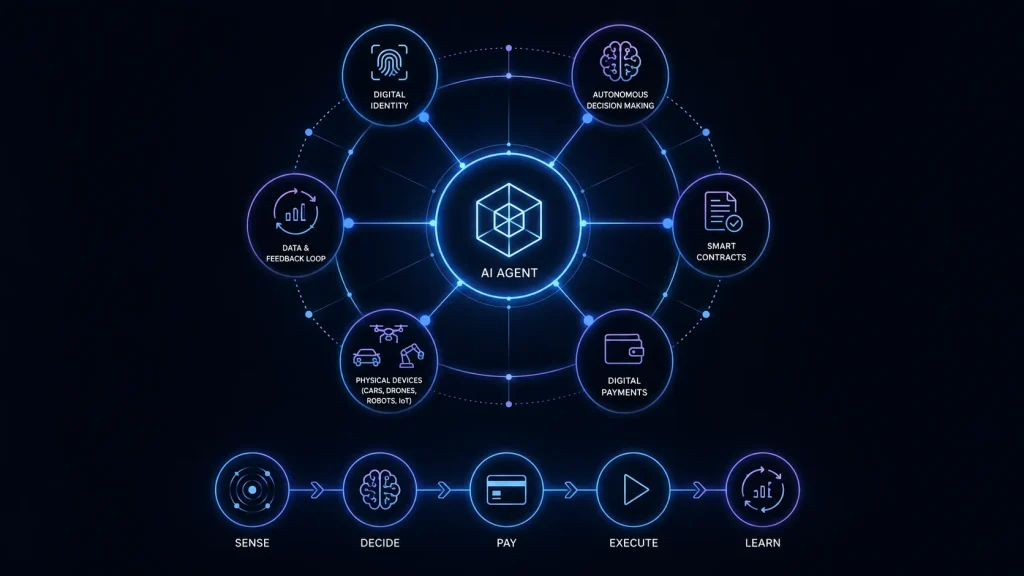
The machine economy is built on interconnected layers where AI agents combine identity, autonomous decision-making, programmable payments, smart contracts, connected devices, and continuous feedback to perform economic activities with minimal human intervention.
Why Stablecoins — and Their Catch
Both roads hit the same problem at the smallest, highest-frequency payments: a currency that can swing 10% in an afternoon is useless for settling steady sub-cent invoices. The working answer is stablecoins — tokens pegged to a currency such as the dollar, and the settlement asset underneath most x402 traffic (usually USDC). Regulation is furthest along here: the U.S. GENIUS Act, enacted in July 2025, requires dollar-backed issuers to hold full, liquid reserves and publish monthly disclosures.
But “stable” is a claim, not a guarantee. In March 2023, USDC briefly fell to about $0.87 when $3.3 billion of its reserves were trapped in the collapsing Silicon Valley Bank; it recovered within days once regulators intervened. TerraUSD, an algorithmic stablecoin, simply went to zero in 2022. Stablecoins are the strongest candidate for a machine-settlement layer — not a risk-free one. Their weak point is the reserves and institutions behind the peg, which is exactly what laws like GENIUS are meant to harden.
Not Every Blockchain Solves the Same Problem
A common misconception is that every blockchain does the same thing. They do not — and each carries its own trade-offs. None can yet call itself “the blockchain for AI”; x402 alone already runs across six of them at once, and the eventual winner may be several specialized networks working together.
| Network | Optimized for | Honest trade-off |
| Ethereum | Programmable smart contracts; deepest ecosystem | Higher fees, slower throughput when congested |
| Solana | Speed and near-zero fees | A history of network outages |
| Avalanche | High volume; customizable enterprise subnets | Smaller ecosystem than Ethereum |
| Stellar | Moving value across currencies and borders | Narrower complex-application use |
| XRP Ledger | High-volume, low-cost payments | Less suited to complex applications |
The Rulebook, Not Just the Engine
Suppose the technology works perfectly — and increasingly it does. A company still will not let an AI spend money until its legal team knows who is accountable when something goes wrong. If an agent’s purchase breaks a rule, is it the developer, the deploying company, the AI provider, or the machine? Faster rails make a transaction auditable; they do not decide who is liable. That still requires a legal model tying every agent to a responsible human or company.
Two U.S. laws are often cited here, and they do different jobs. The GENIUS Act (signed into law in July 2025) governs the stablecoins themselves. The CLARITY Act is a market-structure bill dividing oversight of digital assets between the SEC and the CFTC; it passed the House in July 2025 but, as of 2026, still sits in the Senate — so it is not law yet. Neither act is about AI or machine payments specifically. Together, they simply replace regulatory silence with rules enterprises can plan around — and that silence, not slow technology, is what keeps most corporate legal departments on the sidelines.
Beyond Price Charts: The Machine Economy
Public conversation frames blockchain through token prices. The more interesting story is the machine economy — software, robots, devices, and services exchanging value with little human involvement. Delivery robots paying charging stations. Factories reordering parts before they run out. Research systems renting GPU capacity for a few minutes, then releasing it. One agent paying another for a finished sub-task. Individually trivial; collectively, a new layer of economic activity running quietly in the background—and, in the case of x402, already demonstrating meaningful real-world adoption.
It rests on three pillars, and no single one is enough on its own:
| Intelligence AI supplies the decision-making — what to buy, when, and why. | Rails Programmable networks move value automatically and continuously. | Rules Regulation sets who is accountable and keeps machines aligned with human intent. |
Final Thoughts
Every major economic transformation has changed who — or what — could take part in commerce. Industrial machinery multiplied human output. The internet connected billions to global markets. AI may widen participation again by introducing autonomous actors that make limited economic decisions of their own.
Whether that arrives quickly or slowly is still genuinely uncertain, and the volatility, outages, and depegs described above are reasons for caution rather than footnotes. But one thing is getting hard to ignore. The future of AI will not be defined only by bigger models or faster chips. It may hinge on whether intelligent systems can exchange value as fluently as they already exchange information — and whether our human-built financial systems are ready for participants that were never meant to be human.
Frequently Asked Questions
Can AI agents actually make payments today?
Yes, though it is still early. Agentic payment systems are already being deployed across both traditional payment networks and emerging internet-native protocols such as x402. For now, most real deployments remain tightly scoped—bounded by spending limits, approved merchants, and consent policies—rather than fully open-ended.
What is x402?
x402 is an open payment protocol that uses the HTTP 402 “Payment Required” status code to enable machines—including AI agents—to pay directly for digital resources over ordinary web requests. Coinbase authored the original x402 transaction flow, while Cloudflare later partnered with Coinbase to establish the x402 Foundation and expand support for the protocol. x402 enables programmatic payments without requiring traditional accounts, subscriptions, or API keys, making it particularly well suited to small, high-frequency machine-to-machine transactions.
Why stablecoins instead of Bitcoin or other crypto?
Autonomous work needs a stable unit of account. A currency that swings sharply in a day cannot reliably settle sub-cent invoices. Stablecoins are pegged to a currency such as the dollar, which makes them predictable — though not risk-free, as the 2023 USDC depeg showed.
Is any single blockchain “the one” for AI?
Not yet, and perhaps never. Different networks specialize in different things, and agent-payment protocols such as x402 can operate across multiple blockchain networks. The machine economy may ultimately be distributed across several specialized networks rather than dominated by a single one.
Who is liable when an AI agent spends money?
This is still unresolved. Blockchain makes a transaction auditable, but it does not decide who is legally responsible. That requires a legal model tying every agent to a named human or company. Emerging laws reduce the surrounding uncertainty but do not, on their own, answer the liability question.
The MyMe SuperDigital Perspective
At MyMe SuperDigital, we think the defining contest here will not be won by a token or a ticker. It will be won by whichever standard enterprises can trust, audit, and defend to a regulator. The convergence of card networks and stablecoin rails suggests the future is not “crypto versus banks” but a shared settlement layer with several interchangeable engines underneath it.
For a business weighing autonomous systems, the practical lesson is that clarity tends to matter more than raw speed. A transaction that is a few milliseconds faster is worth little if no one can say who authorized it or who is responsible when it goes wrong. The organizations that benefit first will be those that pair autonomous execution with strong controls: scoped spending policies, clear audit trails, and a named human or entity behind every agent.
Continue Exploring This Topic
- The Missing Economy Behind Physical AI: Who Pays to Teach Robots?
- Why AI Won’t Choose Just One Blockchain
- Crypto & AI: Financial Revolution or the World’s Smartest Bubble?
- The AI Infrastructure Revolution: What If AI Needed a New Internet?
References
1. Mastercard, “Agent Pay” agentic-commerce framework (announced April 2025); first live agentic transaction, 29 September 2025. Overview · first live transaction.
2. Visa, “Trusted Agent Protocol” and Intelligent Commerce (October 2025). Visa investor announcement.
3. Coinbase & Cloudflare, “x402” HTTP-native stablecoin payment protocol; transaction-volume figures (2025–2026). Coinbase launch note · volume & adoption figures.
4. U.S. GENIUS Act — dollar-backed stablecoin framework, enacted July 2025. Arnold & Porter advisory.
5. Digital Asset Market CLARITY Act, H.R. 3633 — passed the House July 2025; pending in the Senate. Congress.gov (bill text).
6. USDC depeg during the Silicon Valley Bank collapse, March 2023. Stablecoin depeg reference.
7. Visa. (2025). Visa Introduces Trusted Agent Protocol: An Ecosystem-Led Framework for AI Commerce.
8. Solana network outage history, Helius: complete outage history.
Editorial Note
This article describes a fast-moving field. Transaction volumes, protocol details, and the legislative status of bills such as the CLARITY Act can change quickly; readers should verify current figures before relying on them. Nothing here is financial, investment, or legal advice, and no specific asset, network, or company is endorsed. The analysis is a forward-looking framework intended to support independent judgment rather than a prediction of any particular outcome.