
The Next Competitive Advantage May Not Be Smarter AI — but AI That Can Prove It Deserves to Be Trusted
| Reading Time | Last Updated | Category |
| 11 min read | August, 2026 | Education |
For a decade, the AI race had one scoreboard: build bigger models, train on more data, score higher on benchmarks. Intelligence was the metric. A quieter metric is now rising beside it — one that has nothing to do with speed or size, and everything to do with a single question: can the system prove how it reached its decision? The answer is becoming an operational requirement, and it is creating demand for an entirely new layer of technology.
Machines do not earn trust through reputation. They earn it through evidence — and evidence requires infrastructure.
Intelligence Is Becoming a Baseline
The first generation of AI innovation rewarded raw capability. Organisations that built better models won advantages in automation, personalisation, prediction, and content generation. But capability alone creates a problem: the more influential a system becomes, the more consequential its mistakes become.
An engine that recommends a film carries little risk. A system that helps evaluate a medical diagnosis, a loan, an insurance claim, a hiring decision, an educational assessment, or a piece of critical infrastructure operates under a completely different standard. There, accuracy remains essential — but accuracy alone is no longer enough. Organisations increasingly must answer questions traditional software rarely faced:
- Which information influenced the decision?
- Which version of the model produced the output?
- Was a human involved in the oversight?
- Has the output been altered since it was generated?
- Could an independent auditor reconstruct exactly what happened?
These questions are no longer theoretical. In regulated and high-impact settings, they are increasingly becoming core requirements for responsible AI deployment.
A Real Case: When a Correct Diagnosis Is Not Enough
Picture a hospital AI system that reviews a scan and recommends a diagnosis — and suppose it is right. In a regulated clinical setting, being correct is only half of what matters. Months later, and to an outside auditor, the hospital must still be able to reconstruct exactly how that recommendation came to be.
| CASE STUDY — HOSPITAL AI DIAGNOSIS – Model version: Which exact version produced the recommendation, and had it changed since it was last validated? – Logs: Which inputs and data influenced the output, and what relevant events were recorded at the time? – Reviewer: Which clinician, with appropriate authority, reviewed, confirmed, or overrode the recommendation? – Timestamp: When was the recommendation generated, when was it reviewed, and when was it entered into the patient record? |
If any of these cannot be produced, the decision may be accurate yet impossible to defend — clinically, legally, or ethically. The diagnosis is the easy part. Proving how it was reached is the hard part, and increasingly the required one. The same logic applies to a loan refusal, a rejected insurance claim, or a flagged exam paper.
| KEY TAKEAWAYS – The competitive frontier is shifting from capability to provability—from what AI can do to what organizations can demonstrate about how it operates. – AI regulation increasingly emphasizes documentation, record-keeping, human oversight, risk management, and lifecycle accountability, not performance benchmarks alone. – Under the EU AI Act, high-risk AI systems are subject to record-keeping requirements, including technical capabilities that enable the automatic recording of relevant events during operation. – Voluntary frameworks such as the NIST AI Risk Management Framework—Govern, Map, Measure, Manage—help translate AI risk management and trustworthiness into repeatable organizational practices. – This creates demand for what this article calls “verifiable infrastructure”: secure records, audit trails, provenance, identity, and version control designed to make AI systems more traceable and accountable—not simply more capable. |
Regulation Is Redefining Success
One of the most significant developments in AI is not technological — it is regulatory. Recent frameworks emphasise governance alongside innovation, introducing expectations around documentation, risk management, transparency, record-keeping, human oversight, and lifecycle accountability.
The EU AI Act makes this concrete. High-risk AI systems are subject to requirements covering risk management, data governance, technical documentation, transparency, human oversight, and record-keeping, including technical capabilities that enable the automatic recording of relevant events during operation. These records can support traceability, monitoring, and regulatory oversight. The Act is being applied in stages: obligations for general-purpose AI models began applying in 2025, while requirements for high-risk AI systems follow a later, phased implementation schedule.
The pattern is not unique to Europe. In the United States, the NIST AI Risk Management Framework—built around four functions, Govern, Map, Measure, and Manage—provides organizations with a structured framework for managing AI risks and trustworthiness, while the ISO/IEC 42001 AI management-system standard, against which organizations can seek certification, complements it. Different instruments, same direction of travel: for decades, digital innovation was judged largely by what systems could achieve; increasingly, organizations are also being asked whether those achievements can be explained, reviewed, and trusted.
Trust Requires Evidence
Trust has traditionally been a social concept. People trust institutions; customers trust brands; citizens trust governments. AI introduces a different challenge, because machines do not earn trust through reputation. They earn it through evidence — and evidence has a supply chain:
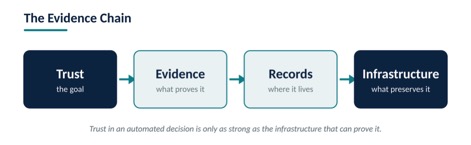
That final link is where the conversation moves beyond AI models themselves. Organisations increasingly need mechanisms to preserve evidence about how AI systems operate across their whole lifecycle: secure logging, immutable audit trails, cryptographic verification, identity management, provenance tracking, version control, and governance designed specifically for automated decisions. Collectively, these capabilities form what we can call verifiable infrastructure. Its purpose is not to make AI smarter. It is to make AI accountable.
| MYME INSIGHT A model tells you what the answer is. Verifiable infrastructure tells you how, when, by which version, and under whose oversight that answer was produced — and lets someone else check. |
The Invisible Layer Behind AI
Public attention fixes on visible technologies — large language models, AI agents, robotics, generative media, autonomous vehicles. Yet every mature technology rests on infrastructure that gets far less attention. The internet relies on protocols; cloud computing depends on distributed data centres; e-commerce depends on payment networks. AI is beginning to require its own supporting layer — not another model or chatbot, but systems that document, secure, verify, and govern automated decisions.
Much of this layer will stay invisible to end users. For organisations in regulated industries, it may become indispensable.
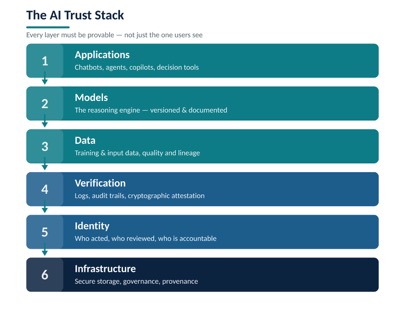
The AI Trust Stack: every layer — not just the visible application — has to be provable.
| QUICK GLOSSARY Verifiable infrastructure: the systems that log, secure, and prove how an AI decision was made — not the model itself.Audit trail: a tamper-evident record of events that lets an independent party reconstruct what happened.Provenance: the documented origin and history of data, a model version, or a generated output.Human oversight: a competent person able to interpret, intervene in, or stop an automated decision.Lifecycle accountability: responsibility that follows a system from design and deployment through post-market monitoring. |
From Automation to Accountability
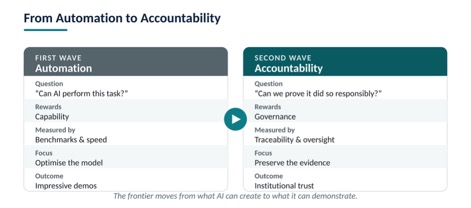
This transition marks a broader evolution in digital transformation. The first wave asked whether AI could perform a task. The second asks whether we can prove it performed the task responsibly. Those are fundamentally different questions: the first rewards capability, the second rewards governance. Organisations that answer only the first may build striking demonstrations; those that answer both are far more likely to build systems that earn lasting institutional trust.
A New Infrastructure Economy
Whenever society changes its expectations, infrastructure follows. The internet created demand for web servers, browsers, cybersecurity, and cloud computing. The smartphone created whole industries around mobile platforms and app stores. AI may now be creating demand for something equally foundational — infrastructure designed not to generate intelligence, but to verify it.
This emerging layer reaches beyond compliance. It touches cybersecurity, enterprise software, digital identity, risk management, governance, and public confidence in automated systems. The organisations building it may never become household names. But history repeatedly shows that foundational infrastructure often outlasts the technologies built on top of it.
What the Verification Layer Actually Includes
It is not one product but several categories of solution — described here as categories, not brands, so the picture stays durable as the market changes:
- Secure logging — tamper-evident, automatic records of what a system did, and when.
- Digital identity — verifiable answers to who acted, who reviewed, and who is accountable.
- Provenance systems — the documented origin and history of data, model versions, and generated outputs.
- Cryptographic attestation — proof that a record has not been altered since the moment it was created.
- AI governance platforms — policy, oversight, and lifecycle accountability managed in one place.
The Honest Limits
Verifiable infrastructure is necessary — but it is not a cure-all, and it is worth naming the caveats as clearly as the promise.
- A perfect audit trail does not make a decision correct. It proves what happened, not that what happened was wise or fair.
- Logs can capture bias faithfully. Recording a flawed process cleanly still leaves a flawed process; provenance is not fairness.
- Verification adds cost and complexity, which can widen the gap between well-resourced institutions and smaller ones.
- Standards are still maturing. Frameworks and laws differ across regions and continue to change, so today’s controls are a moving target.
- “Immutable” and “verified” are engineering claims, not guarantees; poor key management or governance can undermine them.
The takeaway is not that evidence solves trust on its own, but that trust at scale becomes impossible without it.
| MYME INSIGHT The next competitive edge in AI may belong less to whoever builds the most capable system, and more to whoever can prove their system deserves to be trusted — long after the decision was made. |
Frequently Asked Questions
What is “verifiable infrastructure”?
It is the supporting layer that documents, secures, and proves how AI systems operate — secure logging, immutable audit trails, provenance and version tracking, identity management, and governance for automated decisions. Its job is accountability, not raw intelligence.
Why is regulation driving this now?
Frameworks such as the EU AI Act require high-risk systems to keep automatic logs, technical documentation, and human oversight across their lifecycle. Proving compliance is impossible without infrastructure that preserves the evidence.
Isn’t an accurate model enough?
Not for consequential decisions. In healthcare, finance, hiring, or critical infrastructure, organisations must also show which data and model version produced an output, whether a human reviewed it, and whether it was later altered.
Does this slow innovation?
It reframes it. Voluntary frameworks like the NIST AI RMF and standards like ISO/IEC 42001 aim to make risk management repeatable, so responsible systems can be deployed with confidence rather than blocked by uncertainty.
Who builds this layer?
Not a single vendor, but several categories of solution — kept deliberately generic here so the article stays durable: secure logging, digital identity, provenance systems, cryptographic attestation, and AI governance platforms. Most stay invisible to end users, yet become essential wherever real accountability applies.
MyMe SuperDigital Perspective
History rarely turns on a single invention. It turns when society changes the rules by which inventions are judged. AI may be approaching one of those moments. For years, progress was measured by what machines could create; the next phase will increasingly measure what they can demonstrate — not just intelligence, but transparency; not just automation, but accountability; not just performance, but verifiability.
If that transition holds, verifiable infrastructure could become one of the defining technologies of the next decade — not because it makes AI more intelligent, but because it makes intelligence governable. The organisations that internalise this early will not merely comply with the coming rules; they will be trusted to operate where others cannot.
| “ The next competitive advantage in AI may belong not to those who build the most capable systems, but to those who can prove those systems deserve to be trusted. |
Related from MyMe SuperDigital
→ AI Literacy — why understanding AI is becoming a core human skill.
→ Cognitive Overload — how an always-on information stream strains human attention.
→ AI Agents — what changes when AI can act on our behalf, not just answer.
→ The AI Economy — how value, work, and advantage are being redrawn by AI.
References
EU AI Act — Governance, Logging & Oversight
European Union (2024). Regulation (EU) 2024/1689 (Artificial Intelligence Act) — Article 12, Record-Keeping. artificialintelligenceact.eu — Article 12
European Union (2024). AI Act — Article 14, Human Oversight. artificialintelligenceact.eu — Article 14
European Commission. AI Act — Recital 66 (requirements for high-risk AI systems). ec.europa.eu — Recital 66
U.S. & International Frameworks
NIST (2023). AI Risk Management Framework (AI RMF 1.0), NIST AI 100-1. National Institute of Standards and Technology. airc.nist.gov — AI RMF Core
ISO/IEC (2023). ISO/IEC 42001 — AI Management System Standard. International Organization for Standardization. iso.org — ISO/IEC 42001
Written by MyMe SuperDigital — exploring where technology meets the human mind.