| Estimated Reading Time | Last Updated | Category | Companion Documentary |
|---|---|---|---|
| 8 min read | July 2026 | Smart Real Estate & Smart Cities | Available ▶ |
For more than a century, cities measured success in one direction: upward.
The tallest tower. The highest observation deck. The most recognizable skyline.
Height became a universal symbol of economic strength, engineering ambition, and national progress.
Today, however, a different idea is reshaping urban planning.
Increasingly, the world’s most ambitious developments are being judged not by how high they build, but by how intelligently entire communities are designed.
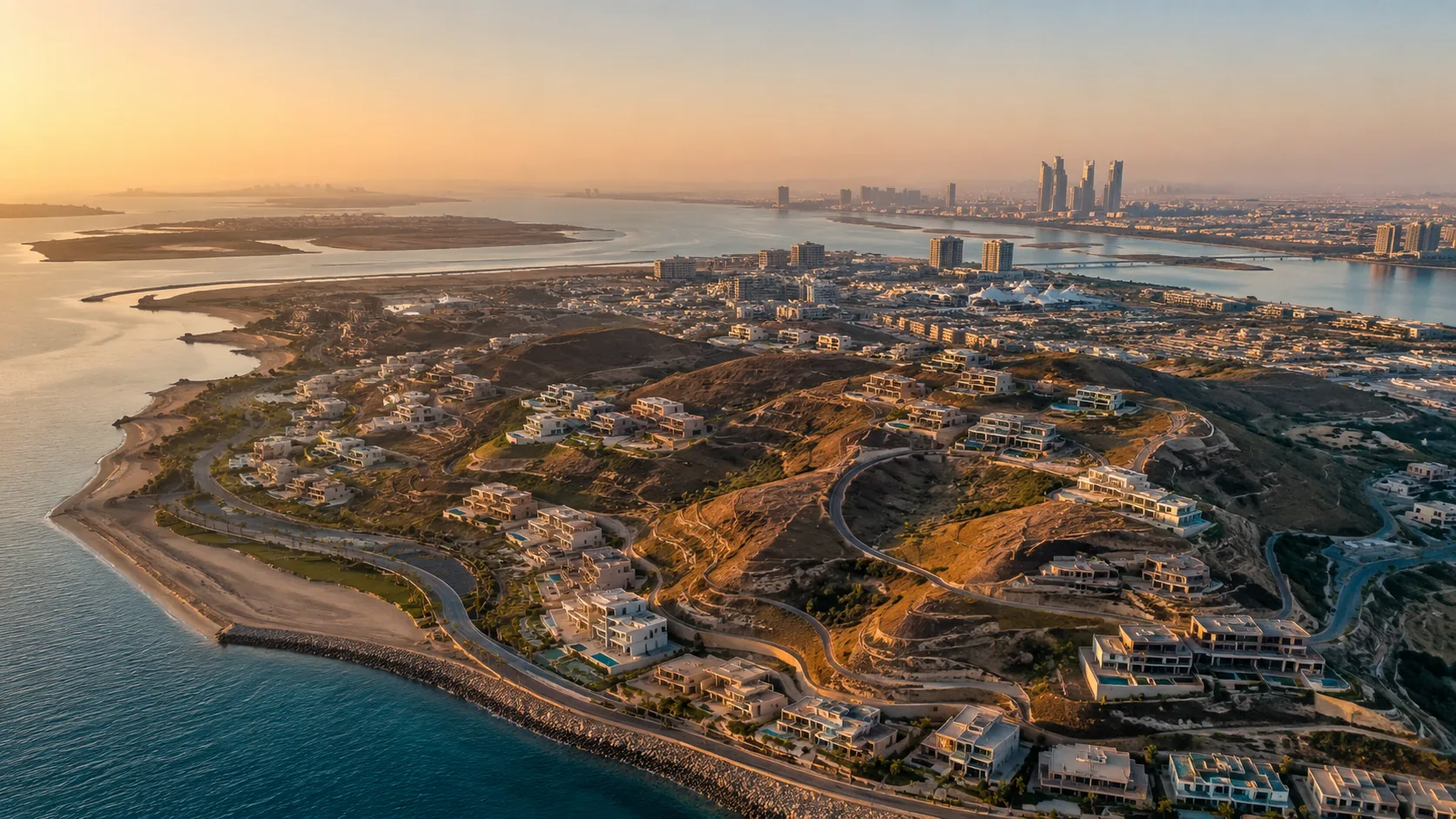
Abu Dhabi’s Hudayriyat Island is one of the clearest examples of that shift.
More than a luxury waterfront destination, it represents an attempt to rethink how people experience a city—from the shape of its landscape to the technologies operating quietly behind it.
It is an ambitious vision, and one that deserves genuine recognition.
At the same time, ambitious projects deserve equally ambitious scrutiny.
This article takes Hudayriyat’s vision seriously, highlights what the development demonstrably achieves today, and then asks a simple question:
How much of the “smart city” promise can we verify based on publicly available evidence?
Developed by Modon, the Government of Abu Dhabi–mandated master developer, Hudayriyat combines engineered landscapes, active public spaces, smart-home technologies, connected infrastructure, smart-city ambitions, and human-centered urban planning across a masterplan exceeding 51 million square metres—roughly 54% of the size of Abu Dhabi Island.
It is one of the most ambitious urban developments currently underway in the region.
It is also, based on publicly available information, still in the process of demonstrating the deepest layer of its smart-city vision.
That gap should not be viewed as criticism.
It is precisely what makes the project worth examining.
Why Traditional Urban Growth Hits a Ceiling
Companion Documentary
Watch the companion documentary on YouTube to see the concepts discussed in this article brought to life through visuals and on-location analysis.
▶ Watch on YouTube
Modern cities have become remarkably good at solving one problem: limited land.
As populations expanded, developers built upward.
The approach worked.
High-rise districts increased density, maximized land value, and created the skylines now associated with cities such as Dubai, New York, Singapore, and Shanghai.
Yet height changes remarkably little about daily life once people reach the street.
Residents may enjoy spectacular views from the fiftieth floor, but they still encounter the same traffic congestion, fragmented public spaces, heat radiating from pavement, and neighborhoods designed primarily around cars rather than people.
In other words, skyscrapers reshape the skyline far more effectively than they reshape everyday life.
That realization is encouraging planners to rethink one of urban development’s oldest assumptions.
Instead of asking how much more can be built, cities are increasingly asking a better question:
How much better can people live?
Hudayriyat Island represents one of the boldest attempts to answer that question—not by adding taller buildings, but by reconsidering how an entire environment is designed.
Its most immediately visible innovations are physical rather than digital.
Engineering Geography Instead of Accepting It
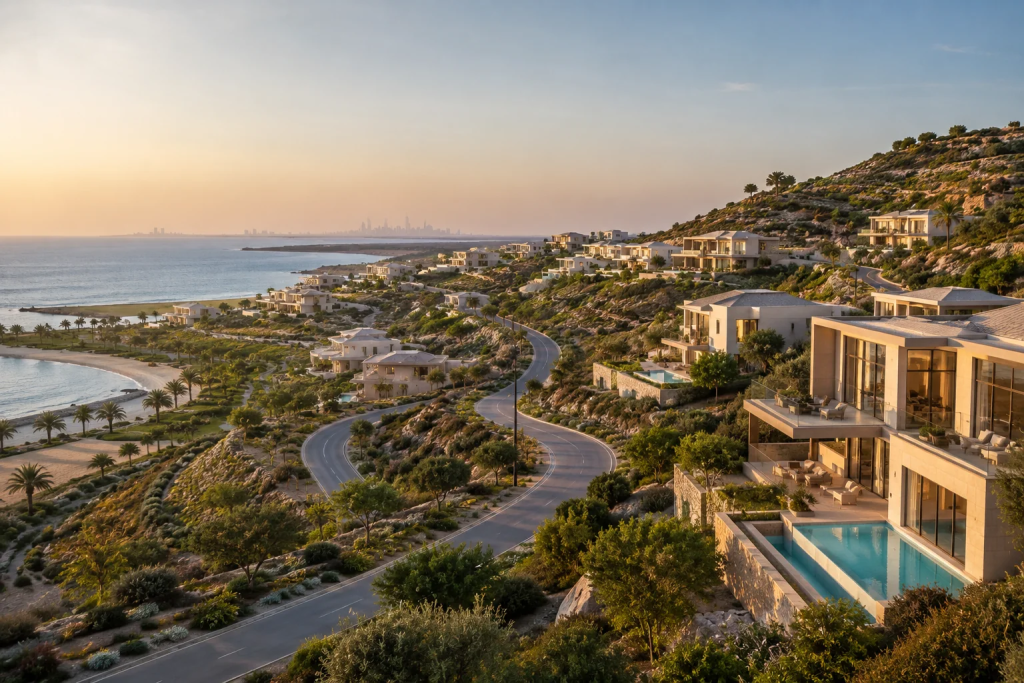
Perhaps the most distinctive aspect of Hudayriyat Island is that it does not simply build on the landscape.
It reshapes it.
The island itself is largely reclaimed land, and within the Nawayef community engineers have created rolling man-made hills reaching up to approximately 60 metres in height.
In a region historically defined by flat coastal terrain, that decision fundamentally changes how neighborhoods feel.
Rather than arranging villas across a level surface, homes are built directly into engineered slopes overlooking the Arabian Gulf and the Abu Dhabi skyline.
The design openly draws inspiration from hillside communities in coastal California, while Nawayef Village introduces townhouses influenced by Tuscan architecture.
The architectural style attracts attention.
The engineering philosophy is arguably even more significant.
For centuries, cities adapted to rivers, mountains, forests, and coastlines that already existed.
Hudayriyat reverses that relationship.
Instead of allowing geography to dictate urban form, engineering creates the geography required to support the desired living experience.
As a placemaking strategy, the result is genuinely innovative.
Elevation reshapes walking routes.
It creates visual diversity.
It encourages movement between parks, public spaces, and residential districts.
Rather than producing another uniform masterplan, the landscape itself becomes part of the architecture.
In that sense, Hudayriyat contributes something genuinely new to human-centered urban planning within the Gulf.
At the same time, responsible analysis also asks what those achievements cost.
Engineering terrain at this scale inevitably raises environmental questions alongside engineering ones.
Those questions deserve attention—not because they diminish the project’s ambition, but because ambition of this magnitude deserves equally serious evaluation.
The Sustainability Questions Worth Asking
Modon presents Hudayriyat as a model for sustainable living.
The ambition behind that vision is evident, and the developer has invested in environmental studies, including marine-impact modelling that began years before construction.
Recognizing those efforts is important.
So is acknowledging where public information remains incomplete.
The first question concerns the earthworks themselves.
Reclaiming land and constructing hills that rise approximately sixty meters requires moving enormous quantities of sand, rock, and engineered fill.
That process inevitably involves dredging, heavy machinery, marine construction, and transportation—activities that carry environmental impacts.
Publicly available information confirms that marine engineering has been undertaken to understand shoreline conditions.
However, no publicly available lifecycle assessment or project-specific carbon analysis currently allows independent evaluation of the overall environmental balance.
The second question concerns water.
Surf Abu Dhabi, extensive landscaping, golf developments, and large recreational spaces all depend on significant water resources.
In the Gulf, freshwater is largely produced through desalination—an energy-intensive process.
This challenge is not unique to Hudayriyat.
It applies to virtually every large coastal development across the region.
Nevertheless, project-level data regarding long-term water consumption and operational efficiency has not yet been publicly disclosed, making independent assessment difficult.
The third question concerns climate.
Hudayriyat’s masterplan includes a 220-kilometre network of cycle tracks, reinforcing the island’s emphasis on active outdoor lifestyles.
During Gulf summers, however, temperatures regularly exceed 40°C, limiting comfortable outdoor activity for extended periods.
To Abu Dhabi’s credit, urban planning increasingly incorporates shaded public spaces, cooling strategies, and climate-responsive design.
The challenge therefore appears less a flaw than an important design question that future smart communities will need to address.
None of these observations diminish Hudayriyat’s achievement.
On the contrary.
Projects attempting to redefine urban living deserve careful analysis precisely because of their ambition.
The larger the vision, the higher the standard by which it should be evaluated.
Is Hudayriyat Island Really a Smart City?
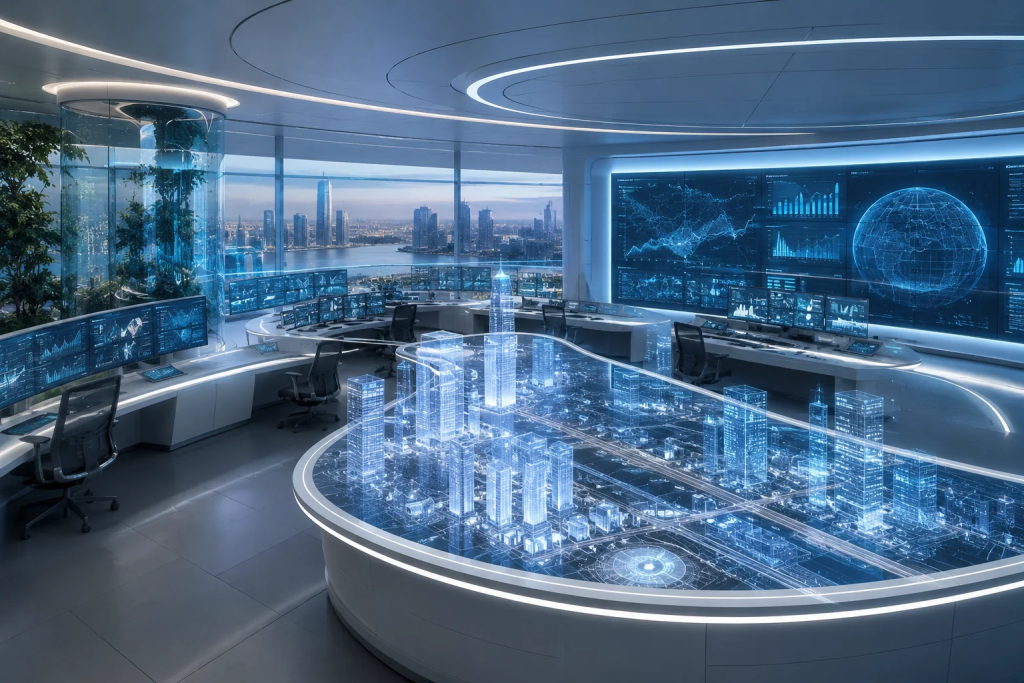
This is where admiration meets a fair caveat.
Modon presents Hudayriyat as a connected community built around smart-home technology, digital infrastructure, and a long-term vision for intelligent urban living. That direction aligns closely with where many leading smart-city projects around the world are heading.
The question is not whether the vision is credible.
The question is how much of that vision has been publicly demonstrated.
Based on information available at the time of publication, the project’s digital layer remains less visible than its physical one.
The developer has not publicly detailed the types of sensors deployed across the community, explained how operational data is collected and analyzed, described its governance framework, or published measurable performance indicators such as projected reductions in energy consumption, water usage, maintenance costs, or traffic congestion.
That absence does not imply these systems do not exist.
Many large developments introduce digital capabilities in stages.
However, until measurable outcomes become publicly available, the smartest interpretation is also the most balanced one.
Today, Hudayriyat demonstrates a sophisticated physical environment designed to support future intelligent infrastructure.
Tomorrow, publishing measurable results would allow that ambition to evolve from a compelling vision into a verifiable smart-city model.
That distinction matters.
A truly smart city is not defined by connected devices alone.
It is defined by measurable improvements in how a city performs.
Who Is Hudayriyat Built For?
A human-centered community naturally raises another important question.
Who is that community designed to serve?
Hudayriyat has clearly positioned itself within Abu Dhabi’s premium residential market.
Nawayef Village sold rapidly, with townhouses averaging approximately AED 5.3 million and Nawayef Mansions beginning from around AED 6.6 million. Other premium communities across the island also achieved record-breaking sales shortly after launch, reinforcing Hudayriyat’s position as one of the UAE’s most desirable luxury residential destinations.
Those results demonstrate exceptionally strong market confidence.
They also define the project honestly.
At present, Hudayriyat represents a premium lifestyle community rather than a model intended for broad affordability.
There is nothing inherently problematic about that.
Luxury developments play an important role within diversified urban economies.
The more interesting long-term question is whether the planning ideas pioneered here—engineered landscapes, active living, and connected infrastructure—can eventually become accessible beyond the luxury segment.
If they can, their impact on future urban development could extend far beyond a single island.
Competing for Global Talent
Cities increasingly compete for people rather than capital alone.
Highly skilled professionals, entrepreneurs, researchers, and technology companies now evaluate quality of life alongside economic opportunity when choosing where to live.
Reliable digital infrastructure.
Walkable neighborhoods.
Environmental quality.
Recreation.
Efficient mobility.
These factors have become competitive advantages.
Positioned only minutes from central Abu Dhabi, Hudayriyat appears designed with exactly that audience in mind.
Viewed through this lens, the island represents more than a residential development.
It forms part of a broader strategy to strengthen Abu Dhabi’s position as a destination for globally mobile talent.
On that objective, the project already presents a coherent and highly competitive proposition.
An Admirable Vision, Still Proving Its Smart Promise
So how should Hudayriyat Island be understood today?
Based on publicly available information, it stands as one of the Gulf’s most ambitious examples of contemporary placemaking.
Its engineered topography is genuinely innovative.
Its outdoor lifestyle strategy is thoughtfully integrated.
Its architectural identity is distinctive.
Its commercial success demonstrates strong market confidence.
These achievements deserve recognition.
Where careful analysis becomes important is the specific label of “smart city.”
At present, the evidence suggests that Hudayriyat is best understood as an emerging smart community rather than a fully demonstrated smart city.
Its ambitions are clear.
Its direction is compelling.
Its physical foundations are exceptionally strong.
Yet several elements remain publicly unverified, including measurable operational performance, transparent data governance, and independently assessable sustainability outcomes.
Recognizing those gaps should not be mistaken for skepticism.
It reflects the same standard applied to any project claiming to represent the future.
Fortunately, the distance between ambition and proof appears entirely bridgeable.
Publishing measurable resource-efficiency results, explaining governance frameworks, and demonstrating how intelligent infrastructure improves everyday life would strengthen an already impressive development.
The future of smart cities will not ultimately be defined by ambitious concepts alone.
It will be defined by measurable outcomes.
Continue Reading
AI is transforming not only how cities are designed, but also how people search for, evaluate, and invest in real estate. Read our analysis: Will AI Replace Real Estate Websites? Or Simply Change the First Decision We Make?
Hudayriyat has already demonstrated bold urban thinking.
The next milestone is demonstrating, with equal confidence, how intelligent infrastructure delivers measurable value for the people who live there.
If that happens, Hudayriyat may become more than an impressive development.
It may become one of the projects that genuinely helped redefine what a smart city means.
This assessment is based on publicly available information available at the time of publication and reflects evidence-based analysis rather than independently audited findings.
Frequently Asked Questions
Is Hudayriyat Island a fully AI-powered smart city?
Not yet in a publicly documented sense. The development incorporates smart-home technologies and connected infrastructure ambitions, but detailed information regarding city-scale AI systems, data governance, and measurable operational performance has not yet been publicly disclosed.
Who develops Hudayriyat Island?
Hudayriyat Island is being developed by Modon, the Government of Abu Dhabi–mandated master developer, as part of a masterplan covering more than 51 million square meters.
Is Hudayriyat Island designed for everyone?
At present, it primarily targets the premium residential market. Whether the planning concepts pioneered there can eventually be adapted for broader communities remains an important question for future urban development.
What are the main sustainability questions?
Current discussion focuses on land reclamation, large-scale earthworks, desalinated water demand, and long-term operational efficiency. While Modon has invested in environmental planning, project-level lifecycle, carbon, and resource-efficiency data have not yet been publicly released.
MyMe SuperDigital Perspective
Smart cities should not be judged solely by connected devices, luxury amenities, or ambitious marketing. Their long-term success will ultimately depend on whether technology, engineering, and urban planning measurably improve everyday life—and whether those improvements can be demonstrated through transparent evidence. Our goal is not to celebrate or dismiss ambitious projects, but to examine them with curiosity, balance, and evidence-based analysis. Hudayriyat Island represents exactly the kind of forward-looking development that deserves both recognition for its achievements and thoughtful scrutiny of its claims.
Continue Exploring This Topic
- AI + Human Expertise: The Future of Real Estate Isn’t What Most People Think
- Will AI Replace Real Estate Websites? Or Simply Change the First Decision We Make?
- The AI Infrastructure Revolution: What If AI Needed a New Internet?
- The Missing Economy Behind Physical AI: Who Pays to Teach Robots?
References
- Modon Holding (Official Website)
- Hudayriyat Island Masterplan – Modon
- Nawayef Village – Official Launch
- Zawya – Al Hudayriyat Island: A Model of Integrated Urban Transformation
- World Construction Network – Modon Awards Contract for Residential Project
- Geosyntec – Hudayriyat Island Marine Engineering & Shoreline Modelling
- Time Out Abu Dhabi – California-Inspired Nawayef Neighbourhood
Source Note: Much of the publicly available information originates from the developer and established real-estate publications. Independent urban-planning, environmental, and social evaluations remain limited, which naturally constrains any definitive assessment.
Technology Note: Information regarding digital infrastructure, smart-home technologies, and AI-related capabilities is based on publicly available material released by the developer and supporting project documentation. At the time of publication, detailed technical specifications, operational performance metrics, and governance frameworks had not been publicly disclosed.