
Artificial intelligence is making answers nearly free. Discover why curiosity, critical thinking, and asking better questions are becoming the defining skills of the AI economy.
| Estimated Reading Time | Last Updated | Category | Companion Documentary |
|---|---|---|---|
| 11 min read | July 31, 2026 | Future Society | Available ▶ |
Artificial intelligence is changing what humans know. Curiosity will determine what humans discover next.
Key Takeaways
- AI is making answers abundant, making curiosity more valuable.
- Better questions lead to better decisions.
- Curious organizations adapt faster to change.
- AI should amplify human curiosity, not replace it.
Every Revolution Changes What Makes Humans Valuable
Every technological revolution has quietly redefined what society values most.
- The Industrial Revolution rewarded physical labor.
- The Information Age rewarded knowledge acquisition.
- The AI Revolution is increasing the value of asking meaningful questions.
Large language models can summarize books, generate code, analyze financial reports, and answer complex questions in seconds. As answers become instantaneous and near-free, the competitive advantage shifts away from merely holding information and toward identifying the questions worth exploring.
The World Economic Forum’s Future of Jobs Report 2025 points the same way. Analytical thinking remains the single most sought-after skill — essential for seven in ten employers — while curiosity and lifelong learning are among the capabilities expected to rise fastest through 2030. The Forum estimates that 39% of workers’ core skills will change by 2030, and that 59% of the global workforce will need retraining within the decade. These are no longer soft, purely educational traits. They are economic assets.
| KEY TAKEAWAYS – AI is making many forms of information and answers increasingly abundant—raising the relative value of well-framed questions. – As access to answers becomes easier, the ability to identify and frame valuable questions becomes increasingly important. – Curiosity is not a mood you wait for. It is a system you can engineer. – That system has three parts: an information gap, strategic constraints, and frictionless failure. – The future advantage may belong to people—and organizations—that never stop asking better questions. |
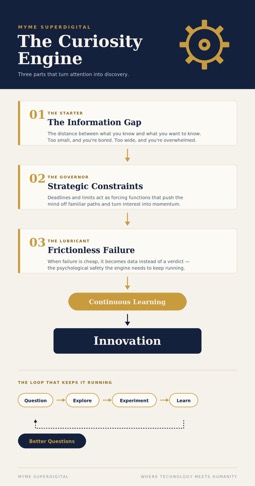
The Curiosity Engine — three parts that turn attention into discovery.
Curiosity Is Not Weather. It Is a Machine.
Most of us treat curiosity like a weather event: a sudden, unpredictable flash that strikes from nowhere. So we wait. We wait for inspiration. We wait for motivation. We wait until something feels interesting.
In an era of rapid automation, waiting is expensive. When routine work is handled by software, the inability to generate interest on demand becomes a structural bottleneck for growth — a quiet curiosity deficit.
There is a more useful way to see it. Curiosity behaves less like weather and more like an engine: a systematic piece of internal machinery that can be deliberately engineered, calibrated, and optimized. Master its mechanics, and you stop being a passive consumer of information and become an active architect of discovery.
An engine needs three working parts. When curiosity stalls, one of them is usually broken.
Component One — The Starter: The Information Gap
The engine ignites through what psychologist and economist George Loewenstein called the information gap: the distance between what we currently know and the specific thing we want to discover. Curiosity is the mind measuring that distance and deciding it is worth crossing.
The size of the gap is everything.
If the gap is too small, there is nothing to cross. Boredom sets in and the engine never turns over. If the gap is too large, the bridge simply breaks — the challenge feels impossible, and the system shuts down under overwhelm. Sustained curiosity lives in the narrow band between the two: a “Goldilocks gap” that is far enough to be worth reaching, yet close enough to feel reachable.
This is not just a metaphor for motivation. Neuroscientists Matthias Gruber, Bernard Gelman, and Charan Ranganath found that states of high curiosity engage the brain’s dopaminergic reward circuit and strengthen hippocampus-dependent memory — people not only learned curious material better, they also retained incidental information encountered while curious. Curiosity, in other words, is a chemical spark that measurably improves how effectively we learn.
| MYME INSIGHT Artificial intelligence can instantly provide information. It cannot decide which information deserves your attention. The advantage belongs to those who can locate the next meaningful gap before everyone else notices it exists. |
Component Two — The Governor: Strategic Constraints
Once the engine is running, it needs a governor: a mechanism that channels raw energy through deliberate limits.
Conventional wisdom says innovation needs unlimited freedom and boundless resources. In practice, the opposite often holds. Tight deadlines, restricted tools, and shifting rules act as forcing functions — they push the mind off its familiar paths and require it to ask new questions simply to navigate the new borders. Constraints supply the pressure that converts passive interest into forward momentum.
Educational researcher Manu Kapur, of ETH Zurich, describes a related mechanism he calls productive failure. In his studies, learners first asked to grapple with a hard, well-designed problem — often failing to solve it — went on to understand the underlying concepts more deeply than peers who were handed the correct method up front. The struggle was not wasted effort; it was the mechanism of understanding.
The relationship isn’t unconditional. Constraints help when they are meaningful and well-matched to the task; arbitrary or crushing limits can just as easily kill momentum. The art lies in choosing the right friction, not the most.
| CASE STUDY — GOOGLE’S 20% TIME: Google became known for allowing engineers to devote a portion of their working time to projects beyond their core responsibilities. Rather than optimizing every hour for immediate output, the approach created space for employee-led experimentation and exploration. It became a prominent example of how organizations can deliberately make room for curiosity alongside core work. The broader lesson is simple: innovation does not always begin with instructions. Sometimes it begins with permission to explore—bounded by enough structure to stay productive. |
| MYME INSIGHT Many startups succeed not despite scarce resources but because of them. AI is lowering technical barriers dramatically — but human creativity still thrives where thoughtful boundaries force sharper thinking. |
Component Three — The Lubricant: Frictionless Failure
An engine under pressure will seize without lubrication. For curiosity, the lubricant is frictionless failure.
If the penalty for a wrong answer is severe, the whole system locks up. People stop experimenting, stop asking, and retreat to what is safe. Harvard Business School professor Amy Edmondson calls the antidote psychological safety: an environment where individuals can question, experiment, and be wrong without fear of embarrassment or punishment. Her research links teams with high psychological safety to greater learning, innovation, and adaptability.
The shift is subtle but decisive. Failure has to be stripped of emotional weight and treated as neutral, actionable data. A wrong turn becomes a diagnostic reading rather than a verdict on your worth. Every unsuccessful experiment reduces uncertainty. Every mistake sharpens the next decision. Failure becomes information — not identity.
| MYME INSIGHT AI’s most underrated contribution may not be automation but cheap experimentation. Ideas that once took months to test can now be tried in hours. When failure costs little, curiosity is free to run. |
| “The important thing is not to stop questioning. Curiosity has its own reason for existing.” — Albert Einstein |
Why AI Changes the Economics of Curiosity
Put the three components together — a well-sized gap, intelligent constraints, and frictionless failure — and you have an engine running at capacity.
AI reshapes the economics around that engine. By driving the cost of producing answers toward zero, it changes what is scarce. Knowledge is no longer the bottleneck; good questions are. The shift is easiest to see as a simple before-and-after.
| The scarce resource BEFORE AI | The scarce resource AFTER AI |
| Knowledge | Questions |
| Memory | Judgment |
| Searching | Thinking |
| Information | Insight |
| Having answers | Knowing what to ask |
Businesses increasingly compete on their ability to spot new opportunities first. Researchers compete on framing unexplored problems. Entrepreneurs win by asking what others overlook. In the AI economy, curiosity behaves like a form of capital — and questions are the assets that appreciate.
This also reframes education. For decades, schooling rewarded memorization and correct answers. But when a machine can produce accurate answers on demand, the value of recall falls and the value of inquiry rises. Bodies like UNESCO and the OECD increasingly argue that education should prioritize critical thinking, creativity, curiosity, and lifelong learning over rote recall. The classroom of the future may care less about remembering information and more about investigating uncertainty.
| MYME INSIGHT Perhaps schools should start grading the quality of a student’s questions, not only the accuracy of their answers. Tomorrow’s breakthroughs will begin with curiosity, not memorization. |
Diagnose Your Own Engine
The most practical consequence of the engine model is this: feeling uninspired is not a character flaw. It is a structural bug in one of three components — and bugs can be found and fixed.
When your curiosity stalls on a project, run a quick diagnostic:
- Is the starter broken? The gap may be wrong-sized. If you are bored, the challenge is too small — widen it. If you are overwhelmed, the gap is too large — break it into a reachable next step.
- Is the governor broken? You may have too much freedom and too little structure. Add a constraint: a deadline, a tighter scope, a tool you’re forced to work within.
- Is the lubricant broken? The cost of failure may be too high. Lower the stakes so experiments feel cheap and mistakes read as data.
Curiosity becomes self-sustaining only when all three parts are working. Stop waiting for inspiration to arrive, and start redesigning the machinery that produces it.
| WHY THIS MATTERS Technology. Curiosity is the human input AI can’t supply for itself — it decides which questions the machine gets pointed at. Business. As answers commoditize, advantage migrates to teams that surface the right problems first and can test them cheaply. Society. Education and hiring built around recall are optimizing for the one thing machines now do for free. The future. The scarce, compounding resource of the AI era is a well-designed question — and the discipline to keep asking better ones. |
Final Thought
History rarely remembers the people who held the most information. It remembers those who asked transformative questions. Isaac Newton asked why objects fall. Charles Darwin asked why species change. Alan Turing asked whether machines could think.
Today, artificial intelligence gives humanity access to more answers than ever before. The next great advantage will not belong to those who collect the most information. It will belong to those who never stop asking better questions.
Frequently Asked Questions
Is curiosity something people are born with?
Not entirely. While some individuals naturally display higher levels of curiosity, decades of psychological research suggest that curiosity can be intentionally developed. Exposure to novel experiences, meaningful challenges, and psychologically safe environments all contribute to strengthening curiosity over time.
Why is curiosity becoming more valuable in the AI era?
Artificial intelligence has dramatically reduced the cost of accessing information. As answers become increasingly abundant, the ability to ask meaningful questions, identify emerging opportunities, and connect unrelated ideas becomes a far more valuable human capability.
How does curiosity improve learning?
Research in cognitive neuroscience shows that curiosity activates the brain’s reward system, increasing motivation while strengthening long-term memory formation. People tend to learn and retain information more effectively when they are genuinely curious about the subject.
Can companies build a culture of curiosity?
Yes. Organizations can encourage curiosity by promoting psychological safety, rewarding thoughtful questions, supporting experimentation, and treating failure as part of the learning process rather than something to avoid.
Can AI replace human curiosity?
Not in the human sense. AI can generate questions, summarize knowledge, and identify patterns, but determining which unanswered questions are meaningful, valuable, or worth pursuing ultimately depends on human goals, values, and context.
MyMe SuperDigital Perspective
Artificial intelligence is often described as a machine that produces answers.
We believe its greatest impact is something much deeper. As AI continues to reduce the cost of generating information, it simultaneously increases the value of human curiosity.
Throughout history, competitive advantage evolved from physical strength to knowledge, and now toward the ability to recognize meaningful problems before others do. This shift may become one of the defining characteristics of the AI economy.
At MyMe SuperDigital, we view curiosity as more than a personality trait. It is the operating system behind lifelong learning, responsible AI adoption, innovation, critical thinking, and resilient decision-making.
The organizations that encourage questioning will innovate faster. The schools that reward exploration will prepare students more effectively. And the individuals who continuously refine their curiosity engine will remain adaptable regardless of how rapidly technology evolves.
The future will not belong to those with unlimited information. It will belong to those who continue asking better questions.
Watch the Documentary
The ideas explored in this article were inspired by the documentary “The Curiosity Engine: Why Inspiration Isn’t Enough.”
The documentary introduces the concept of curiosity as an engine composed of three core components: the Information Gap, Strategic Constraints, and Frictionless Failure. This article expands those ideas through independent analysis, academic research, and additional perspectives on artificial intelligence, neuroscience, education, and the future of work.
Continue Exploring This Topic
- The Hidden Cost of Cognitive Overload — and the AI Tax on Your Attention
- The Efficiency Trap: How to Use AI Without Outsourcing Your Mind
- AI Thinks Faster. Are We Thinking Less?
- Can Artificial Intelligence Help You Grow? The Truth About AI Coaching
References
Academic Research
Amy Edmondson (2018). The Fearless Organization.
George Loewenstein (1994). The Psychology of Curiosity: A Review and Reinterpretation.
Matthias J. Gruber, Bernard D. Gelman & Charan Ranganath (2014). States of Curiosity Modulate Hippocampus-Dependent Learning via the Dopaminergic Circuit.
Manu Kapur (2008). Productive Failure.
Amy C. Edmondson (1999). Psychological Safety and Learning Behavior in Work Teams.
Reports & International Organizations
World Economic Forum – The Future of Jobs Report 2025
UNESCO – Guidance for Generative AI in Education and Research
OECD – Future of Education and Skills 2030
Background Inspiration
YouTube Documentary – The Curiosity Engine: Why Inspiration Isn’t Enough
Editorial Note
This article was inspired by the documentary above but substantially expands its central ideas through independent analysis, peer-reviewed academic research, international reports, and original commentary developed by MyMe SuperDigital.
Written by MyMe SuperDigital — exploring where technology meets humanity.