
Why the Most Valuable Cognitive Resource of the AI Age Is Mental Space
| Reading Time | Last Updated | Category |
| 12 min read | August, 2026 | Future Society |
We have solved one of humanity’s oldest problems: information is no longer scarce. A lecture streams anywhere; a dense paper is summarised in seconds; AI explains, translates, and drafts on demand. By the measure of access, there has never been a better time to think. And yet many people feel mentally exhausted, scattered, and strangely unable to think clearly. If information has become almost limitless, why does clarity feel increasingly rare? The answer points to a resource almost no one is protecting — mental space.
The problem is not that the mind lacks answers. It rarely receives enough silence to discover which questions deserve asking.
The Most Expensive Resource You Don’t Realise You’re Losing
For centuries, knowledge was scarce. Books were rare, experts were hard to reach, and access to information decided who could take part in science, business, and innovation. Today that scarcity has almost vanished. Measured by access alone, this is the richest moment in history — and yet the paradox is hard to ignore: we hold more knowledge than any generation before us, and report less clarity than ever.
The scarce resource of the modern mind is not information, intelligence, or even time. It is mental space — the room in which information becomes understanding. And it is disappearing quietly, one notification at a time. The distinction is worth stating plainly: cognitive overload describes how much enters the mind; mental space describes what happens after that information arrives.
| KEY TAKEAWAYS – Information is increasingly abundant, making mental space—the time and attention available for reflection—increasingly valuable. – Periods with fewer external demands can support processes such as reflection, memory consolidation, and connecting ideas. – Research on workplace interruptions found that people took an average of about 23 minutes to return to an interrupted task, while more recent research has found average screen attention of roughly 47 seconds. – Task-switching can leave what researcher Sophie Leroy calls “attention residue”—attention from a previous task can persist and interfere with performance on the next. – As AI makes many forms of information and explanation easier to access, interpretation, judgment, and reflection become increasingly valuable—and sustained interruption can make these forms of thinking harder. |
The Quiet Disappearance of the Mental Pause
Most people assume thinking happens in a continuous stream. Cognitive science suggests otherwise. The brain alternates between externally focused attention and quieter, internally directed states — associated with the brain’s default mode network — that support processes such as consolidating memory and connecting distant ideas (Buckner & DiNicola, 2019; Benedek et al., 2023). Some of our most useful insights can emerge not while consuming information, but shortly after consumption stops — on a walk, in the shower, during a quiet commute. The absence of input is not necessarily empty; it can be quietly productive.
Modern digital environments rarely allow those states to form. Notifications interrupt reflection before it matures; feeds replace curiosity with endless novelty; algorithms compete not just for attention but for its continuity, shrinking the space between one stimulus and the next. Our capacity to consume keeps expanding while our opportunity to process quietly keeps contracting. The result is not ignorance. It is cognitive congestion.
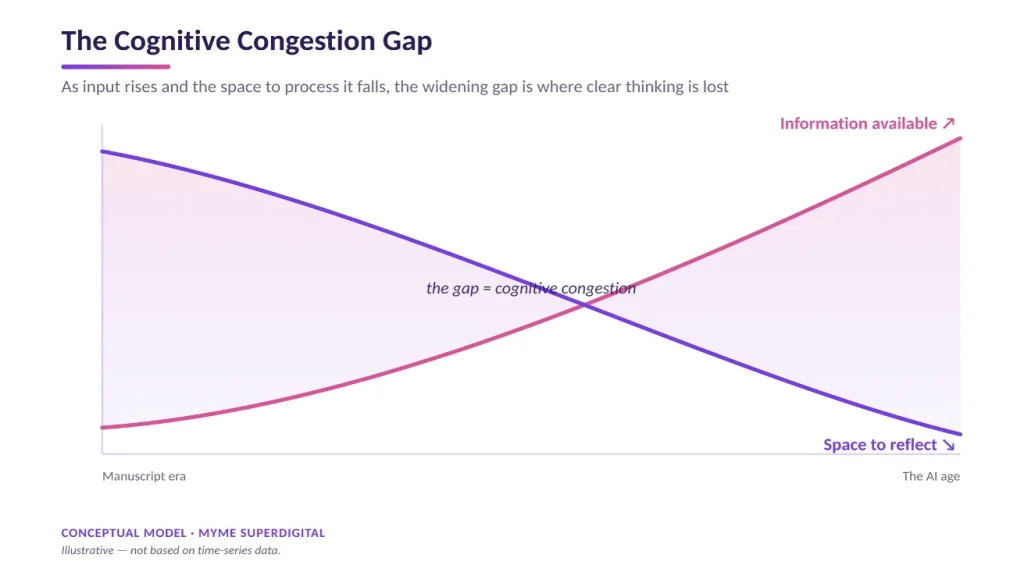
A conceptual model (MyMe SuperDigital), not time-series data: as input rises and the space to process it falls, the widening gap is where clear thinking is lost.
Information Has Become Cheap. Reflection Has Not.
Economists separate abundance from value. When something becomes abundant, its value does not vanish — its competitive advantage moves. Electricity once transformed economies because few had it; today it is assumed. Connectivity once differentiated businesses; today it is infrastructure. AI is doing the same to knowledge: explanations, summaries, and structured information are becoming almost free to generate. So the advantage shifts — not toward acquiring more information, but toward creating better thinking from the information everyone already has.
That reframes productivity itself. For decades we measured it by visible output: emails answered, meetings attended, documents produced. But the decisions that actually shape careers and organisations are rarely improved by accelerating activity. They require space — to question assumptions, recognise patterns, reconsider conclusions, and notice what constant motion hides. Perhaps the defining challenge of the AI era is not protecting human intelligence from machines. It is protecting human reflection from permanent interruption.
| MYME INSIGHT When explanation becomes free, the bottleneck is no longer getting the answer — it is having the uninterrupted space to decide what the answer means before you act on it. |
The Attention Economy Never Wanted You to Pause
Every digital platform competes for something more valuable than data: your sustained attention. The economics of the internet reward engagement — the longer you stay, the more room there is for advertising, recommendation, and behavioural prediction. Continuous engagement becomes a commercial objective, not an accident. Within such systems, silence has almost no economic value; a moment spent quietly thinking produces neither clicks nor impressions. The environment is optimised for reaction, not reflection.
Research on attention and task-switching consistently shows that repeatedly shifting between activities can impose costs that persist beyond the interruption itself. Sophie Leroy described this as “attention residue”—attention from a previous task can persist and interfere with performance on the next. Gloria Mark’s research helps illustrate the scale of the problem: workplace studies found that people took an average of about 23 minutes to return to an interrupted task, while more recent research has found average screen attention of roughly 47 seconds. Her research has also found that a substantial share of interruptions are self-generated rather than externally imposed. The cost of distraction may therefore extend beyond the minutes we lose to include ideas and lines of thought that are repeatedly interrupted before they fully develop.
The Mind Was Never Designed for Endless Input
We tend to assume that better thinking simply requires more information. Research on attention and cognitive load suggests that additional input can become counterproductive when it exceeds our capacity to process it effectively. Human cognition is less like a storage device that grows more valuable with every file and more like an ecosystem—it benefits from periods of engagement and recovery. Without sufficient space to process what we take in, reflection and integration can become more difficult.
Psychologists have long separated attention (absorbing external input) from reflection (reorganising it into understanding). They complement each other, but they don’t happen equally well at the same moment. Daniel Kahneman’s distinction between fast, automatic thinking and slow, deliberate reasoning captures it: AI excels at supporting the fast layer — it retrieves, summarises, explains, suggests — but none of that removes the need for slow thinking. If anything, the faster information arrives, the more deliberate interpretation is required before acting. The challenge is no longer informational scarcity. It is reflective scarcity.
| Attention | Reflection |
| Absorbs external input | Reorganises input into understanding |
| Consumed by the present task | Connects the task to the bigger picture |
| Often rapid and stimulus-driven | Often slower and deliberative |
| Supports task engagement | Supports integration and interpretation |
| Thrives on stimulation | Thrives on uninterrupted space |
| Often accelerated by digital tools | Benefits from deliberate protection |
Attention creates activity; reflection creates insight. AI accelerates the first — which makes protecting the second the human advantage.
| QUICK GLOSSARY – Mental space: the uninterrupted room in which information is turned into understanding. – Cognitive congestion: rising input with shrinking time to process it — more consumed, less understood. – Attention residue (Leroy, 2009): the part of your mind that stays stuck on a previous task after you switch. – Internally directed cognition: quieter, inward-focused brain states (linked to the default mode network) that support consolidating memory and connecting distant ideas. – Reflective scarcity: the modern shortage — not of information, but of time to think about it. |
Why Silence Has Become a Competitive Advantage
Silence is often misread as the absence of activity. It is better understood as the presence of uninterrupted processing. Gloria Mark’s research shows knowledge workers are redirected constantly between messages, meetings, and platforms; the deepest cost is not the interruption itself but the effort of rebuilding the original train of thought afterwards. Each interruption feels trivial. Together they reshape how thinking happens — which is why people can finish a day exhausted yet unable to name what they actually accomplished. Their attention was busy. Their thinking was fragmented.
When machines produce information instantly, human advantage shifts toward interpretation, synthesis, ethical reasoning, and original judgment — and none of these thrive under constant interruption. The future may reward something modern culture has quietly neglected: the ability to think without being continuously stimulated.
Designing Space Instead of Filling Time
Most productivity advice begins with the wrong question — “How can we do more?” A better one is “How can we create better conditions for thinking?” That shift changes the goal from optimising every minute to protecting the moments that look unproductive but generate disproportionate value.
- A short walk without a phone.
- Five uninterrupted minutes before opening email.
- Reading without switching applications.
- Ending one task completely before beginning another.
Individually these look insignificant; cumulatively they restore what digital environments systematically erode — mental continuity.
A Simple Practice for the AI Age
The point applies most directly to how we use AI. The tools deliver the input instantly — so the discipline is to reinsert the step they remove: a deliberate pause between getting an answer and acting on it.
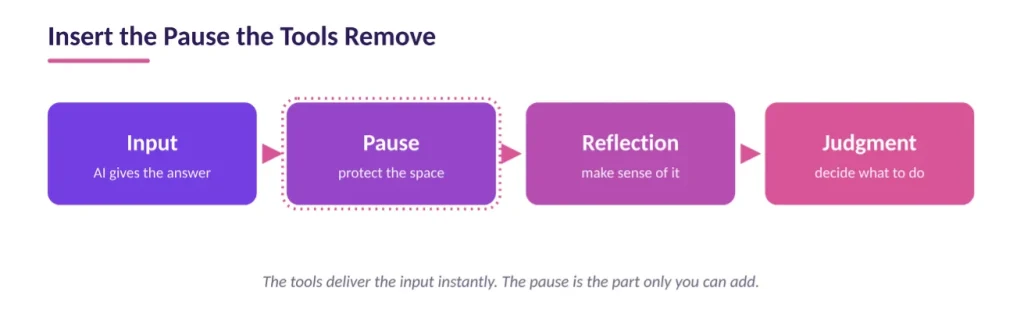
In practice: read the AI’s output, then close the tab for a moment before deciding. Ask what it assumes, what it leaves out, and whether it actually fits your context — then choose. The habit is small; over a day of decisions, the difference between reacting and reflecting compounds. Educational frameworks point the same way: the OECD Learning Compass frames agency as the capacity to reflect, anticipate consequences, and act responsibly, and UNESCO’s guidance on AI emphasises human-centred learning and critical reflection alongside technological skill. Neither rejects technology. Both reject letting technology set the pace at which human thinking occurs. The future belongs neither to those who refuse AI nor to those who depend on it unquestioningly — but to those who know when to accelerate, and when to pause.
The Honest Limits
Silence is a lever, not a cure — and the caveats deserve as much honesty as the promise.
- Silence alone isn’t insight. Empty time without prior engagement rarely produces good thinking; reflection works on material you’ve actually wrestled with.
- Not all interruption is harmful. Collaboration, feedback, and serendipity often arrive through interruption; the goal is protected depth, not total isolation.
- “Just unplug” ignores real constraints. Many jobs and caregiving roles cannot be paused at will; mental space is partly a design and equity problem, not only a personal choice.
- AI can also create space. Used deliberately, it can absorb busywork and hand time back — the risk is using it to fill the pause rather than to protect it.
The point is not to romanticise stillness, but to treat uninterrupted thought as something worth designing for — on purpose.
| MYME INSIGHT A day can be full of attention and empty of thinking. Activity is easy to measure; the reflection that turns it into insight leaves no notification behind — which is exactly why it is the first thing we stop protecting. |
Frequently Asked Questions
Isn’t more information always better?
Only up to a point. Beyond it, added input competes for the same limited processing capacity, producing cognitive congestion — more consumed, less understood. Past a threshold, the constraint is reflection, not information.
What exactly is “mental space”?
In this article, “mental space” refers to periods of reduced interruption that allow time for reflection, integration, and deliberate thought.
Does this mean I should quit technology?
No. As Gloria Mark argues, the goal is to use technology as a tool without being subservient to it — protecting periods of uninterrupted thought rather than abandoning devices.
Why does a busy day leave me exhausted but empty?
Because attention was active while thinking stayed fragmented. Each switch leaves attention residue, so effort is spent rebuilding context rather than producing insight.
How does AI change any of this?
It makes explanation nearly free, so human value shifts to interpretation, judgment, and reflection — precisely the capacities that require silence and cannot be rushed.
MyMe SuperDigital Perspective
Every technological revolution creates a new scarcity as it solves an old one. The industrial age made physical labour less scarce; the internet made information less scarce; AI is making explanation less scarce. What grows more valuable as each becomes abundant is not more information — it is better attention, better reflection, and better judgment.
That is why so many people feel exhausted inside history’s most information-rich society. Creating silence does not require abandoning technology; it requires using technology without surrendering the mental space that makes thoughtful judgment possible.
| “ In an age where almost everyone can generate information, the rarest intellectual resource is no longer knowledge — it is the ability to stop long enough to turn it into understanding. |
| A QUIET COMPANION TO THIS ARTICLE Mind Reset Cards™ — 100 reflection prompts Not advice, and not another productivity hack. Each card is a deliberate pause — a single question that turns a spare minute into a moment of intentional thinking. It puts the idea of this article into a simple daily practice: creating a little silence, on purpose. → Explore Mind Reset Cards (Free PDF) |
Continue Exploring
→ The Hidden Cost of Cognitive Overload — the AI tax on your attention, and how to pay less of it.
→ The Efficiency Trap — how to use AI without outsourcing your own thinking.
→ The Curiosity Engine — why asking better questions may become humanity’s greatest AI skill.
→ The Classroom of 2035 — why education’s scarce resource is shifting from knowledge to judgment.
References
Attention & Interruption
Mark, G. (2023). Attention Span: A Groundbreaking Way to Restore Balance, Happiness and Productivity. Hanover Square Press. gloriamark.com
Leroy, S. (2009). “Why is it so hard to do my work? The challenge of attention residue when switching between work tasks,” Organizational Behavior and Human Decision Processes. doi.org/10.1016/j.obhdp.2009.04.002
Cognition
Kahneman, D. (2011). Thinking, Fast and Slow. Farrar, Straus and Giroux. macmillan — Thinking, Fast and Slow
Neuroscience of Internally Directed Cognition
Buckner, R. L. & DiNicola, L. M. (2019). “The brain’s default network: updated anatomy, physiology and evolving insights,” Nature Reviews Neuroscience, 20, 593–608. doi.org/10.1038/s41583-019-0212-7
Benedek, M., Beaty, R. E., Schacter, D. L. & Kenett, Y. N. (2023). “The role of memory in creative ideation,” Nature Reviews Psychology, 2, 246–257. doi.org/10.1038/s44159-023-00158-z
Education & AI
OECD (2019). The OECD Learning Compass 2030. oecd.org — Learning Compass 2030
UNESCO — Miao, F. & Holmes, W. (2023). Guidance for Generative AI in Education and Research. doi.org/10.54675/EWZM9535
Written by MyMe SuperDigital — exploring where technology meets the human mind.