September 2026 · My Me Super Digital
How a home shifts from a device that waits for commands to a property that makes its own calls — energy, maintenance, security and charging — while the final approval stays with the owner.

The industry oversold the smart home. The real shift is a property that runs itself, and it forces owners to ask a question they have never had to ask before: who makes the decisions inside your home?
| Reading Time | 15 min read |
| Last Updated | September 2026 |
| Category | Smart Real Estate & Smart Cities |
Ask anyone who has bought a new-build in the last ten years what “smart home” meant in the brochure. Most of the time it came down to an app for the lights, a thermostat you could reach from your phone, and maybe a video doorbell. Useful features, but none of them changed how the property actually ran. The device sat there and did nothing until someone told it to.
What is arriving now is a different animal, and people in this business should be paying attention. Picture a building that spots an air-conditioning compressor starting to fail, moves its heavy power use to the cheapest part of the night, holds off charging the car so it does not clash with the water heater, and books a technician into a slot it can see is free. In the morning the owner gets one message: approve the repair, yes or no?
A normal smart home cannot do that on its own. It waits to be told. What I am describing is a home that acts. The word people are starting to use for it is agentic, and it changes the one thing our industry rarely stops to question: who actually makes the decisions inside a property.
A smart home does what you tell it. An agentic home decides, then tells you.
Prefer to watch? Here’s the whole idea in a few minutes.
THE SHORT VERSION
- The industry has oversold “smart.” The real change is a building that runs itself, not one you run from an app.
- Agentic real estate means a property that can watch its own systems, work out what to do, and act on it, checking with the owner only when a call costs real money or carries risk.
- This is moving out of the lab. Recent research and 2026 pilots already put teams of AI agents in charge of a building’s energy operations.
- The change that matters is not the leasing office using AI. It is the asset itself becoming a decision-maker.
- Dubai already runs half of this. DEWA’s grid finds, isolates and fixes faults on its own.
- For an owner, the real question is control: as buildings start deciding, who sets the rules, and who carries the blame when a decision goes wrong.
“Smart” Has Mostly Been a Sales Word
The technology showing up now works on a different principle, and that principle is the whole story. Older systems answered when you asked and then stopped. The AI behind this wave can be handed a goal and left to pursue it, pulling in data and taking steps by itself until the job is finished. Put that inside a building and the thermostat schedule you used to set becomes a strategy the building runs on its own. The maintenance reminder you used to act on becomes a repair the building books.
For an owner that is a change in the relationship with the asset. You stop operating the property and start supervising something that operates itself. Anyone who has managed a building, chased a contractor, or argued over a service charge will understand straight away why that is a bigger deal than a nicer app.
What Agentic Actually Means for a Property
It is worth being clear about the term, because the market will overuse it within a year. An agentic property is one where the software runs a full loop without a person in the middle of every step. It watches the meters, sensors, weather, tariffs and equipment. It reads what those numbers mean against the goals it has been given. It picks an action. It carries that action out through the building’s systems. And when a decision is expensive or risky, it stops and puts it to the owner.
That last step is the difference between a building that is set up well and one that is set up carelessly. The aim is not a property that does everything itself. It is a property that handles the chasing, the checking and the routine, and hands back the calls you would never want made for you.
One honest note, because I would say the same to a client. “Agentic real estate” is not a settled industry term yet, the way PropTech or smart city are. The science under it, agentic AI in buildings, is real and published. The idea of your home as an agent is the lens I am putting on that science, not a product on a shelf. Anyone selling it to you today as a finished thing is running ahead of the facts.
WHERE I LAND ON ITThe point is not a building that does everything by itself. It is a building that does the legwork and leaves the calls that cost real money to the owner. Automation without that line drawn is a liability, not a feature.
It Is Not Just Theory
The easy thing to do with a piece like this is wave at “someday.” I would rather point at what is already on the table.
In 2025 the journal Energy and Buildings ran a review it called Agentic Built Environments, pulling together how goal-driven AI agents are starting to work across the life of a building, from the design model to the management system to the digital twin and up to the city. The short version is that buildings are moving from something you run to something that runs itself.
Then the prototypes turned up. In early 2026 researchers at Syracuse University and the Pacific Northwest National Laboratory built a system called OptAgent that puts 11 specialist agents and 72 tools to work running a building’s energy operations from end to end, and tested it across roughly 4,000 runs. On the home side, other 2026 work has AI agents scheduling a house’s power use around comfort and cost, diagnosing air-conditioning faults, and turning plain instructions into working automation. Each piece is one function. Join them up and you have the makings of a building that reads its own state and acts on it.
It Is the Building Itself, Not the Back Office
Most of the coverage points the wrong way. When McKinsey looked at agentic AI in real estate in March 2026, it focused on the workforce: agents that log maintenance tickets from a tenant’s message, rank them, send out contractors and update residents, with staff signing off the bigger calls. It put the potential at $430–550 billion a year in productivity across real estate, construction and development. Worth reading, but look at what it is about. It is the company that runs the property getting automated. The leasing desk. The facilities team.
The question I find more interesting is about the asset. What happens when the building itself, not the firm managing it, is the one deciding? A leasing team using AI is a better-run business. A building that manages, protects and negotiates on its own behalf is a different kind of thing to own, and the industry has barely started thinking about it.
WHERE I LAND ON ITEveryone is busy automating the people around the building, the agents, the FM team, the call centre. Far fewer are asking what happens when the building itself becomes one of the parties making decisions about your asset.
Dubai Already Has Half of This
For a home to act, something on the other side has to answer. In the UAE, that other side is already running.
DEWA now calls itself the world’s first “AI-native utility”, and in 2026 it held an agentic AI retreat at its headquarters. That is not only branding. Its grid detects faults, isolates the affected section and restores power without a person stepping in, which is part of how it has driven the average customer’s supply interruption down to about 0.82 minutes a year, roughly 49 seconds, among the best figures anywhere.
Behind that sits an AED 7 billion smart-grid programme running to 2035, built around automated decision-making, and in 2026 DEWA started rolling out what it describes as the world’s first AI-powered virtual engineer to optimise generation. This is the direction the whole sector is taking. Figures cited at the World Governments Summit 2026 suggest about 40% of utility control rooms worldwide will be running on AI-driven automation by 2027.
For a property, that changes the maths. A home that pushes its laundry, water heating and car charging into the cheapest, cleanest hours is not a concept here. It is the natural partner to a grid built to respond. The building stock is being set up for it too. Developers such as Emaar and DAMAC increasingly hand over homes with automation as standard, and connected monitoring is already trimming utility costs for some residents. New stock rather than old retrofits, regulators willing to move, and clean data feeding the system: that is exactly the ground agentic buildings need. If you want to see how far the built-from-scratch version goes, read Is Hudayriyat Island Really a Smart City?
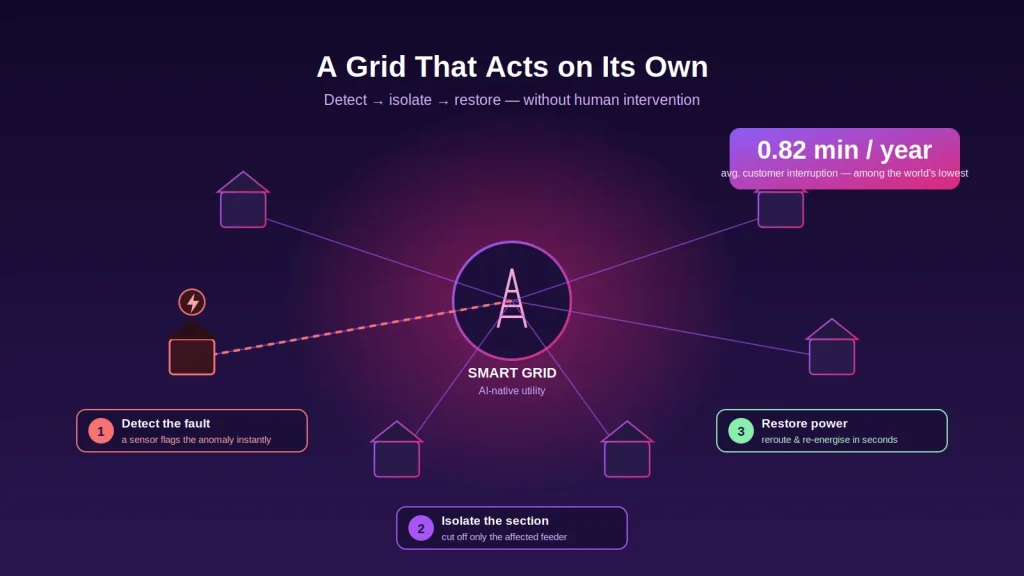
Dubai’s smart grid detects a fault, isolates it and restores power on its own — the responsive partner an agentic home is built to work with.
What It Looks Like in a Real Home
Take a villa in Abu Dhabi next year. Overnight the house sees that tomorrow’s midday tariff and grid demand will both spike, so it heats the water and charges the car in the early hours and cools the concrete while power is cheap, and the afternoon stays comfortable without the bill jumping. A humidity reading under the kitchen sink flags a slow leak before there is a mark on the cabinet, so the house shuts the local valve and books a plumber. It has noticed you always drop the bedroom temperature at ten, so it stops overriding you. When the insurer offers a lower premium for a documented maintenance record, the house files its own logs.
None of these on its own is new. What is new is having one system hold all of it at once, sort out the clashes between cheap power, comfort, battery life and your diary, and keep doing it without a dashboard you have to babysit. Then, at the edge of what it is allowed to decide, it stops. The repair costs money and takes a Thursday afternoon, so that one comes back to you.
Who Actually Owns the Decision?
This is the part I care about most, and the part the technical papers skip. If the building can decide, whose decision is it?
When a home negotiates an energy price, cools a room, or refuses to charge the car until three in the morning, three parties have a hand in that call. There is you, the owner, whose money and comfort are on the line. There is the technology company whose platform runs the agent, sets the defaults and decides what it is trying to optimise. And there is the AI itself, whose reasoning is not always readable even to the people who built it.
Convenience moves control without anyone noticing. Every default you never change is a decision made for you by someone else. If the system is set to chase “lowest cost”, who defined cost, and did they weigh it against your comfort, your privacy, or the platform’s own commercial interest? A home that acts for you is also a home that holds data on when you sleep, when you are out, and how you live. Owning the walls and owning the decisions made inside them are starting to look like two separate things, and sorting out which is which may become one of the bigger questions in property and technology law over the coming years.
Where It Can Go Wrong
None of this comes for free, and an owner should walk in with eyes open.
First, the data. A system is only as good as what it can measure, and it cannot manage what it cannot see accurately. Feed it a stale reading or a badly fitted sensor and it will act on bad information with full confidence.
Second, the black box. When decisions run through models whose logic is not transparent, mistakes do not raise their hand. And a mistake by an automated system is not like a human one. It is confident, instant, and copied across everything it touches before anyone catches it.
Third, privacy. These systems run on a constant feed of personal data, which raises fair questions about where it is stored, how it is secured, and who is allowed to use it.
The answer is not to slow the technology down. It is to be deliberate about where the human sits. Let the building handle the small, endless optimisations. Route anything that costs real money, affects safety, or matters personally back to a person, with the reasoning laid out, so approving takes a moment and refusing is always on the table. When something goes wrong, the responsibility has to land on a person, not a platform.
Where This Is Heading
Agentic real estate will not arrive with a launch date. It will show up piece by piece: a grid that fixes itself, an air-conditioner that flags its own fault, a home that starts making calls the owner used to make, until one day the building is doing more of the thinking than anyone noticed.
The sensible middle is not hard to see. A building that decides everything is not a home, it is a landlord you cannot argue with. A building that decides nothing wastes what it can do. The version worth having does the work and leaves the meaning to the owner: the machine carries the load, and the person stays the one who signs off on what matters. Keep the last word human, and the rest of it is a genuine upgrade.
Frequently Asked Questions
What is agentic real estate?
A property that can act for itself: watching its own systems, working out what to do, and carrying it out, from shifting energy use to booking a repair, instead of waiting for a command the way an ordinary smart home does.
How is an agentic home different from a smart home?
A smart home does what you tell it. An agentic home is given goals and makes the day-to-day decisions itself, bringing you in only when a call is costly or carries real risk.
Is any of this real yet, or is it hype?
The research is real and published, including a 2025 Energy and Buildings review and a 2026 system, OptAgent, that runs 11 agents and 72 tools for building operations. What you can actually buy as a finished “home that decides” is still early, so treat any such sales pitch with caution.
Why does the UAE matter here?
Because the grid a home would work with is already partly automated. DEWA calls itself the world’s first AI-native utility and runs a grid that finds and fixes faults on its own, which is exactly the partner an agentic home needs.
What is the biggest risk?
Losing track of who owns the decision. As buildings start acting on their own, control drifts to whoever sets the defaults, so data quality, transparency, privacy and clear human accountability matter more, not less.
MyMe SuperDigital Perspective
We do not judge this technology by how many decisions a home can take off your hands. We judge it by whether the decisions that matter still end with the owner. A building earns the word “intelligent” when it is open about what it decides, careful with the data it holds, and set up so a person always keeps the last word.
A smart home does what you say. A building that decides needs a clear rule about who has the final call. Get that rule wrong and “smart” just means someone else is running your property.
Continue Exploring
→ AI + Human Expertise: The Future of Real Estate Isn’t What Most People Think — why the best calls still pair machine analysis with a person who knows the market.
→ Will AI Replace Real Estate Websites? Or Simply Change the First Decision We Make? — how AI is rewriting the first step of the property search.
→ Is Hudayriyat Island Really a Smart City? — what “smart” means when a city is built from the sensors up.
References
Research on Agentic Buildings
Lee, J., Song, J., Koo, J., et al. (2025). Agentic Built Environments: a review. Energy and Buildings, vol. 346. Elsevier. sciencedirect.com
Jiang, Z., Xu, W. & Dong, B. (2026). OptAgent: an Agentic AI framework for Intelligent Building Operations. Syracuse University & Pacific Northwest National Laboratory. arxiv.org/abs/2601.20005
Industry Analysis
McKinsey & Company (March 2026). How agentic AI can reshape real estate’s operating model. mckinsey.com
UAE Smart Infrastructure
Dubai Electricity and Water Authority. Smart Grid Programme. dewa.gov.ae
Dubai Electricity and Water Authority (June 2026). DEWA, the world’s first AI-native utility. dewa.gov.ae
Any forward-looking scenarios in this article are evidence-based analysis, not confirmed products or roadmaps.
About the author — The MyMe SuperDigital editorial team covers where technology meets everyday life, with a focus on real estate, PropTech and smart cities in the UAE. This piece is built on peer-reviewed research, industry analysis and public infrastructure data, checked against primary sources.
Written by MyMe SuperDigital — where technology meets the home.