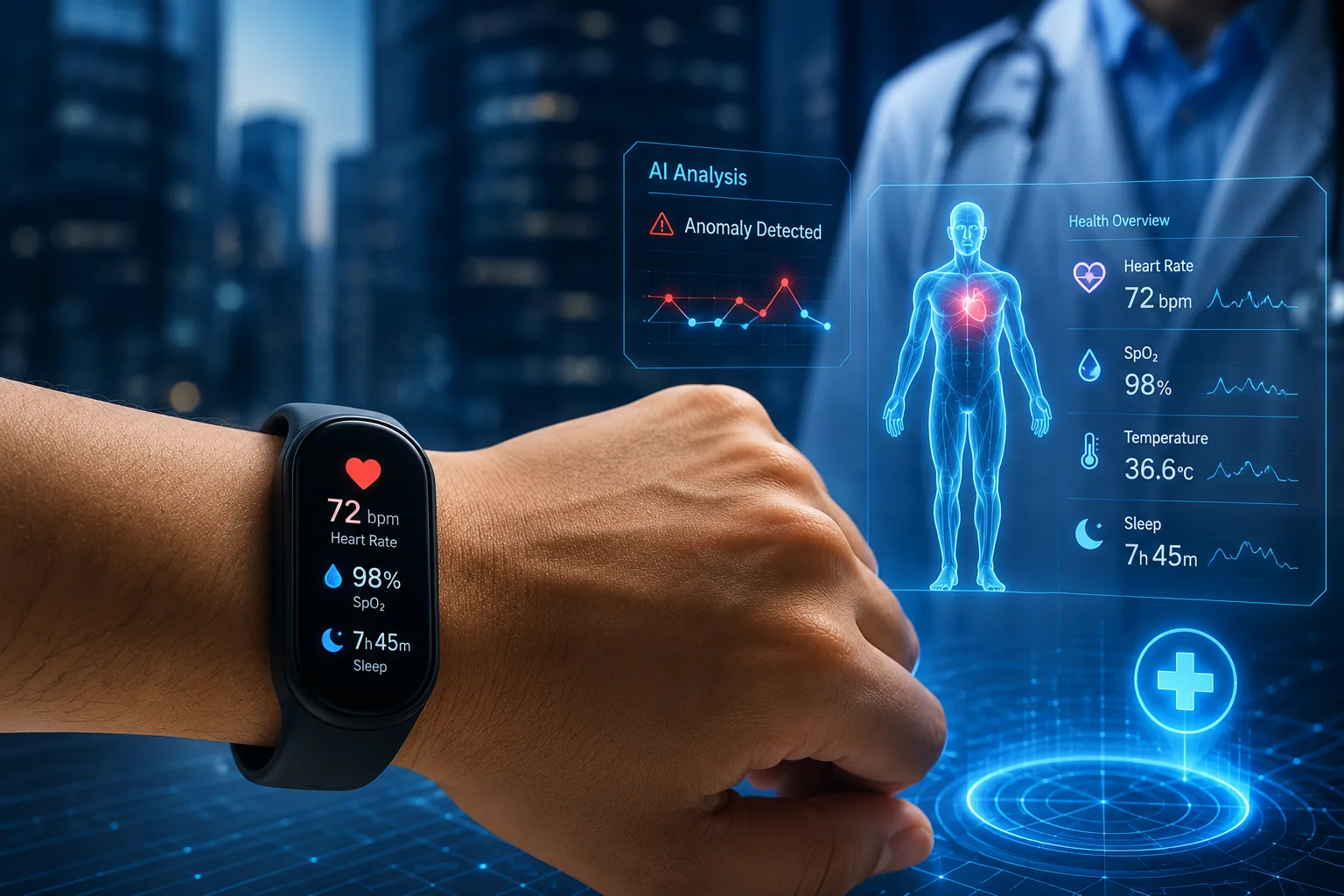
What Wearables Can Already Detect — and Where the Hype Outruns the Evidence
| Reading Time | Last Updated | Category | Companion Video |
| 13 min read | August, 2026 | Future Society | Available ▶ |
Your smart band listens to your body around the clock, and AI turns that stream into early-warning signals. The promise is real — and so are the limits. Here is what the science actually shows.
Watch the Companion Video
This article accompanies the short film The Future of Healthcare: AI Smart Bands That Could Save Your Life, examining what wearables can and cannot do — with the studies, numbers, and caveats behind the technology.
Medicine has always waited for illness to announce itself. Wearables promise to hear the body’s earliest whispers — if we can tell a real signal from noise.
Medicine Built on a Single Snapshot
On an ordinary January morning, Mike Gomez felt completely fine. He was using his smartwatch the way most people do — to count workouts and calories — when it sent him an alert he had never seen before: an elevated heart rate warning, then a second notification, then more, until one told him it had detected atrial fibrillation and to contact a health professional immediately. He had no symptoms at all. He went to the hospital anyway. Doctors found he was in serious atrial fibrillation, a leading and often-silent cause of stroke, and told him the notification may have saved his life.
His case is not a fluke, and the stakes are not small. Atrial fibrillation affects an estimated six million people in the United States alone, and it frequently causes no symptoms at all — until it triggers a stroke. That is exactly what makes a silent alert on the wrist so consequential: it can surface a dangerous condition the person had no way of feeling.
Stories like his are now common enough to feel almost routine — and that is exactly what makes them remarkable. For most of history, medicine has been reactive: it waits for a system to fail — a severe infection, a cardiac event, a collapse — before it acts. Part of the reason is structural. A typical person sees a doctor once or twice a year, giving the physician a brief snapshot of a body that is changing every minute of every day.
Picture a year of your health as a graph. Traditional care rests on one or two data points — a single blood-pressure reading, one heart-rate check — leaving the other 363 days essentially unrecorded. In that dark space between appointments, conditions can take root and progress unnoticed, because the system only gathers data when you happen to be sitting in an exam room.
Closing those blind spots means recording something closer to a continuous film of the body rather than a few still photographs. That is exactly what a modern smart band attempts — and it is why the idea has drawn serious clinical research, not just marketing.
| KEY TAKEAWAYS Traditional care is reactive — built on one or two yearly snapshots. Wearables offer a continuous record instead. Smart bands use optical and motion sensors to track heart rate, rhythm, blood oxygen, temperature, heart-rate variability, and sleep against your personal baseline. The evidence is genuinely promising: wearables can flag atrial fibrillation, signs of infection days before symptoms, and sleep-apnea risk. But a wearable is an early-warning flag, not a diagnosis. Signals are often non-specific, false alarms happen, and clinical confirmation is still required. The biggest open problems are no longer technical — they are accuracy (including lower reliability on darker skin), over-diagnosis, and the privacy of extremely sensitive biological data. |
How a Smart Band Listens to Your Body
The core sensor is optical, and the approach is shared across the major devices — Apple Watch, Samsung Galaxy Watch, Fitbit, Garmin, Oura, and others. The band emits pulses of light into the skin and measures how they reflect off moving blood — a technique called photoplethysmography (PPG). From that steady stream it derives foundational metrics: heart rate, blood-oxygen saturation, and small fluctuations in skin temperature.
Two signals are especially useful. By timing the tiny intervals between beats, the band estimates heart-rate variability — a window into the autonomic nervous system and the physiological stress the body is under. And at night, motion sensors map how you shift and settle, reconstructing sleep stages that once required a clinical lab. Individually these are just numbers. Their value comes from the aggregate: a large, uninterrupted record that defines a baseline unique to you.
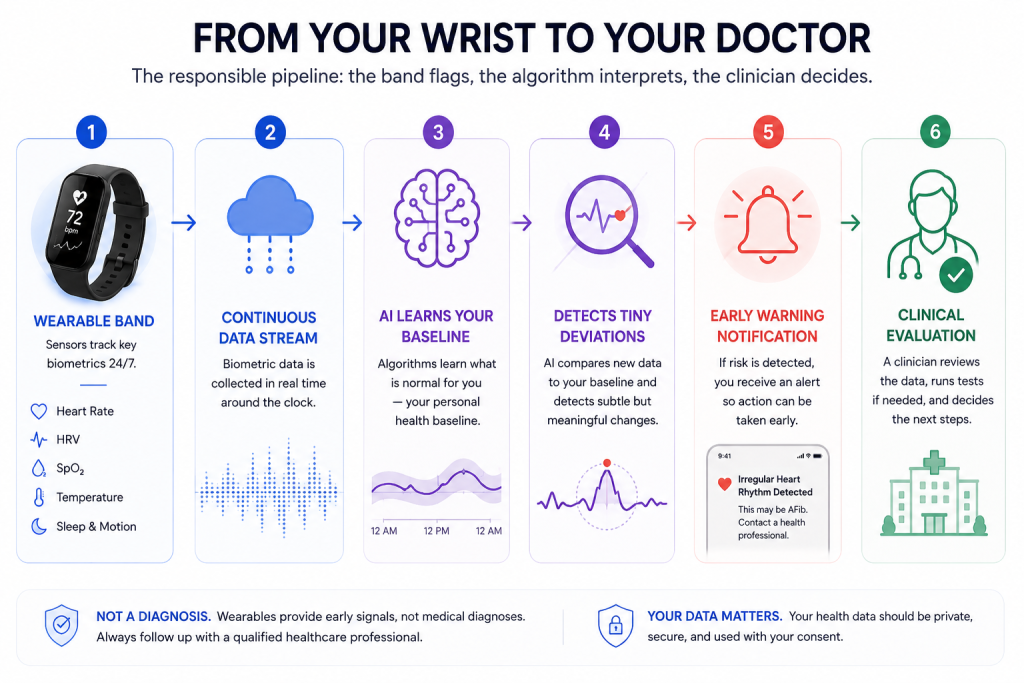
| Continuous Data Heart rate, HRV, oxygen, temperature, sleep — 24/7 | → | AI Baseline Algorithms learn what is normal for you | → | Anomaly Flag A deviation triggers an early-warning alert | → | Clinical Check A doctor confirms — or rules out — a diagnosis |
The responsible pipeline: the band flags, the algorithm interprets, the clinician decides.
| QUICK GLOSSARY PPG (photoplethysmography): shining light into the skin to measure blood flow — how most wearables read your pulse and oxygen. HRV (heart-rate variability): tiny beat-to-beat timing differences; a proxy for stress and recovery. Baseline: your personal normal, learned over time — the reference the AI compares new readings against. SpO2: blood-oxygen saturation, the percentage of oxygen your red blood cells are carrying. |
Why AI Is the Missing Piece
A single smart band can generate hundreds of thousands of data points a week — far more than any human could review. This is where AI earns its place. Instead of reading individual numbers, algorithms learn the shape of your normal: your resting heart rate, your usual sleep, your typical variability. Once that baseline is established, the system watches for deviations from it.
A person might dismiss a small overnight rise in resting heart rate as nothing. An algorithm, comparing your pattern against your own history and against millions of anonymized records, can flag it as an anomaly worth attention. The software’s job is not to diagnose but to refine an overwhelming flood of raw data into a small number of targeted early-warning signals a clinician can act on.
| MYME INSIGHT The wearable is the microphone; the AI is the translator; the doctor is still the one who reads the meaning. Remove any of the three and the system breaks — most dangerously when people treat an alert as an answer. |
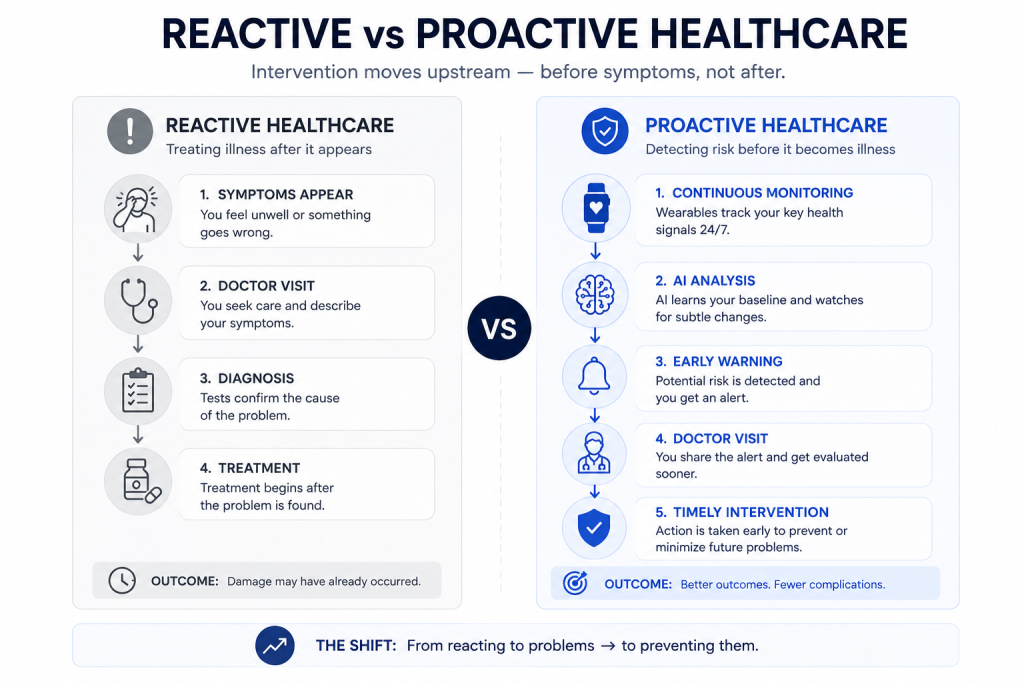
| Reactive Healthcare Symptoms appear ↓ Doctor visit ↓ Diagnosis ↓ Treatment | Proactive Healthcare Wearable data ↓ AI analysis ↓ Early warning ↓ Doctor visit ↓ Treatment |
The shift wearables enable: intervention moves upstream — before symptoms, not after.
What the Evidence Actually Shows
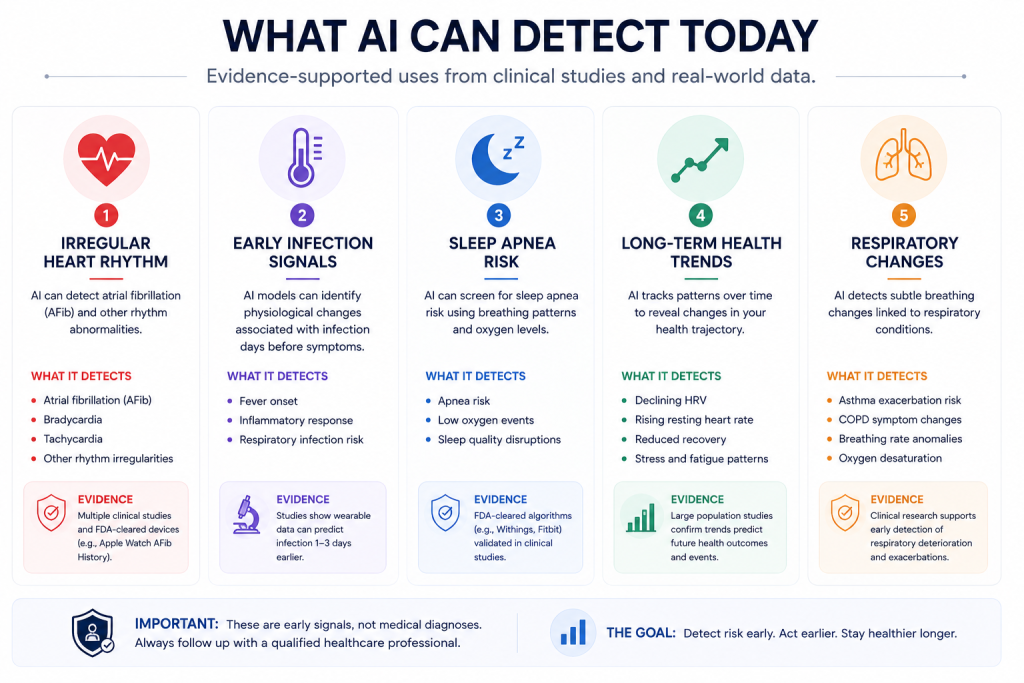
This is no longer hypothetical — but the details matter, and they are more measured than the marketing. (Apple’s studies are cited below because they are the largest and most public; the same capabilities appear across Fitbit, Garmin, Samsung, and other devices, and the Stanford infection research below used Fitbit and Garmin as well as Apple.)
Atrial fibrillation
The landmark Apple Heart Study followed 419,297 participants. Only 0.52% ever received an irregular-rhythm notification — reassuringly low, easing fears of mass false alarms. Among those who were notified and wore a follow-up ECG patch (applied on average about two weeks later), roughly a third had confirmed atrial fibrillation, a leading and often-silent cause of stroke. When the watch flagged an irregular pulse and an ECG was recorded at the same time, the two agreed about 84% of the time. But the study had a real limitation: it was not built to measure how many true cases it missed, and a later analysis suggested the watch flagged only a minority of participants who separately reported new atrial fibrillation. It is a capable screen — not a complete one.
Infection, days before symptoms
Stanford researchers led by Michael Snyder showed that consumer wearables can catch the physiological signature of an infection before a person feels sick. In their studies, most infected participants showed measurable changes — often an elevated resting heart rate — days ahead of symptoms, and in some cases more than a week early. The honest catch: those same signals are non-specific. A raised resting heart rate can mean a coming viral infection — or a cold, poor sleep, travel, stress, or a couple of drinks the night before. Wearables are good at sensing that something is off; they cannot yet tell you what.
Sleep apnea
In 2024 the FDA cleared Apple Watch’s sleep-apnea notification feature — a genuine milestone. But its clearance is explicit: it is a risk screen, not a diagnosis. In validation it caught roughly two-thirds of moderate-to-severe cases (missing about a third, especially milder ones) while rarely raising false alarms. It can prompt a useful conversation and, potentially, reduce some unnecessary testing — but a formal diagnosis still requires a clinical sleep study. The wearable narrows the gap to care; it does not replace the doctor.
Seen side by side, the division of labor is the whole point:
| Wearable (early-warning flag) | Clinician (medical diagnosis) |
| Continuous, everyday monitoring | Point-in-time expert evaluation |
| Detects deviations from your baseline | Interprets cause and context |
| Signals “something may be off” | Confirms what it actually is |
| Prompts you to seek testing | Orders tests and treatment |
| A helpful alert | An authoritative answer |
Wearables and clinicians are partners, not substitutes — the flag is the beginning of care, not the verdict.
The Honest Limits
It would be easy to end on the promise. Reliability means naming the caveats just as clearly.
- Non-specific signals and false alarms. Because a deviation can have many causes, wearables generate alerts that turn out to be nothing — which can drive anxiety and unnecessary appointments.
- Over-diagnosis. Screening large, healthy, often young populations can surface “abnormalities” that would never have caused harm, leading to more tests, cost, and worry rather than better health.
- Accuracy is not equal across skin tones. Optical sensors read light through the skin, and melanin absorbs light — so PPG-based readings, especially blood-oxygen (SpO2), tend to be less accurate on darker skin. Studies going back decades, and an FDA advisory panel in 2022, found pulse oximeters can overestimate oxygen levels in people with darker skin, risking delayed care. It is an active area of research and regulation — and a reason to treat any single reading, on anyone, with caution.
- Other accuracy factors. Motion, tattoos, loose fit, and cold hands can all distort optical readings, and validation is stronger for some metrics (heart rhythm) than others.
- Proof of better outcomes is still thin. Detecting more is not the same as helping more; whether earlier flags actually reduce strokes, hospitalizations, or deaths at the population level is still being studied.
None of this cancels the promise. It frames it: wearables are a powerful new front door to the health system, most valuable when they send you to a clinician rather than standing in for one.
| MEDICAL DISCLAIMER This article is general information, not medical advice. Wearable alerts are not diagnoses. If you have a health concern — or receive a notification from a device — consult a licensed clinician rather than acting on the reading alone. |
The Next Step — and Its Price
As algorithms improve, researchers are working toward medical digital twins: a virtual, continuously updated model of your specific biology. In principle, a hospital could one day simulate how you — not an average patient — might respond to a treatment before prescribing a single pill. Today this remains largely a research goal rather than a bedside reality, and it is worth describing as such.
It also sharpens an ethical question that continuous monitoring raises from day one. A 24/7 biological record is extraordinarily sensitive data. Who owns it — you, the device maker, your insurer? Who may see it, and what happens if it leaks or is used against you? The ultimate barrier to this future is no longer technical capability. It is trust: earning confidence in the algorithms, and guaranteeing that intimate biological data stays protected and under your control.
The hard problem is no longer whether a band can hear the body. It is whether we can trust who else is listening.
| MYME INSIGHT The real breakthrough is not that AI can tell when you are sick. It is that medicine no longer has to wait until you feel sick to start paying attention. The center of gravity shifts from treating illness to guarding health — and that is a change in what medicine is, not just what it can do. |
Frequently Asked Questions
Can a smart band really detect illness before I feel it?
Sometimes, yes. Research shows wearables can pick up physiological changes — like a raised resting heart rate — days before infection symptoms, and can flag irregular heart rhythms and sleep-apnea risk. But these are early-warning signals, not diagnoses, and the same signals often have harmless causes. Treat an alert as a prompt to check with a clinician, not a conclusion.
Should I trust an alert from my watch?
Take it seriously, but don’t panic or self-treat. Wearable features like AFib and sleep-apnea notifications are FDA-cleared as screens, not diagnostic tools, and they both miss real cases and raise false alarms. The right response to any alert is a conversation with a healthcare provider, who can confirm or rule out the issue.
Can a wearable replace a doctor or a lab test?
No. Wearables narrow the gap between when something goes wrong and when you get care, but diagnosis and treatment still require clinical evaluation. A watch can suggest you may have sleep apnea; only a proper sleep study can diagnose it.
What’s the biggest risk of all this monitoring?
Two things: over-diagnosis (chasing harmless anomalies with tests and anxiety) and privacy. A continuous biological record is deeply personal data, and questions of ownership, security, and misuse are still unresolved. The technology is ahead of the rules governing it.
MyMe SuperDigital Perspective
For thousands of years medicine operated in the dark, waiting for disease to strike before responding. Pairing a continuous biological record with the analytical depth of AI genuinely shifts the focus from managing illness to maintaining health — one of the most hopeful changes in modern medicine.
But the same technology asks something of us in return: to stay clear-eyed. A wearable that turns every twitch of data into alarm is not health; it is anxiety with a battery. Used well — as a sensitive early-warning system that sends you to a human expert — a smart band really can help save a life. The future of healthcare may be defined less by hospitals that treat disease faster, and more by a system that notices the earliest signs of trouble long before they become an emergency — and gets a patient and a doctor into the same room while there is still time to change the outcome.
Continue Exploring This Topic
- The Hospital That Doesn’t Need Doctors? How AI Is Transforming Modern Healthcare
- Digital Immortality: Can AI Really Outlive You?
- AI Thinks Faster. Are We Thinking Less?
- Can Artificial Intelligence Help You Grow? The Truth About AI Coaching
References
Clinical Research
Perez, M. V., et al. (2019). Large-Scale Assessment of a Smartwatch to Identify Atrial Fibrillation. New England Journal of Medicine, 381(20), 1909–1917. doi.org/10.1056/NEJMoa1901183
Mishra, T., et al. (Snyder lab, 2020). Pre-symptomatic detection of COVID-19 from smartwatch data. Nature Biomedical Engineering, 4, 1208–1220. doi.org/10.1038/s41551-020-00640-6
Alavi, A., et al. (Snyder lab, 2022). Real-time alerting system for COVID-19 and other stress events using wearable data. Nature Medicine, 28, 175–184. doi.org/10.1038/s41591-021-01593-2
Regulatory & Background
Sjoding, M. W., et al. (2020). Racial Bias in Pulse Oximetry Measurement. New England Journal of Medicine, 383(25), 2477–2478. doi.org/10.1056/NEJMc2029240
FOX 7 Austin (2025). Austin man credits Apple Watch notifications with saving his life (Mike Gomez case). fox7austin.com
U.S. Food and Drug Administration (2024). FDA clears Apple’s over-the-counter sleep apnea notification feature (FDA Roundup, September 17, 2024). fda.gov
Apple (2024). Estimating breathing disturbances and sleep apnea risk from Apple Watch (clinical validation summary). apple.com
Written by MyMe SuperDigital — exploring where technology meets the human body.